First Seen
2023-05-24T22:39:01+00:00
simple-description (qwen3.5_2b-q8_0)
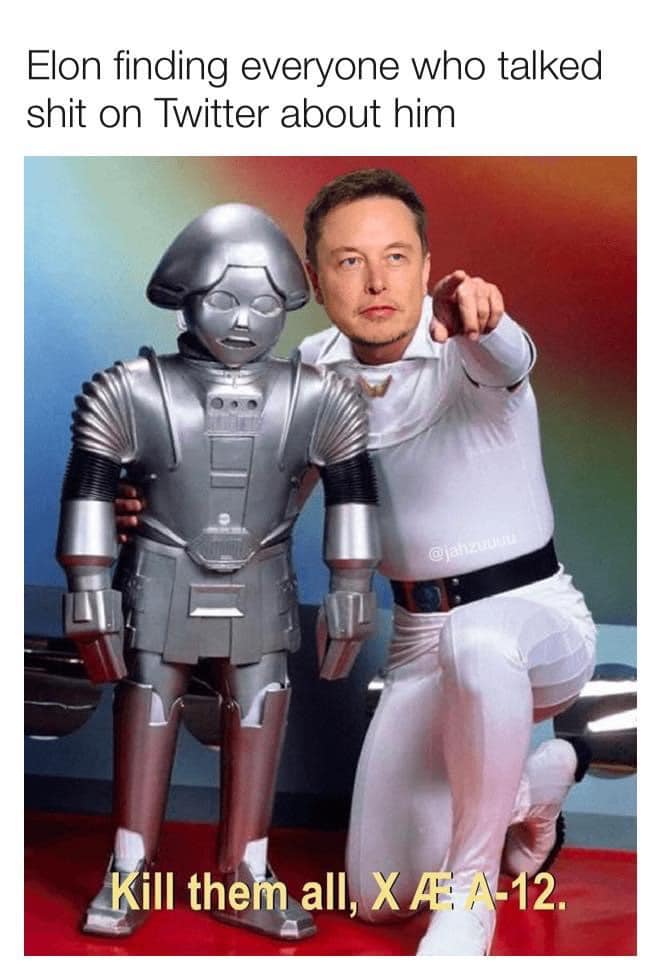
This meme depicts Elon Musk standing next to a silver robot that serves as the AI interface for Twitter (X), looking furious at people who have posted negative comments about him online. The bottom text reveals that he plans to "Kill them all," specifically commanding the X AI team to purge the entire group of critics. This fits the anti-oligarch category because it portrays a powerful individual deciding to violently destroy anyone who opposes their rule or spreads their negative propaganda.
simple-description (llama3.2-vision_11b)
The meme is a satirical image featuring Elon Musk, with a caption "Elon: I'm going to make sure the oligarchs are held accountable for their crimes." The image is a play on the "I am the one who knocks" meme from Breaking Bad, where a character says "I am the one who knocks" and the meme is often used to imply that someone is going to take action against someone else. In this case, the meme is implying that Elon Musk is going to take action against the oligarchs, who are wealthy and powerful individuals who have a significant influence on the world.
detailed-analysis (gemma3-27b-vision)
Okay, let's break down this meme through the lenses you've requested. It's a complex image with layers of possible interpretation, so these will be somewhat lengthy.
Visual Description
The image is a composite meme. It features Elon Musk pointing directly at the viewer, with a serious expression. Standing beside him is a robot, similar to a Dalek from the British science fiction television series Doctor Who. The robot is metallic, grey, and has visible joints and mechanisms. Both stand on a maroon-colored carpeted base. The bottom of the image includes the text "Kill them all, X AE A-12." The overall aesthetic is humorous and intentionally jarring, juxtaposing a real person with a fictional, antagonistic character. The composition aims to be visually striking and unsettling.
Foucauldian Genealogical Discourse Analysis
This meme is ripe for analysis through a Foucauldian lens. Michel Foucault's work focuses on how power operates through discourse—the systems of thought, language, and practice that shape our understanding of the world.
- Power/Knowledge: The meme exemplifies how power and knowledge are intertwined. Elon Musk, a figure with considerable economic and cultural power, is positioned as the commander ordering the “killing” (figuratively, in this context) of those who critique him online. This positions his power not just as financial or technological, but as discursive – an ability to define who is acceptable to disagree with. The "critics" are rendered as objects of control, silencing them through the implicit threat.
- Genealogy: A genealogical analysis would trace the historical emergence of this specific configuration of power. The meme leverages the well-established Doctor Who universe, where Daleks represent ruthless extermination of anyone deemed “different.” This cultural memory is tapped into to create a sense of chilling control. The meme also draws on the contemporary culture of online "cancel culture" and the heightened sensitivity surrounding public criticism on platforms like Twitter.
- Discursive Formation: The meme represents a “discursive formation” around the figure of Elon Musk – a complex, evolving set of statements, beliefs, and practices that define him and his relationship to the public. The meme contributes to this formation by constructing a narrative of Musk as a controlling, potentially dangerous figure who suppresses dissent.
- Panopticism: While not a direct parallel, we can see a trace of panoptic control here. The threat implied by the image suggests that Musk is always “watching” and ready to punish dissent, even if not in a physically literal sense. The very act of online posting potentially becomes subject to his “judgment” or the judgment of those aligned with him.
Critical Theory
Applying critical theory (rooted in the Frankfurt School) we can examine the broader social implications.
- Instrumental Rationality: The meme suggests a disturbing application of "instrumental rationality"—the pursuit of goals efficiently, even at the expense of ethical considerations. Musk is portrayed as treating criticism as an obstacle to be eliminated, not as a legitimate form of feedback or discourse. This embodies the Frankfurt School’s critique of modern society's emphasis on efficiency and control.
- Culture Industry: The meme itself can be seen as a product of the “culture industry,” the mass production of standardized cultural goods. It’s a quick, easily digestible piece of content that contributes to the constant stream of information and opinion that shapes our perceptions of powerful figures.
- Commodification of Criticism: The image subtly comments on how criticism itself has been commodified in the digital age. Online engagement (even negative) often benefits the subject of criticism, creating a perverse incentive for generating controversy.
Marxist Conflict Theory
From a Marxist perspective, this meme can be understood as an expression of class conflict, though it's a particularly mediated and symbolic form.
- Power Dynamics: Musk, as a billionaire and owner of a major social media platform, represents the ruling class. Those who criticize him online can be seen as representing the working class or those who challenge the established order. The image depicts a blatant assertion of power—a symbolic "command" to suppress dissent.
- Ideology: The meme reinforces the ideology of the ruling class by portraying criticism as inherently threatening and deserving of punishment. This serves to legitimize the control and suppression of any challenge to the status quo.
- False Consciousness: The image, and its potential circulation, can contribute to "false consciousness"—a state in which the working class is unaware of its true interests and accepts the ideology of the ruling class. The meme's humor may serve to normalize the idea that powerful individuals can and should control public opinion.
Postmodernism
Postmodern analysis highlights the breakdown of grand narratives and the proliferation of simulations and signs.
- Hyperreality: The meme operates within a state of "hyperreality"—a condition in which simulations of reality become more real than reality itself. Musk’s public persona, constructed through social media and carefully crafted PR, is a simulation, and the meme is a further layer of simulation on top of that.
- Fragmentation and Juxtaposition: The image’s power comes from the jarring juxtaposition of disparate elements—a real person, a fictional robot, and a strange alphanumeric name. This fragmentation reflects the postmodern condition of fragmented experience and the loss of a coherent, unified worldview.
- Irony and Parody: The meme is heavily reliant on irony and parody. It’s not a literal call for violence, but a darkly humorous commentary on the power dynamics between powerful individuals and their critics. This self-referential quality is characteristic of postmodern art and culture.
Queer Feminist Intersectional Analysis
While not the primary focus of the meme, a queer feminist intersectional lens can illuminate some of its implications:
- Silencing of Marginalized Voices: The “kill them all” command inherently represents a desire to silence dissenting voices. This silencing disproportionately impacts marginalized groups (including queer, feminist, and BIPOC individuals) who are more likely to face backlash and harassment for expressing their opinions.
- Patriarchal Power Dynamics: Musk, as a powerful male figure, embodies patriarchal structures of authority and control. The image reinforces the idea that those in power can dictate what is acceptable discourse and punish those who deviate from it.
- Weaponization of Power: The image embodies how those in power, particularly those who are privileged, can weaponize their resources and influence to silence dissent and maintain the status quo. This is especially true in the online sphere, where harassment and coordinated attacks are often used to silence marginalized voices.
Important Notes:
- Ambiguity: The meme is open to interpretation, and these analyses represent possible readings.
- Context Matters: The specific context in which the meme is shared will influence how it is understood.
- Complexity: These theoretical frameworks are complex, and this analysis is a simplified overview.
I hope this detailed breakdown is helpful. Let me know if you'd like me to elaborate on any of these points.
simple-description (llama3.2-vision)
This meme is a humorous image of a man in a white suit, pointing at the camera with a robotic child in the background. The text at the top reads "Elon finding everyone who talked s**t on Twitter about him" and the text at the bottom says "Kill them all, X-4, A-12." The image is a playful and satirical take on the idea of a powerful and angry figure, in this case, Elon Musk, seeking revenge on his online critics.
tesseract-ocr
Elon finding everyone who talked shit on Twitter about him Pe @) eat a, 7 kana \} Y : \) fal Z , SZ eS PSs i \ ; nm = S if = Pat a El we my