First Seen
2023-05-24T22:39:03+00:00
simple-description (qwen3.5_2b-q8_0)
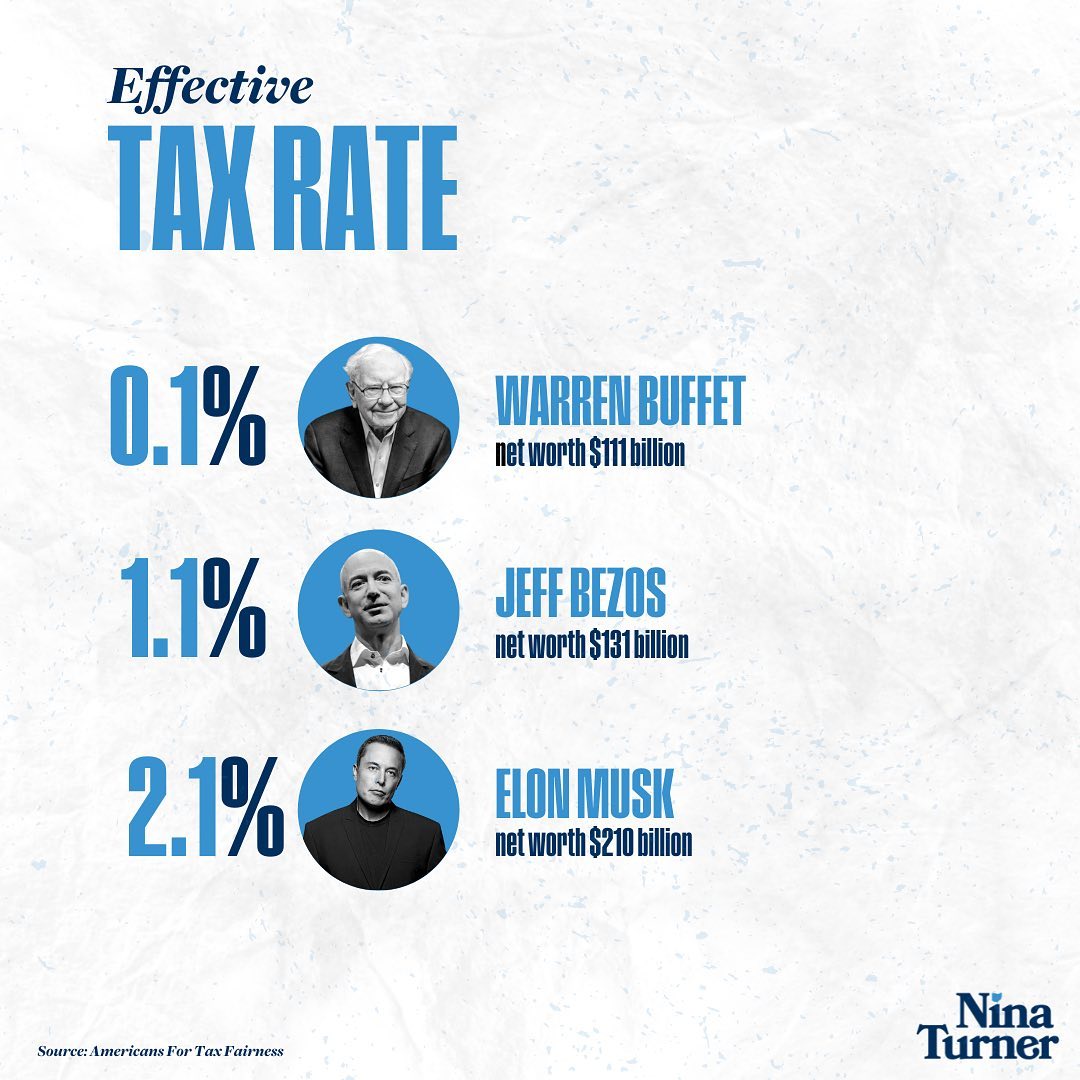
This visual joke relies on the standard "tax bracket" concept to suggest that the wealthy are paying a fraction of their wealth in taxes. By claiming that Warren Buffett, Jeff Bezos, and Elon Musk have "effective tax rates" as low as 0.1% and 2.1% respectively, it humorously exaggerates the idea that billionaires get away with keeping almost all of their fortune. This anti-oligarch perspective suggests that the tax system is broken because the few who own everything are paying virtually nothing, while the rest of the country bears the cost.
simple-description (llama3.2-vision_11b)
The meme is a humorous illustration of the proposed tax rate for billionaires like Jeff Bezos and Elon Musk, implying they would pay more in taxes than they currently do. The image shows a chart with the names of these billionaires and the corresponding tax rates, with Bezos and Musk's names listed under 0.1% and 0.2%, respectively. The text "They'd pay more in taxes than they currently do" is written below the chart.
detailed-analysis (gemma3-27b-vision)
Okay, here's an analysis of the image, broken down into sections based on the theoretical frameworks you requested. I will include sections only where the framework is particularly relevant.
Image Source: Americans for Tax Fairness, with a signature by Nina Turner.
Visual Description
The image is a minimalist infographic presenting the effective tax rates of three very wealthy individuals: Warren Buffett, Jeff Bezos, and Elon Musk. The background is a light grey, slightly textured. Each individual's name and a portrait in a circular frame are presented alongside their reported net worth and corresponding effective tax rate. The tax rates are displayed prominently with large, bold numbers, followed by a percentage sign. The overall design is clean and impactful, aiming for immediate readability and a focus on the numerical disparity. The text and numbers are rendered in a teal color, creating a contrast with the background and the portraits. The source is located in the lower left corner.
Critical Theory
This image resonates deeply with principles of Critical Theory, particularly those concerning power structures and ideology.
- Challenging Dominant Narratives: The image directly challenges the dominant narrative that high earners already contribute enough in taxes. It confronts the idea that wealth equates to fair contribution. The very act of publicly displaying this data is a disruption.
- Ideology and Concealment: The low effective tax rates are not the result of evasion but the result of systemic flaws in tax policy that benefit the wealthy. The image lays bare a structural problem presented as an individual circumstance. It uncovers how tax policy can conceal the true distribution of wealth and maintain existing power dynamics.
- Critique of Rationality: A classical economic argument for lower taxes on the wealthy rests on the idea that it incentivizes investment and job creation. This image implicitly questions the rationality of this argument when the actual impact is a disproportionately small tax contribution despite immense wealth. It implies a deeper, more cynical motivation for maintaining the status quo.
- Power Relations: It explicitly highlights the power imbalance between the ultra-wealthy and the rest of society. It demonstrates how the system is rigged in favor of the former, creating and perpetuating inequality.
Marxist Conflict Theory
The image is a potent example of class conflict, readily analyzed through a Marxist lens:
- Capitalist Class vs. The Rest: The image starkly illustrates the separation between the capitalist class (Buffett, Bezos, Musk) and the rest of society. The ultra-wealthy accumulate capital, while their tax contribution is a tiny fraction of their total holdings.
- Exploitation and Surplus Value: While the image doesn't directly show the source of their wealth, the implication is that it's derived from the exploitation of labor and resources. Their low tax contribution represents a further extraction of surplus value from society.
- Class Consciousness & the Seed of Revolution: The image is designed to raise class consciousness—to make visible the unequal distribution of wealth and the mechanisms that perpetuate it. This could serve as a catalyst for political action aimed at reforming the tax system.
- State as Instrument of the Ruling Class: The low tax rates are not accidental; they are a result of lobbying, legal loopholes, and political influence by the wealthy. This demonstrates how the state can function as an instrument of the ruling class, protecting and furthering their interests.
Postmodernism
While not the primary framework, postmodern elements can be observed:
- Deconstruction of the “Fairness” Narrative: The image doesn't directly define what is "fair" but instead exposes the discrepancy between the rhetoric of fairness and the reality of the tax system. It deconstructs the assumption that current tax laws are inherently just.
- The Power of Representation: The image itself is a representation of data, and therefore a constructed reality. It's not a neutral depiction of facts, but a strategic communication designed to evoke a specific response. This acknowledges the subjective nature of truth and the role of power in shaping narratives.
- Emphasis on Discourse: The image initiates a discourse around wealth inequality and tax policy. It's a piece of visual rhetoric meant to challenge existing assumptions and provoke debate.
I hope this detailed analysis is helpful. Let me know if you'd like me to explore any of these perspectives in greater depth or adjust the focus of the analysis.
simple-description (llama3.2-vision)
The meme is a humorous comparison of the effective tax rates of three wealthy individuals: Warren Buffett, Jeff Bezos, and Elon Musk. The image shows their net worths and their corresponding effective tax rates, which are 0.1%, 1.1%, and 2.1% respectively. The text "Effective Tax Rate" is written at the top of the image.
tesseract-ocr
Effective 0.1% & wawe 11% @ sams 2%@ au