First Seen
2023-05-24T22:39:04+00:00
simple-description (qwen3.5_2b-q8_0)
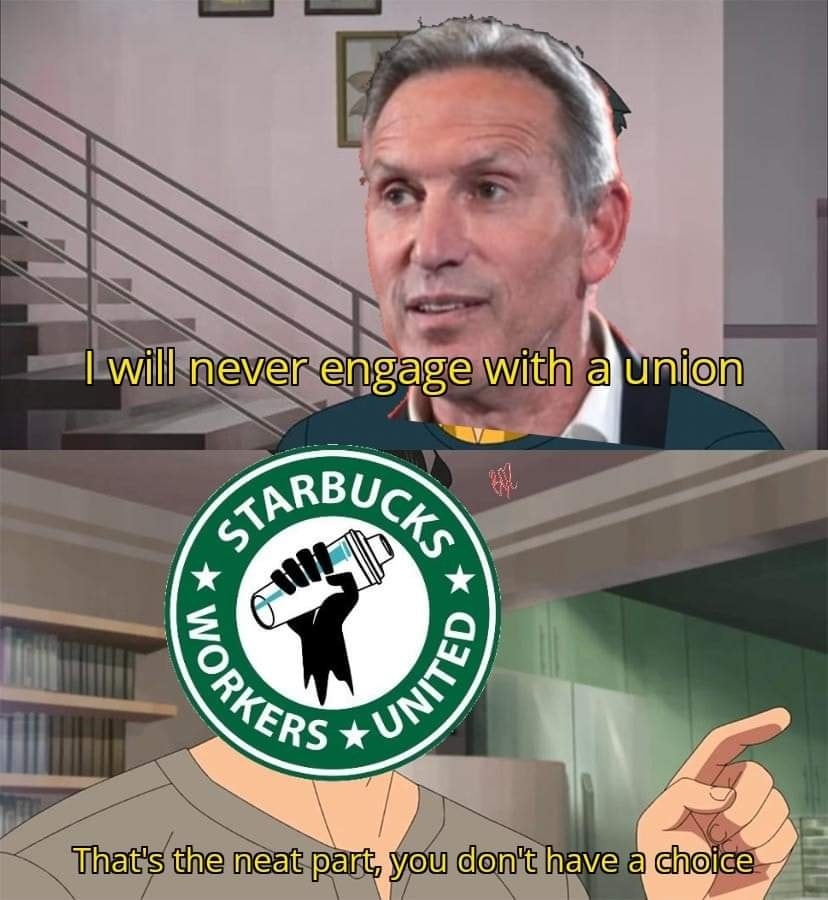
This meme satirizes the idea that a massive corporation like Starbucks possesses such immense power that employees are essentially prisoners in their own union. The top image features a man stating he will never engage with a union, while the bottom image points at the logo with the caption "That's the neat part, you don't have a choice." It is an anti-oligarch joke because it mocks the narrative that workers are forced into their working lives by the greed of big business.
simple-description (llama3.2-vision_11b)
This meme is from the perspective of the Anti-Oligarch category, which critiques the concentration of power and wealth in the hands of a few individuals. The meme depicts a humorous exchange between two characters, with the first character saying "I will never engage in a union" and the second character responding with a sarcastic "That's the neoliberal way to say 'I will never engage in a union'". The image is likely a commentary on the struggles of workers in the modern economy, where the emphasis on individualism and competition can lead to exploitation and inequality.
detailed-analysis (gemma3-27b-vision)
Okay, let's break down this meme through the requested theoretical lenses.
Visual Description
The meme uses a screen capture of Howard Schultz, former CEO of Starbucks, looking stern and pointing accusingly. Overlaid text reads, "I will never engage with a union," with a follow-up line, "That's the neat part, you don't have a choice." A circular logo for "Starbucks Workers United" is centrally positioned, depicting a raised fist. The overall aesthetic is confrontational and sarcastic, utilizing a popular meme format ("That's the neat part...") to convey a power dynamic and challenge the original statement. The framing and body language suggest authority being undermined, with the union logo acting as a visual stand-in for collective worker power.
Marxist Conflict Theory
This meme is highly illustrative of Marxist Conflict Theory. The core of this theory rests on the idea that society is structured by class conflict, rooted in the control of the means of production. Here:
- Bourgeoisie vs. Proletariat: Howard Schultz embodies the bourgeoisie (the owners of capital), while Starbucks Workers United represents the proletariat (the workers). Schultz's statement ("I will never engage with a union") exemplifies the owners' attempt to maintain control and suppress worker agency.
- Exploitation and Alienation: The very existence of a union drive suggests underlying tensions related to wages, working conditions, and worker alienation. Workers are seeking to collectively address imbalances of power and reclaim some degree of control over their labor.
- Class Consciousness & Collective Action: The meme highlights the increasing class consciousness among Starbucks workers, who are organizing to challenge the status quo. The response "You don’t have a choice" speaks to the rising power of collective action and the workers’ refusal to passively accept exploitation.
- Contradictions of Capitalism: The meme points to the inherent contradictions within capitalist systems – the tension between maximizing profit (Schultz's interest) and ensuring fair labor practices (workers' interests).
In essence, the meme encapsulates the central conflict between capital and labor and presents a moment where the proletariat is asserting its agency.
Foucauldian Genealogical Discourse Analysis
Michel Foucault’s work focuses on the relationship between power and knowledge. A genealogical approach looks at how concepts and power structures emerge and change over time.
- Power/Knowledge: The meme reveals how Schultz’s statement isn’t just an opinion but an exercise of power. His statement attempts to define the terms of the relationship between management and workers, denying the workers' right to organize. The 'knowledge' he implies is that unionization is undesirable and outside the bounds of acceptable behavior.
- Discourse of Management: The meme exposes the dominant discourse of management, which often presents itself as benevolent and focused on “partnership” with employees while simultaneously resisting any challenge to its authority. Schultz's statement is a manifestation of this discourse.
- Resisting Normalization: The union logo and the sarcastic reply ("You don't have a choice") represent a resistance to the normalization of managerial control. The union is challenging the accepted power dynamic and creating a new discourse of worker empowerment.
- Shifting Power Relations: The meme’s virality demonstrates that the accepted power dynamic is not static. Public awareness and support for unionization efforts are shifting the balance of power.
Critical Theory
This meme aligns with Critical Theory (a school of thought born from the Frankfurt School) which analyzes societal structures and challenges dominant ideologies.
- Ideology Critique: Schultz's initial statement serves as a manifestation of the dominant ideology of corporate power and anti-union sentiment. Critical theory would argue that this ideology masks the underlying exploitative relationships within the company.
- Emancipation and Praxis: The meme implies a call for emancipation from oppressive structures. The union's actions and the sarcastic retort suggest a commitment to praxis – the fusion of theory and action to transform social reality.
- Dominant Narrative Disruption: The meme disrupts the dominant narrative that companies have a paternalistic relationship with their workers. Instead, it highlights the inherent conflict of interest and the need for workers to protect their own rights.
Postmodernism
While less directly applicable, postmodern themes are present:
- Deconstruction of Authority: The meme deconstructs the traditional image of the CEO as an all-powerful figure. The sarcastic retort undermines Schultz's authority and presents a more complex, contested reality.
- Simulacra & Simulation: The image of Schultz, divorced from the actual complexities of the labor dispute, can be seen as a simulacrum – a copy without an original. The meme relies on the pre-existing cultural understanding of Schultz as a corporate figure.
Queer Feminist Intersectional Analysis
This is the least directly applicable lens, but intersectionality is still relevant.
- Power Dynamics and Marginalization: While the meme doesn't explicitly address gender or sexuality, it implicitly highlights the power dynamics at play in any workplace. Workers, especially those from marginalized groups, often face additional barriers to asserting their rights and organizing for better conditions.
- Intersection of Labor Rights and Social Justice: The fight for unionization can be seen as part of a broader struggle for social justice. Workers may be fighting for issues like fair wages, safe working conditions, and protection from discrimination.
Let me know if you'd like me to expand on any of these analyses or explore a different theoretical framework!
simple-description (llama3.2-vision)
This meme is a satirical take on the relationship between Starbucks and its employees. It features a split-screen image with a photo of Howard Schultz, the former CEO of Starbucks, on top and a character from the anime "Berserk" on the bottom. The text "I will never engage with a union" is written above the photo of Schultz, while the character's quote "That's the neat part, you don't have a choice" is written below the image of the character.
tesseract-ocr
S a , | ( aa 6 odes } = -_—~ a A = =kwillivevermencacelwitin ig Walon _ 1:70) a ee ale it fay tn 2%, ‘ fj) TT NOTED y VY ~~ / i lL Y 2 eA x Thefts tine mest Dart, you Comainave é f= fi : al