First Seen
2023-05-24T22:39:05+00:00
simple-description (qwen3.5_2b-q8_0)
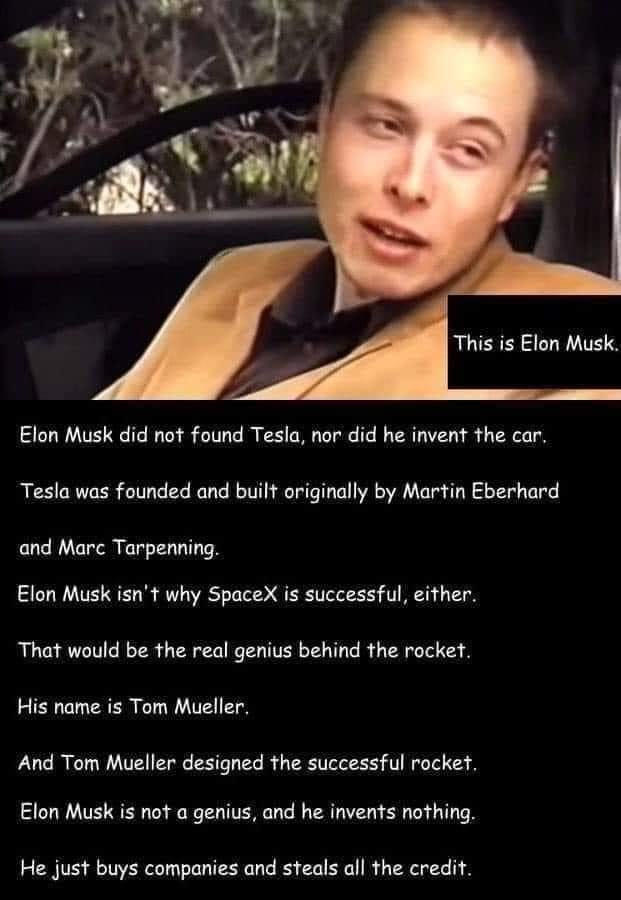
This anti-oligarch meme frames Elon Musk as a corporate hoarder rather than an innovator. The text argues that Musk did not actually build Tesla but simply purchased the company and stole the credit from Martin Eberhard, the true inventor. It further criticizes Musk for his role in SpaceX, labeling him an ungenius who "steals all the credit" for the rocket designed by Tom Mueller.
simple-description (llama3.2-vision_11b)
The meme is a humorous take on the idea that Elon Musk is not a genius, but rather a master of rebranding and redefining success. The image shows a screenshot of a tweet from Elon Musk, but the text has been edited to make it sound like a boastful, over-the-top claim of success, with phrases like "I just" and "I am" used to emphasize Musk's accomplishments. The meme pokes fun at Musk's tendency to exaggerate and take credit for others' work, implying that he is more of a "rebranding genius" than a true innovator.
detailed-analysis (gemma3-27b-vision)
Here's an analysis of the image and text provided, broken down into relevant theoretical frameworks. I’ll explain why certain sections aren’t applicable if that’s the case.
Visual Description
The image depicts Elon Musk in a close-up, appearing mid-speech or in a conversational setting. He appears to be in a dark, almost monochromatic, setting. The photo is of low quality. A white box with the text “This is Elon Musk” is superimposed. This visual framing immediately establishes the subject and, combined with the text, indicates a critical intention. The quality of the image appears to be a way to lower his status.
Foucauldian Genealogical Discourse Analysis
This is arguably the most relevant theoretical lens for the image/text. The statement directly challenges the discourse surrounding Elon Musk – the accepted narrative of him as a brilliant innovator and founder. The text attempts to genealogically deconstruct this narrative by tracing its history, demonstrating how the "truths" about Musk's accomplishments are not inherent, but constructed through power dynamics.
- Power/Knowledge: The text argues that Musk’s reputation is a product of power dynamics—Musk uses his wealth and influence to appropriate the work of others and present it as his own. The knowledge attributed to Musk is not derived from genuine invention but from control of the narrative.
- Discursive Formation: The text attempts to disrupt the established “discursive formation” around Musk—the rules and conventions that define how we talk about him and his companies. By identifying the original creators, the text challenges the boundaries of who is considered an "inventor" or "founder."
- Archaeology of Knowledge: The text implicitly engages in an “archaeological” uncovering of the historical conditions that enabled Musk to take credit for the work of others. It doesn’t present a comprehensive history, but it identifies the origins of the ideas and technologies within Tesla and SpaceX.
Critical Theory
The text operates within a broader Critical Theory framework, particularly the Frankfurt School's emphasis on revealing hidden power structures and challenging dominant ideologies.
- Ideology Critique: The central claim – that Musk is a fraud who takes credit for the work of others – functions as an ideology critique. It challenges the glorification of individual genius and the capitalist myth of the self-made entrepreneur.
- Dominant Narratives: It exposes how dominant narratives (e.g., the “innovator” myth) serve to mask underlying inequalities and power dynamics. It suggests that our understanding of innovation is shaped by who controls the media and public discourse.
- The Culture Industry: One could extend this analysis to consider how media coverage and branding contribute to the construction of Musk’s image as a visionary, reinforcing the power of the “culture industry” (a Frankfurt School concept) to manufacture consent and reinforce dominant ideologies.
Marxist Conflict Theory
This framework is present, though not the most central.
- Class Conflict: Implicitly, the text points to a class dynamic. Musk, as a wealthy owner and CEO, is seen as exploiting the labor and intellectual property of others for personal gain and accumulation of capital.
- Means of Production: The conflict over credit for inventions is ultimately a conflict over control of the "means of production" – the intellectual property and technological innovations that drive economic value.
- Alienation: This can be extended to discuss the alienation of the actual inventors, who do not receive the recognition or rewards they deserve for their work.
Postmodernism
While some elements align, applying strict Postmodernism is less direct.
- Deconstruction of Grand Narratives: The text attempts to "deconstruct" the "grand narrative" of the heroic individual inventor. It challenges the idea that innovation is solely the product of individual genius, suggesting it is a more complex, collaborative process.
- Rejection of Metanarratives: The text doesn’t present a replacement narrative but instead undermines the dominant one. This aligns with Postmodernism's suspicion of totalizing explanations.
- Subjectivity of Truth: The claim that Musk is not an inventor implies that “truth” about his accomplishments is not objective but constructed.
Queer Feminist Intersectional Analysis
This is largely not applicable to the text itself. There is no overt discussion of gender, sexuality, or intersecting forms of oppression. While one could potentially explore the power dynamics between individuals as a broader critique of patriarchal structures (where men often receive disproportionate credit for work), this would be a significant stretch and not directly supported by the text. The focus is primarily on economic and technological power dynamics, not gender or sexuality.
Let me know if you'd like me to expand on any of these analyses or explore different theoretical frameworks!
simple-description (llama3.2-vision)
The meme is a humorous image of Elon Musk with a series of outlandish and false statements about his life and accomplishments. The text below the image reads: "Elon Musk did not invent the car. Tesla was founded and built by Martin Eberhard and Marc T. The rest of the text is a series of absurd and humorous statements about Elon Musk's life, including that he did not invent the car, was not a genius, and was actually a 'nothing' who just bought companies and stole credit for them.
tesseract-ocr
_ ep Ni peee a a \: Ae af , mes : , 4 < A es ah ys mY a8 , os " iv ape Seema Lea Elon Musk did not found Tesla, nor did he invent the car. BUC eM mel ste SeReute Moll palate Lael aley AUC Ran slo a ole and Mare Tarpenning. Elon Musk isn't why SpaceX is successful, either. BUM Mu eee aCe le mu alae MeO MT Cae And Tom Mueller designed the successful rocket. ee SRC e Re eat LCT ee CMTC m Mel TU eu leaclRel Ra aag te