First Seen
2023-05-24T22:39:06+00:00
simple-description (qwen3.5_2b-q8_0)
This meme satirizes a wealthy individual, Joseph Geevarghese, whom the caption mocks for simply "deciding" he is worth billions, highlighting how a corporation's owners (oligarchs) can generate massive wealth out of thin air. The text further jokes that the billionaire renamed the company "Twizzler," referencing a fast-food chain, to show how arbitrarily a businessman changes a company's name to fit his preferences.
simple-description (llama3.2-vision_11b)
The meme is a screenshot of a tweet from Elon Musk, where he responds to a question about his net worth. The text reads: "I'm going to be worth more than $200B in the next year." However, the meme is a joke that says "I'm going to be worth less than $200B in the next year." The meme is poking fun at the idea that Elon Musk is worth over $200 billion, and is making a humorous comment about his net worth.
detailed-analysis (gemma3-27b-vision)
Here's an analysis of the provided Twitter post, broken down into sections as requested. It’s important to note that applying these theoretical lenses is interpretive – different analysts might prioritize different aspects or read the same content in different ways.
Visual Description
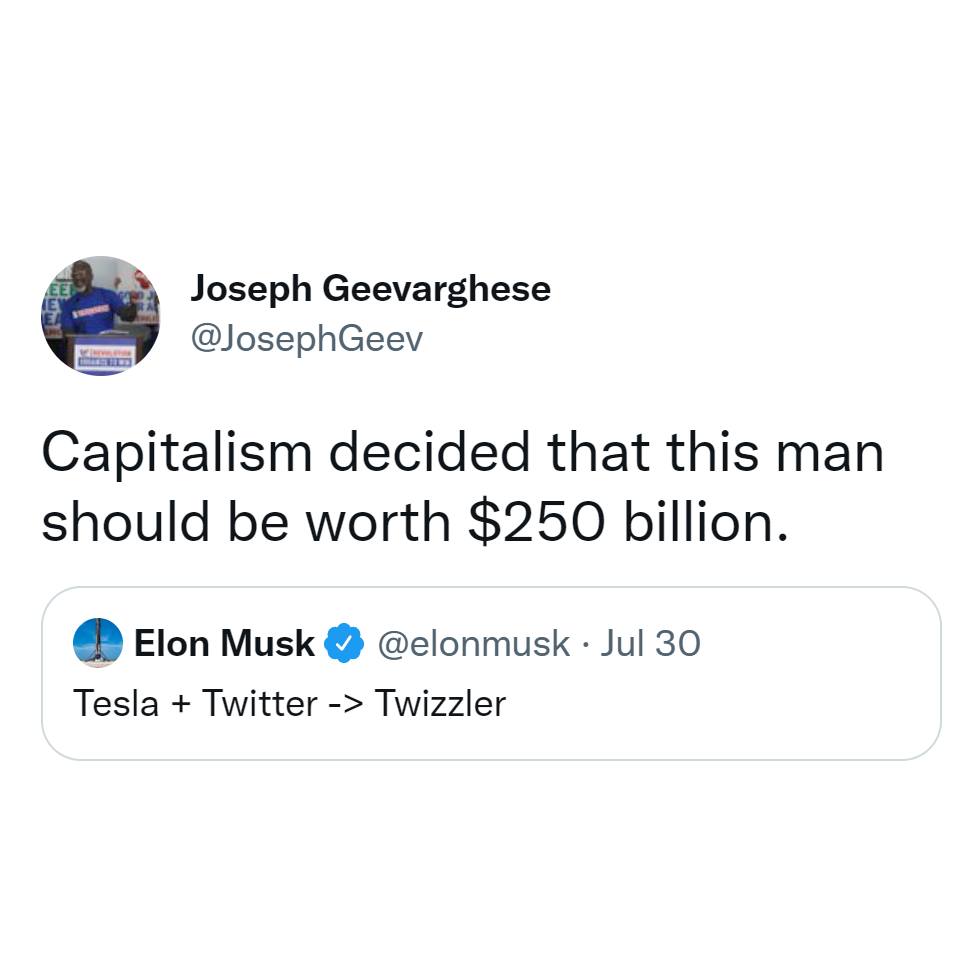
The image is a screenshot of a Twitter post. It shows two tweets. The top tweet is from user "@JosephGeev" and has a profile picture of a man in a blue shirt, with a logo that seems to contain a blue, white, and red flag. The tweet reads, “Capitalism decided that this man should be worth $250 billion.” The tweet is referencing Elon Musk.
The lower tweet is from @elonmusk (with a verified blue checkmark) and reads: “Tesla + Twitter -> Twizzler.”
The visual presentation is stark - the minimal aesthetic of Twitter, with text-based communication, emphasizes the messaging. The contrast between the declarative statement about capitalism and the playful brand-name mashup by Musk is notable.
Marxist Conflict Theory
This post is deeply resonant with Marxist conflict theory. The statement "Capitalism decided that this man should be worth $250 billion" explicitly frames wealth inequality not as a product of individual merit or effort, but as an outcome of the capitalist system. The tweet implicates capitalism as an active agent, ‘deciding’ the worth of an individual. This highlights the power dynamics inherent in capitalism where wealth concentrates in the hands of a few, creating a class struggle.
Musk's tweet, while seemingly trivial, can be interpreted within this lens as a demonstration of the symbolic capital accumulated through wealth. He wields the power to redefine (or at least play with) brands (Tesla and Twitter), suggesting control over cultural and economic narratives. The playful branding exercise underscores the commodification inherent in capitalism. The 'Twizzler' brand mashup signifies the consumption of brands and the control over that consumption.
Critical Theory
The post aligns with Critical Theory's concern with power structures and ideology. The first tweet doesn’t simply state a fact about wealth, but delivers a critique. It implies that the immense wealth attributed to Elon Musk is not organic or deserved, but a construct of the capitalist system. This construction serves to legitimize vast inequality.
Musk’s response, while appearing lighthearted, contributes to the perpetuation of this ideological construct. His self-branding and playful control over consumer culture reinforce his position of power and mask the systemic issues underlying wealth concentration. Critical Theory would analyze how these seemingly innocuous interactions contribute to a hegemonic discourse that naturalizes inequality.
Foucauldian Genealogical Discourse Analysis
Applying a Foucauldian lens, the statement regarding the $250 billion value is not a statement of objective truth, but a point within a discourse. The discourse of 'wealth,' 'success,' and 'entrepreneurship' are not neutral, but historical constructions shaped by power relations. The "decision" to assign that value isn’t made by a single entity, but emerges through a network of institutions, media representations, and cultural norms.
Foucault would analyze how this value is produced through specific power/knowledge regimes (e.g., financial markets, media coverage, technological innovation). Musk's tweet is also a performance of power within that discourse. The playful creation of ‘Twizzler’ is an assertion of control over the meaning of his brands and, by extension, his wealth. It demonstrates how language and symbolism are used to construct and maintain power relations.
Postmodernism
From a postmodern perspective, the post highlights the instability of meaning and the breakdown of grand narratives. The notion of a “worth” of $250 billion is itself a social construct, not a fixed reality. This points to the inherent arbitrariness of value systems. The contrast between the serious claim about capitalism and Musk’s playful branding reinforces this sense of fragmentation.
The tweet embodies the postmodern fascination with simulation and hyperreality. The “worth” of Musk isn’t tied to any intrinsic value, but to the symbolic representations (brands, media coverage, stock prices) that circulate within a culture obsessed with consumption and image.
Note: A Queer Feminist Intersectional Analysis isn't strongly applicable to this specific text in isolation. While it's possible to explore how wealth inequality impacts marginalized groups (which is a central tenet of intersectionality), the post itself doesn't directly address gender, sexuality, or other intersectional axes of oppression. It would require further contextualization to bring this lens into play.
simple-description (llama3.2-vision)
This meme is a tweet that pokes fun at the idea of capitalism. The tweet is from Elon Musk, the CEO of Tesla and SpaceX, and it's a response to a tweet that was made in his name. The tweet says "Capitalism decided that this man should be worth $250 billion" and is a humorous take on the idea that someone's wealth is determined by the value of their company, rather than their actual worth as a person.
tesseract-ocr
SS Joseph Geevarghese es @JosephGeev Capitalism decided that this man should be worth $250 billion. @ Elon Musk @ @elonmusk - Jul 30 Tesla + Twitter -> Twizzler