First Seen
2023-05-31T18:49:49+00:00
simple-description (qwen3.5_2b-q8_0)
This meme satirizes the anti-oligarchic sentiment of the character, Admiral Hux, from the Star Wars film. In the scene depicted, the character is shown ordering Admiral Hux to "fuck them yachts," which is a direct, violent metaphor for destroying the political power and wealth of the wealthy elite. This commentary mocks the idea of fighting the rich oligarchy by suggesting the only way to liberate the poor from their grip on the economy is to physically tear down their property, thereby casting the wealthy as the enemies of democracy.
simple-description (llama3.2-vision_11b)
This meme is from the Star Trek: The Next Generation series and features a character, Mr. Worf, who is known for his strict adherence to Klingon tradition. The meme is a play on a famous quote from the movie Star Trek II: The Wrath of Khan, where Mr. Worf's character says "I am Worf. I am Klingon. I will kill you." However, in this meme, the character is saying "I am Worf. I am Klingon. I will kill... the whales. I will kill them." The meme is a humorous take on the original quote, replacing "kill" with "kill whales," which is a play on the original quote.
detailed-analysis (gemma3-27b-vision)
Okay, let's break down the image and its potential interpretations through several theoretical lenses.
Visual Description
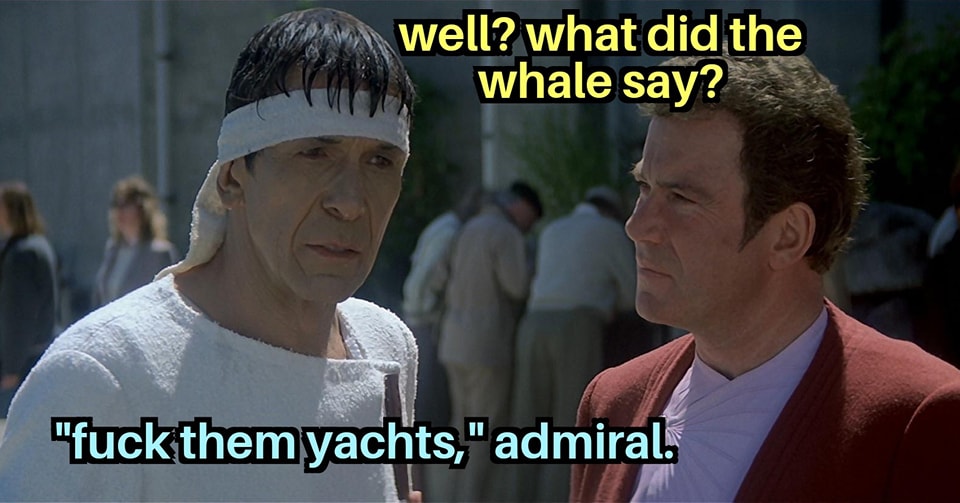
The image is a still from the movie Star Trek VI: The Undiscovered Country. The scene depicts a tense confrontation between Captain James T. Kirk (William Shatner, in a red uniform) and a Klingon captain, Captain Klaa (Michael Dorn, with a forehead ridge and wearing a white uniform). Kirk is leaning in, appearing concerned and curious, while Klaa has a stern, determined expression. Above the heads is the dialogue from the scene with Kirk asking "well? what did the whale say?" and a caption below which states "fuck them yachts," admiral. The background shows other people in uniform, seemingly aboard a ship. The color palette is generally cool, with greens and blues dominating the scene. The lighting is somewhat flat, typical of early 90s film production.
Foucauldian Genealogical Discourse Analysis
This scene and its caption provide a fascinating entry point for a Foucauldian analysis. Foucault's genealogy focuses on the historical development of power dynamics and the discourses that sustain them. In this case, the question "What did the whale say?" isn't about literal cetacean communication, but rather about uncovering truth, or as Kirk understands it, a "truth" needed to prevent a galactic war.
The caption, "fuck them yachts,” admiral." disrupts this conventional power structure. Yachts can be read as symbols of opulent, privileged power – representing the imperial forces of the Klingons. The dismissive attitude toward these symbols of power ("fuck them") suggests a radical rejection of the existing order. The use of such language is itself a form of power/knowledge. In other words, the phrasing "fuck them yachts," is a way to assert agency and challenge established norms within the context of galactic politics. The unexpected response from Klaa, delivered so bluntly, throws into question the established discourse of diplomacy and strategic negotiation, revealing the underlying desires of those traditionally silenced.
Critical Theory
From a Critical Theory perspective, (rooted in the Frankfurt School), the image points to issues of dominance and control. The Starfleet/Federation, while presented as enlightened, still operates within a hierarchical structure. Klaa’s response (“fuck them yachts,") disrupts the carefully constructed ideology of the Federation, highlighting the hypocrisy beneath the surface. The "yachts" symbolize the material comforts and privileges enjoyed by those in power, while the aggressive phrasing reveals a discontent and potentially a call for liberation. This scene can be seen as a critique of power structures, suggesting that beneath the veneer of diplomacy lie deep-seated tensions and resentment. It's a challenge to the rational, progressive narrative often associated with the Federation.
Marxist Conflict Theory
From a Marxist perspective, the scene embodies class conflict. The "yachts" represent the means of production and the wealth accumulated by the ruling class (the Klingons, in this case). Kirk is attempting to understand the motivations of the Klingons – their desire for wealth and power, and the means they are willing to employ to attain it. The response ("fuck them yachts") could be interpreted as a proletarian uprising, a rejection of capitalist values and a desire for a more equitable distribution of resources. It's a defiant statement against the ruling class and their opulent lifestyle.
Postmodernism
The image aligns with some core tenets of postmodernism. The scene undermines grand narratives (e.g., the Federation's ideology of peace and progress) by presenting a disruptive, illogical response. The unexpected language and the seemingly random connection between the whale, diplomacy, and "yachts" deconstructs established meanings. It creates a sense of absurdity and challenges the notion of objective truth. The disruption of logic and embrace of the illogical are hallmarks of postmodern thought.
Queer Feminist Intersectional Analysis
This area is more subtle, but interesting. The scene’s subversion of power dynamics—especially the Klingon Captain subverting the expectations of traditional diplomacy and discourse—can be read through a queer lens as a challenge to normative power structures. The bluntness and resistance against expectations can be seen as resistance to traditional patriarchal norms. The intersectional element could be that this scene, within the context of a science fiction world, offers a space to imagine different ways of relating—ways that reject the usual patterns of domination and control. The Klingon Captain’s rejection of the traditional norms can be a form of rebellion against dominant systems and, by extension, challenge the status quo.
Let me know if you'd like me to expand on any of these interpretations or explore other theoretical frameworks!
simple-description (llama3.2-vision)
The meme is a humorous exchange between characters from the Star Trek franchise. It features a scene from the movie "Star Trek: The Next Generation" where the character of Captain Picard is speaking to the alien species known as the "Klingon" (or "Kl...") and is asked to explain the meaning of the phrase "f*ck them yachts, Admiral." The meme is a humorous and irreverent take on the original scene, with the character's response being a humorous and unexpected answer.
tesseract-ocr
7 well?. what did the Cty whale Cy Vee _ Sem SF : : } : e / \% f i ~~ TREO NET ne