First Seen
2023-06-21T03:06:37+00:00
simple-description (qwen3.5_2b-q8_0)
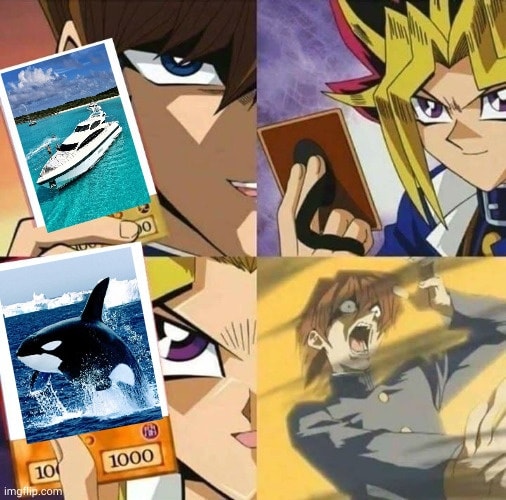
This meme, created for the "Anti-Oligarch" format, uses characters from the Yu-Gi-Oh! anime to depict a character struggling against the pressures of a wealthy opponent. In the top left, a character holds a photo of a luxury yacht, while the text "10" is visible on the card. The bottom right character reacts dramatically with a shout, and a playing card displays the text "1000" and "10". The visual story illustrates the comedic concept of a less wealthy character fighting for control against a rich or powerful antagonist.
simple-description (llama3.2-vision_11b)
The meme is a photo of a yacht with a caption "I'm not arguing, I'm explaining why I'm right." The image is from the TV show "The Office" and is a reference to a character's argumentative personality. The meme is poking fun at the idea that someone is so convinced of their own correctness that they can't even have a simple conversation without dominating it with their own views.
detailed-analysis (gemma3-27b-vision)
Okay, let's break down this image using the requested analytical frameworks. It's a fairly complex meme using imagery from Yu-Gi-Oh! cards, so there's a lot to unpack.
Visual Description
The image is a four-panel arrangement reminiscent of a meme template. It features imagery drawn from the Yu-Gi-Oh! trading card game, with the face of Seto Kaiba (a prominent character) as the backdrop for each card.
- Top Left: Depicts a white yacht sailing on a calm blue sea. The card is formatted like a Yu-Gi-Oh! monster card with its ATK and DEF points shown as 0.
- Top Right: Shows Seto Kaiba holding a card, expressing a slightly stern expression.
- Bottom Left: Features an image of an orca leaping out of choppy blue water, also formatted as a Yu-Gi-Oh! monster card, but with the attack point of 1000.
- Bottom Right: Shows a distressed Jounouchi Katsuya, another character in Yu-Gi-Oh!, engulfed in what appears to be an explosion/energy effect.
The overall impression is that the image is setting up a comparison or contrast between wealth (yacht), power (Kaiba), an imposing natural force (orca), and defeat/suffering (Jounouchi). It suggests an ironic narrative is being created through the juxtaposition.
Marxist Conflict Theory
This image lends itself rather well to a Marxist interpretation. The yacht immediately symbolizes wealth, privilege, and the capitalist class. Kaiba, within the Yu-Gi-Oh! universe, is a self-made industrialist and often represents concentrated economic and political power.
The orca, while a natural element, can be seen as a disruptive force, representing the underlying potential for rebellion or the raw power of nature against the constructed order of capitalism. The higher attack point of the orca compared to the yacht suggests a potentially stronger counter-force.
Jounouchi’s distress represents the suffering of the working class, or those crushed by the forces of wealth and power. His position – being "attacked" – signifies the exploitation inherent in capitalist structures.
The meme seems to subtly critique the imbalance of power between the wealthy (Kaiba and the yacht) and the working class/forces of nature (Jounouchi and the orca). The irony may be that, despite the apparent luxury, there's an underlying vulnerability or threat to this wealth.
Foucauldian Genealogical Discourse Analysis
Through a Foucauldian lens, we can look at how power operates within the imagery, not necessarily as top-down domination, but as a diffuse network of discourses.
- The Card Game as Discourse: Yu-Gi-Oh! itself creates a system of rules, hierarchies (card rarity, strength), and strategies. The act of "dueling" is a microcosm of power struggles, where discourse (the cards, the rules, the strategy) constitutes the conflict.
- Construction of Value: The yacht isn’t intrinsically valuable; its value is socially constructed through discourses of wealth, status, and leisure. Similarly, the "strength" of the cards is a constructed concept.
- Discursive Formation of "Victory" and "Defeat": The image implies a "duel" between these elements, and the outcome (Jounouchi’s distress) is not just a physical defeat but a discursive one—a labeling and categorization within the rules of the game. Jounouchi is discursively positioned as the "loser."
- The Orca as a Discourse Disruptor: The orca, as a symbol of untamed nature, can be seen as a force that challenges the established discourse of control and domination represented by Kaiba and the yacht.
Postmodernism
The image is very much steeped in postmodern sensibilities:
- Intertextuality: It's a remix of existing cultural elements (the Yu-Gi-Oh! franchise, the imagery of wealth and nature). It doesn’t create something entirely new, but appropriates and recontextualizes existing symbols.
- Irony and Parody: The meme relies heavily on irony – the juxtaposition of a luxury yacht with an orca and a suffering character creates a humorous yet critical effect. It parodies the tropes of both Yu-Gi-Oh! and societal representations of wealth.
- Deconstruction of Meaning: The meme doesn't offer a straightforward message. The relationship between the elements is ambiguous and invites multiple interpretations. It questions the inherent "value" assigned to wealth and power.
- Simulacra and Simulation: The Yu-Gi-Oh! cards are themselves simulacra - representations of things that are not themselves real. The meme operates on another level of simulation, creating a representation of a representation.
Critical Theory
From a broad Critical Theory perspective, the image can be interpreted as a commentary on the alienation inherent in modern capitalist society.
- Commodification of Experience: The yacht represents the commodification of leisure and experience. It's not about enjoying the sea, but about possessing a symbol of wealth.
- Power Dynamics: The power dynamics are central. Kaiba, as the figure of industrial power, embodies the systemic forces that create inequality.
- Critique of Ideology: The image subtly critiques the ideology that equates wealth with success and happiness. Jounouchi’s suffering suggests that this ideology is flawed.
- Alienation and Disconnection: The image implies a disconnection between the wealthy (Kaiba/yacht) and the natural world (orca) and the suffering of others (Jounouchi).
Queer Feminist Intersectional Analysis
This is the most challenging lens to apply directly, as the imagery doesn’t explicitly address gender or sexuality. However, we can make some arguments:
- Challenging Hierarchies of Power: While not explicitly queer or feminist, the image disrupts traditional hierarchies of power. The orca, representing a force of nature, can be seen as challenging the patriarchal and capitalist structures embodied by Kaiba.
- Intersectionality of Oppression: Jounouchi’s suffering can be understood as a consequence of intersecting forms of oppression – economic disadvantage and potentially class-based discrimination. The meme implicitly suggests that those marginalized by the system are often the ones who bear the brunt of its consequences.
- Deconstruction of Masculinity: Kaiba’s hyper-masculine persona within Yu-Gi-Oh! can be seen as a performance of traditional masculinity. The image, by juxtaposing this with forces that challenge his power, implicitly critiques these performances.
Important Note: The application of Queer Feminist Intersectional Analysis is a stretch, and relies on reading between the lines and applying those theoretical frameworks to the broader symbolic meanings of the image.
Let me know if you'd like me to elaborate on any of these sections.
simple-description (llama3.2-vision)
This meme is a mashup of four different images. The top-left image shows a character from the anime "Yu-Gi-Oh!" (Yami) with a shocked expression. The top-right image is a photo of a boat on the water. The bottom-left image is a photo of a whale. The bottom-right image is a character from the anime "Yu-Gi-Oh!" (Yami) with a shocked expression again. The text "1000" is overlaid on the bottom-left image.
tesseract-ocr
ea al === —_. Ss SY MG V / \ > p ! \ (Sa een x , | a 1 ae / 104 4000 s 7!