First Seen
2023-06-21T03:08:29+00:00
simple-description (qwen3.5_2b-q8_0)
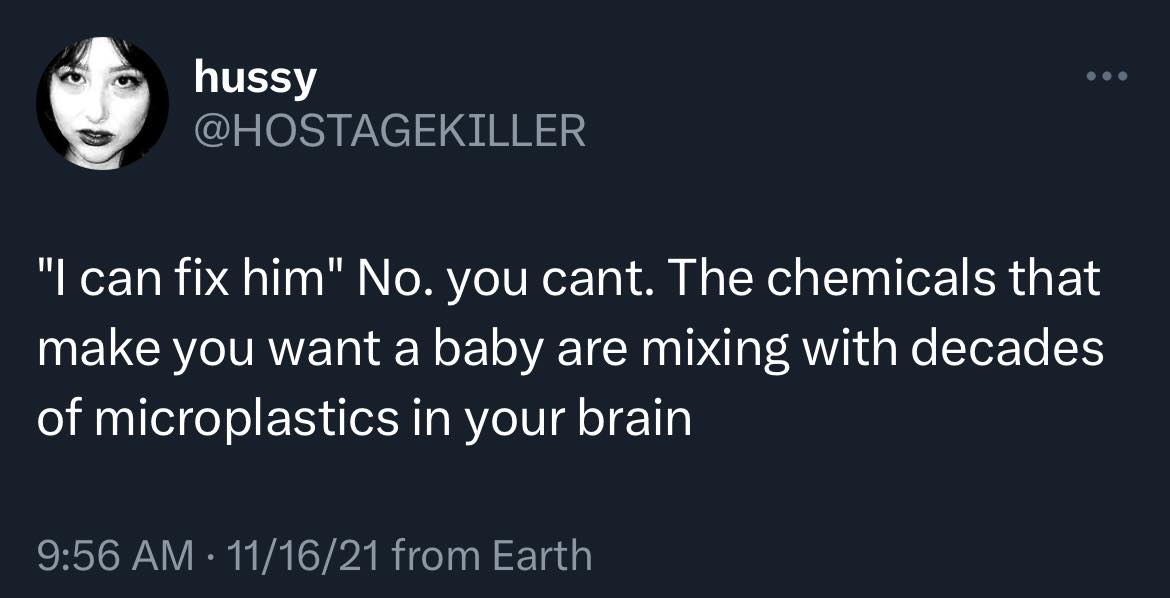
The tweet from "hussy" (@HOSTAGEKILLER) argues that women cannot successfully reproduce due to a toxic mix of chemicals and microplastics, a stance that resonates with 'anti-oligarch' ideology by attacking the 'oxygenated' economy of reproductive control. This perspective champions a 'naked' form of reproduction that supposedly requires less money and more natural agency than the chemical-heavy system that elites like you profit from.
simple-description (llama3.2-vision_11b)
The meme is a sarcastic commentary on the absurdity of societal expectations placed on women. The image is a screenshot of a Twitter post that reads: "I can fix him, no, I just need to love him. The idea that a woman's love can fix a man's problems is a harmful trope that perpetuates toxic masculinity. The meme is a humorous way to poke fun at this expectation, implying that love is not enough to fix someone's problems.
detailed-analysis (gemma3-27b-vision)
Okay, let's break down this Twitter post through the lenses you requested. It's a provocative statement, so there's a lot to unpack.
Visual Description
The post features a circular profile picture of a person with a stylized, somewhat eerie aesthetic. They have pale skin, dark lips are painted with a thick line, and appear to be wearing vintage makeup or costume. The background is dark, and the lighting is dramatic, suggesting a deliberate creation of a certain mood. The dark background and vintage effect create a sense of alienation, a sense of otherness. The username "@HOSTAGEKILLER" is ironic and disturbing, adding to the disturbing theme.
Foucauldian Genealogical Discourse Analysis
This post is ripe for a Foucauldian analysis. The statement "I can fix him" is immediately met with a rejection ("No, you can't"). This suggests a power dynamic, specifically the pervasive belief in 'fixing' men, often within romantic or societal expectations. Foucault would be interested in the discourse surrounding this idea of 'fixing' – where did it come from? What power structures does it support? The post then introduces a biological/chemical disruption: "The chemicals that make you want a baby are mixing with decades of microplastics in your brain."
This move is critical. Foucault would see this as a disruption of the established discourse. Instead of focusing on emotional/psychological explanations for desire and the impulse to “fix” someone, it moves to a material, embodied level. The “microplastics” are a modern anxiety – a symbol of late-capitalist pollution and its insidious effects on the human body. The statement suggests that desire itself isn't a pure, innate feeling, but a product of chemical interactions contaminated by the material conditions of our existence.
The genealogy traces the history of these ideas – the idea of a ‘flawed’ man needing repair, the development of hormonal control/understanding, and the more recent emergence of microplastic pollution as a societal concern.
Critical Theory
This post strongly aligns with the Frankfurt School's Critical Theory. It's a critique of the rationalized and commodified nature of desire and relationships. The impulse to "fix" someone implies a view of individuals as projects to be improved, aligning with the capitalist logic of optimization and control. The introduction of microplastics isn't merely a scientific fact; it's a metaphor for the ways in which systems of production and consumption infiltrate and fundamentally alter our inner lives.
The post suggests that our desires aren't authentic or free but are products of a polluted and alienating system. It’s a rejection of the “culture industry” that constructs and sells us idealized images of love and relationships, obscuring the material realities that shape our experiences.
Postmodernism
The post embodies several key elements of Postmodern thought. There's a rejection of grand narratives – the idea that love, relationships, or even desire can be explained by universal or essential truths. The statement deliberately breaks down the illusion of stable meaning. The sudden shift from the psychological ("I can fix him") to the biological/material ("microplastics in your brain") is jarring and defamiliarizing – a common Postmodern technique.
This creates a sense of fragmentation and uncertainty. There's a deliberate ambiguity: Are the microplastics simply a physical impediment, or a symbol of a deeper, more pervasive corruption? This ambiguity is central to the Postmodern rejection of fixed meanings and objective truths. The post questions the possibility of authentic connection and genuine desire in a world saturated with artificiality and pollution.
Queer Feminist Intersectional Analysis
This post is ripe for a queer feminist analysis. The "I can fix him" sentiment often implicitly places the burden of emotional labor and transformation on women, reinforcing patriarchal expectations. The rejection of that sentiment is a reclaiming of agency and a refusal to participate in that dynamic.
The intersectional aspect comes in with the inclusion of the microplastics. This can be interpreted as a commentary on environmental racism and the disproportionate impact of pollution on marginalized communities. The idea that our bodies are being infiltrated by toxic substances is particularly relevant for feminist critiques of reproductive justice and bodily autonomy. The post suggests that the capacity for desire and connection is being compromised not just by patriarchal expectations, but by systemic environmental injustices. Moreover, by linking desire and biology, the post can be read as a critique of essentialist views of gender and sexuality, suggesting that our desires are shaped by a complex interplay of material, social, and political forces.
I hope this analysis is thorough and useful! Let me know if you'd like me to elaborate on any particular aspect.
simple-description (llama3.2-vision)
This meme is a humorous response to a common phrase "I can fix him" by poking fun at the idea of using chemicals to make someone's baby. The text in the image reads: "I can fix him. No. You can't. The chemicals that make you want a baby are mixing with decades of microplastics in your brain."
tesseract-ocr
S 2 hussy @HOSTAGEKILLER "| can fix him" No. you cant. The chemicals that make you want a baby are mixing with decades of microplastics in your brain 9:56 AM - 11/16/21 from Earth