First Seen
2023-07-08T22:41:26+00:00
simple-description (qwen3.5_2b-q8_0)
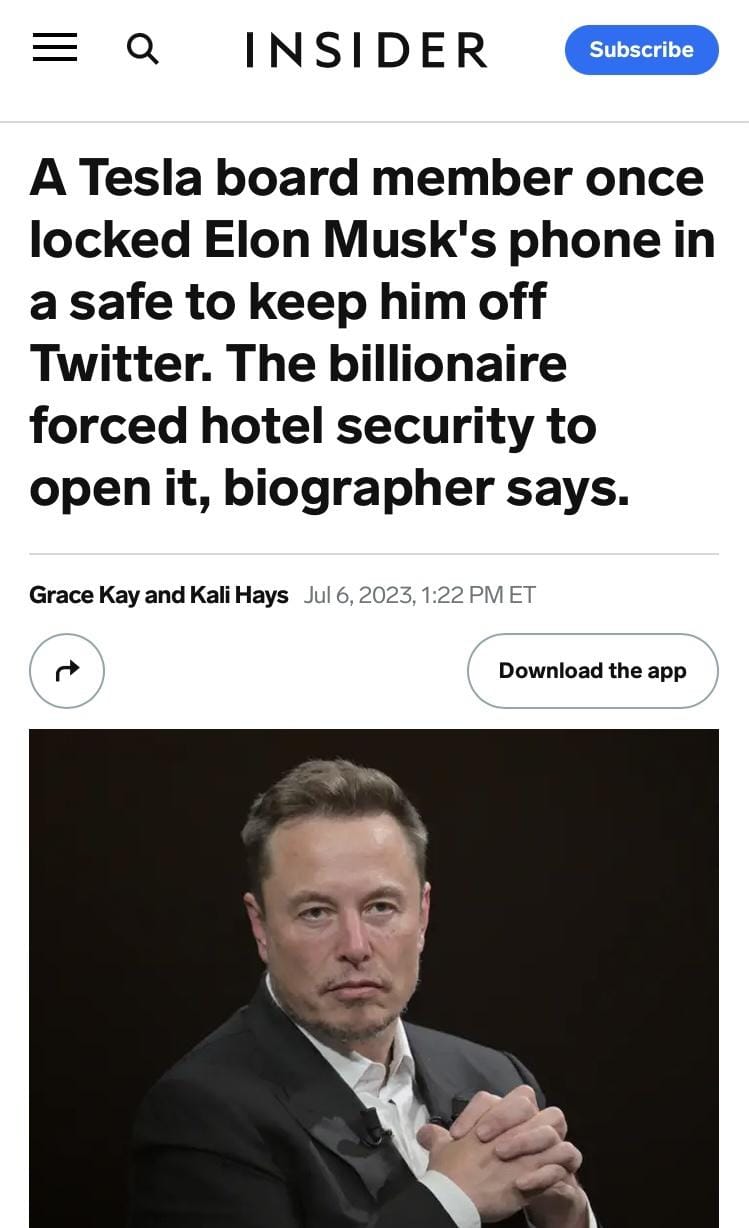
This image satirizes the "anti-oligarch" meme, which depicts a fictional character fighting against wealthy elites. The headline text reveals the irony: a Tesla board member locked a billionaire's phone in a safe to keep him off Twitter. The caption adds to the humor by stating that the billionaire was forced to open the phone himself, highlighting the "anti-oligarch's" attempt to be petty despite having no real power.
simple-description (llama3.2-vision_11b)
The meme is a screenshot of a news article from The Onion, a satirical news organization. The article is titled "Elon Musk's Neuralink implant hacked by billionaire's butler" and features a photo of Elon Musk with a shocked expression. The article is a humorous take on the idea that even the most secure technology can be compromised by a well-placed joke.
detailed-analysis (gemma3-27b-vision)
Okay, here's an analysis of the image and headline, broken down into the requested theoretical frameworks where relevant. I will indicate if a particular framework doesn't apply strongly to the content.
Image & Headline Overview:
The image shows Elon Musk in a formal black suit, with his hands clasped together in front of him, appearing to look down slightly. The headline reports that a Tesla board member once locked his phone in a safe to prevent him from posting on Twitter (now X), and that he then made hotel security open the safe. This suggests issues of control, power dynamics, and compulsion.
1. Visual Description
- Subject: Elon Musk, a globally recognized entrepreneur and CEO of multiple companies (Tesla, SpaceX, X).
- Composition: Close-up shot, focuses on Musk’s face and upper body. This creates a sense of immediacy and draws the viewer’s attention to his expression.
- Expression/Posture: Musk appears to be in a somewhat pensive or possibly frustrated posture. The clasped hands suggest control or tension. The slightly downward gaze could be interpreted as introspection or an attempt to avoid eye contact.
- Attire: The formal black suit signifies power, authority, and professionalism. It also suggests an environment of business and control.
- Overall Impression: The image projects a sense of controlled power and potential internal conflict. It sets the tone for a story about control and compulsion.
2. Foucauldian Genealogical Discourse Analysis
This framework strongly applies. The story lends itself well to a Foucaultian reading.
- Power/Knowledge: The headline directly reveals a power struggle. Locking the phone is not merely a protective act, but an exercise of power over Musk, attempting to control his discourse. Conversely, demanding the hotel staff open the safe is an assertion of his power over them, disrupting the norms of security and access. Musk's ability to force the hotel staff is key. It demonstrates his societal position enabling this exertion of power.
- Discipline & Surveillance: The act of locking the phone is a form of disciplinary power—an attempt to regulate Musk's behavior (specifically, his Twitter activity). It suggests an awareness that his unfiltered communication poses a risk (to the company, perhaps, or to himself). The "surveillance" aspect lies in the board member's concern over what Musk will say.
- Genealogy: Tracing the genealogy of this event (why was it felt necessary to lock his phone in the first place?) would reveal the evolving norms surrounding corporate communication, the role of social media in public image/stock value, and the increasing anxieties around the power of individuals with large platforms. We might explore how such actions were unthinkable a decade or two ago.
- Normalization: The board member's action, while dramatic, could be seen as part of an emerging normalization of controlling executive communication. The story suggests that such interventions, while unusual, are becoming more plausible in the age of instant, unfiltered social media.
3. Critical Theory
Critical Theory (particularly from the Frankfurt School) is relevant here.
- Domination & Control: The headline reveals a microcosm of the larger dynamics of domination and control in contemporary society. Musk, as a billionaire and CEO, holds immense power, but even he is subject to attempts at control by those around him. This highlights how power isn’t simply top-down but operates in complex, negotiated ways.
- Instrumental Reason: The board member's action can be interpreted as an example of “instrumental reason”—a focus on efficiency and control, prioritizing the preservation of corporate image/stock value over individual autonomy.
- Culture Industry: The very existence of this news story, and the interest in it, suggests the power of the "culture industry" (as described by Adorno and Horkheimer) to manufacture narratives around powerful figures like Musk. The story focuses on the spectacle of control, distracting from potentially larger systemic issues.
4. Marxist Conflict Theory
Applies to a limited extent, but it's present.
- Class Conflict: Although subtle in this particular instance, the story touches on class dynamics. Musk, as a member of the capitalist class, exerts control over the working class (hotel security, potentially the board member themselves). His ability to simply demand access showcases the privileges of wealth and power.
- Means of Communication as Control: The control over Musk's communication channels can be seen as a struggle over the “means of communication.” By attempting to restrict his access to Twitter, the board member is trying to control the dissemination of information and potentially protect the capitalist interests of Tesla.
5. Postmodernism
Relevant, but more in terms of how the story is presented.
- Meta-narratives & Deconstruction: The story challenges the meta-narrative of the "rational executive." Musk, as portrayed, isn't simply a logical decision-maker; he's someone prone to compulsion, requiring external control. This deconstructs the myth of the all-powerful, self-regulating CEO.
- Simulation & Hyperreality: The story itself becomes part of the “simulation.” The reporting of the event—the focus on the spectacle of control—can be seen as more important than the event itself. The news cycle feeds into the hyperreality surrounding Musk's public persona.
- Fragmentation of Authority: The fact that a board member felt the need to take such drastic action suggests a fragmentation of authority within the company. This challenges the traditional hierarchical power structures of corporate governance.
6. Queer Feminist Intersectional Analysis
This framework is the least directly applicable, but it can be brought in with some stretching.
- Power Dynamics & Control: The overarching theme of control and restriction resonates with feminist concerns about patriarchal control over bodies and voices. While Musk is a man, the story reveals how power operates across different hierarchies, even among those already in positions of authority.
- Intersectionality: While not explicitly present in the headline, the analysis could be extended by considering the broader context of Musk's public persona and any criticisms related to his treatment of women or other marginalized groups. The pattern of control revealed by the headline could be seen as part of a larger pattern of behavior.
In summary: The story is most powerfully analyzed through Foucauldian and Critical Theory lenses, revealing the dynamics of power, control, and discourse in contemporary society. Postmodernism adds a layer of understanding about the presentation of the story itself, while Marxist and Queer Feminist analyses offer peripheral but potentially relevant insights.
simple-description (llama3.2-vision)
This meme is a screenshot of an article from Insider, with the title "A Tesla board member once locked Elon Musk's phone in a safe to keep him off Twitter. The article's text is displayed in a large font, but the actual content is not visible due to the image description. The image shows a photo of Elon Musk with a serious expression, but the text "The billionaire forced hotel security to open it, biographer says" is displayed below the image.
tesseract-ocr
= Q INSIDER G&D A Tesla board member once locked Elon Musk's phone in a safe to keep him off Twitter. The billionaire forced hotel security to open it, biographer says. Grace Kay and Kali Hays Jul 6, 2023, 1:22 PM ET Pr Download the app = nw ») a