First Seen
2023-07-06T00:19:41+00:00
simple-description (qwen3.5_2b-q8_0)
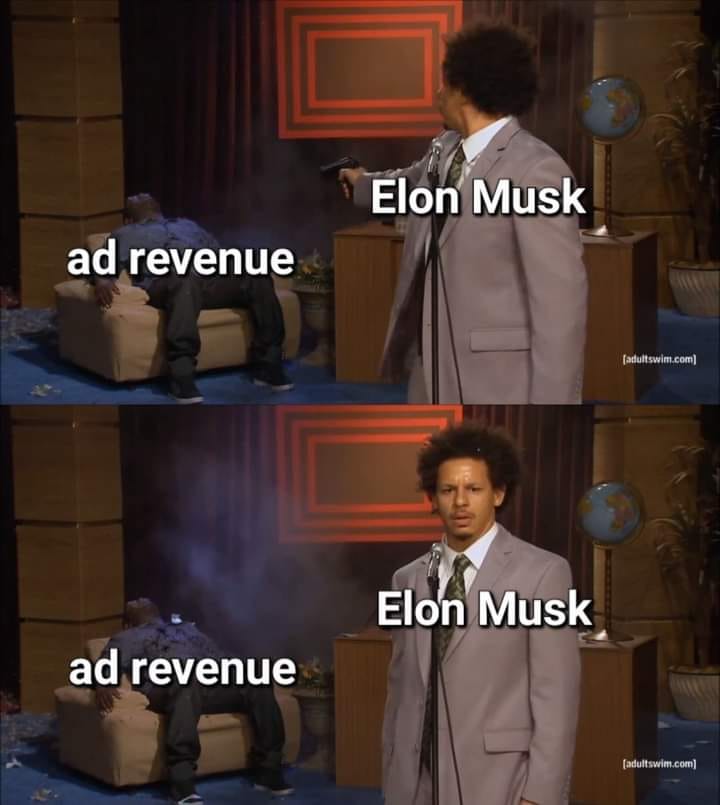
This meme depicts a person attempting to get "ad revenue" from Elon Musk, only to be threatened by the billionaire's gun. This aligns with the "Anti-Oligarch" category because it illustrates a powerful figure oppressing his followers by bullying them into submission, threatening violence to silence their efforts even as they try to monetize their support.
simple-description (llama3.2-vision_11b)
The meme is a commentary on the wealth and influence of billionaires, specifically Elon Musk. It features a split-screen image of a man holding a gun to his head, with the caption "I don't want to be a billionaire, I just want to be left alone" and "I am a billionaire, and I want to be left alone." The meme is a humorous take on the contrast between the two statements, highlighting the absurdity of being a billionaire and wanting to be left alone.
detailed-analysis (gemma3-27b-vision)
Okay, let's break down this image using the requested theoretical frameworks. It's important to note that meme interpretation is inherently open to multiple readings, and applying dense theory can be a bit of a stretch in some cases, but it's a valuable exercise in critical thinking.
Visual Description
The image is a two-panel meme extracted from a stand-up comedy performance. It features a cropped image of comedian Dave Chappelle standing on stage in a suit. The stage is illuminated by a single spotlight. A dark, seemingly endless corridor is visible in the background, suggesting a void or infinity.
- Panel 1: Text overlays the image: "ad revenue" is placed in the lower left corner, and "Elon Musk" is positioned in the upper right. A small, distorted image of a cardboard box appears in the bottom corner.
- Panel 2: The image is a repeat of panel 1. The layout and captions remain the same.
The repetition of the image and text creates a stark, almost unsettling effect. The low resolution and slightly warped appearance contribute to a sense of unease.
Foucauldian Genealogical Discourse Analysis
This meme can be interpreted through a Foucauldian lens as an exploration of power/knowledge dynamics surrounding digital media and its financing.
- Discourse: The meme constructs a discourse linking "ad revenue" and "Elon Musk." This isn't a straightforward statement of cause and effect, but rather a framing of their relationship as inherently entangled.
- Power/Knowledge: Elon Musk embodies a concentration of power – both economic and increasingly cultural – through his ownership of platforms like X (formerly Twitter). "Ad revenue" is the mechanism through which this power is amplified and perpetuated. It’s a form of capital that enables Musk’s influence. The meme suggests that Musk is ad revenue, that he embodies its essence, or is inextricably linked to its continued existence.
- Genealogy: Historically, the relationship between advertising and media ownership has always been present, but its form and intensity have changed. Musk represents a hyper-capitalist iteration of this relationship – a singular figure controlling a vast platform and extracting value through advertising, algorithmic amplification, and data collection. The meme implies a breakdown in the traditional boundaries between content creation, platform ownership, and financial gain. The cardboard box could represent the base layer of this system, highlighting its simplistic yet pervasive nature.
Critical Theory
The meme can be seen as a critique of late-stage capitalism and the commodification of culture.
- Commodification: The meme implies that everything, even the image of a comedian like Dave Chappelle (a cultural figure), is ultimately subject to the logic of capital. His presence is only valuable in the context of generating "ad revenue".
- Culture Industry: The meme critiques the idea of a "culture industry" (as theorized by Adorno and Horkheimer). It suggests that culture is no longer created for artistic or social purposes, but rather as a commodity to be bought and sold. The meme’s repetition highlights the cyclical and homogenous nature of content in this system.
- Alienation: The meme also subtly suggests alienation – the separation of individuals from the products of their labor and from each other. Dave Chappelle, a comedian meant to bring joy and critical commentary, is reduced to a vessel for generating profits.
Marxist Conflict Theory
From a Marxist perspective, the meme highlights the inherent class conflict within the digital economy.
- Bourgeoisie vs. Proletariat: Elon Musk embodies the bourgeoisie (the capitalist class), who own the means of production (in this case, the social media platform). "Ad revenue" represents the surplus value extracted from the "proletariat" – the users who generate the content and engagement that drives the platform’s profits.
- Exploitation: The meme suggests that users are exploited, with their attention and data being commodified and sold to advertisers, while Musk accumulates wealth.
- Ideology: The meme itself functions as a form of counter-ideology, challenging the dominant narrative of technological progress and entrepreneurial success. It exposes the exploitative underpinnings of the digital economy.
Postmodernism
From a postmodern perspective, the meme can be seen as a playful deconstruction of meaning and a commentary on the fragmentation of contemporary culture.
- Simulacra and Simulation: The meme suggests that the relationship between "ad revenue" and "Elon Musk" is a simulation – a representation that has become detached from any underlying reality. It's less about a literal connection and more about a hyper-real image of power and wealth.
- Intertextuality: The meme relies on the viewer’s pre-existing knowledge of both Dave Chappelle's comedic persona and Elon Musk's public image. It layers these references to create a new, ironic meaning.
- Irony and Parody: The stark simplicity of the meme, combined with the unexpected juxtaposition of elements, creates a sense of irony and parody. It challenges the viewer to question the conventional wisdom about technology, capitalism, and celebrity.
Queer Feminist Intersectional Analysis (This is where it gets less direct, and is a broader reach)
While not immediately obvious, a Queer Feminist Intersectional reading could focus on the ways in which these systems exacerbate existing inequalities.
- The Platform & Marginalized Voices: Platforms like X, while potentially offering space for marginalized voices, are ultimately controlled by individuals like Musk, whose values and biases can shape the conversation and suppress certain perspectives. “Ad revenue” incentives might prioritize engagement over genuine inclusivity or accurate representation.
- Data Extraction & Bias: The data collected to drive ad revenue is often riddled with biases, perpetuating harmful stereotypes and reinforcing existing power structures. This disproportionately impacts queer, feminist, and other marginalized communities.
- The Commodification of Identity: The platform's focus on engagement and virality can lead to the commodification of identity, where individuals are pressured to perform their identities in ways that are palatable to advertisers and algorithms. This can be particularly harmful for queer and feminist communities, where authenticity and self-expression are crucial.
Important Note: This is a complex meme, and these analyses are just interpretations. The meaning of any meme is ultimately shaped by the viewer's own experiences and perspectives.
Let me know if you’d like me to elaborate on any of these points or explore other theoretical frameworks!
simple-description (llama3.2-vision)
This meme is a humorous commentary on the relationship between Elon Musk, the CEO of Tesla and other companies, and his use of Twitter. The image shows a man holding a gun to a person's head, with the text "ad revenue" and "Elon Musk" overlaid on it. The joke is that Elon Musk is holding a gun to the person's head, threatening to cut off their ad revenue, implying that he is a powerful and intimidating figure.
tesseract-ocr
; , fe - ®. , sft | hearts : | tte oy ‘ y / we i | ; i y / i fe = _ L ji | =