First Seen
2023-07-19T03:03:01+00:00
simple-description (qwen3.5_2b-q8_0)
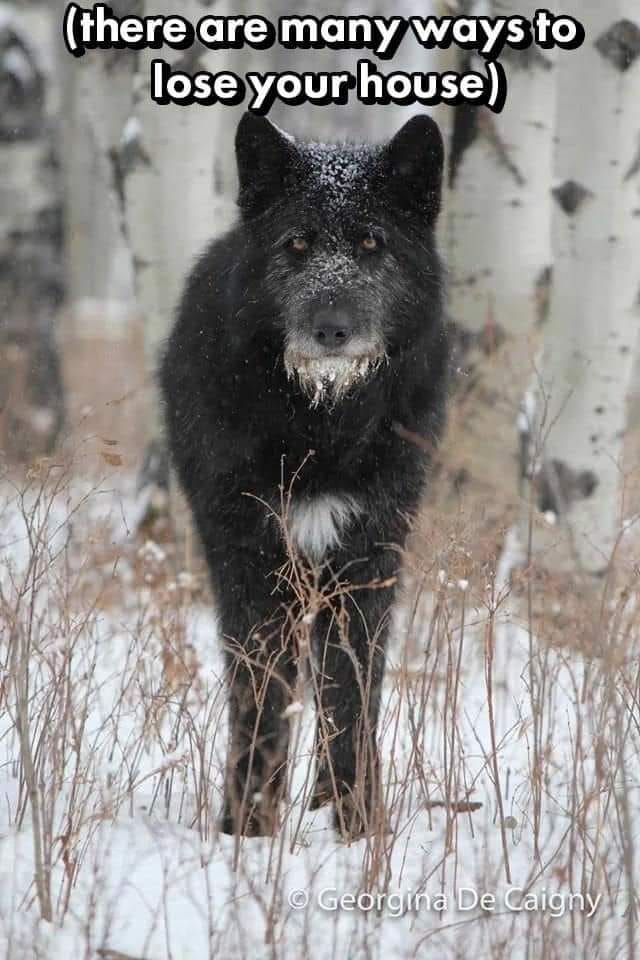
In the context of an Anti-Oligarch movement, this image makes a biting joke about political inequality by framing wealth disparity as a dangerous, almost predatory system. A vulnerable black wolf is shown walking into a wintry landscape only to find that the "oligarchy" can easily "evict" or destroy one's home without a single struggle. The text overlay, "(there are many ways to lose your house)," highlights the danger of this structural vulnerability, suggesting that the power structure is so strong that ordinary people can be stripped of their assets and home simply by their mere presence.
simple-description (llama3.2-vision_11b)
The meme features a photo of a wolf with a caption that reads: "When you're a wolf and you have to deal with all the oligarchs in your forest." The image is a play on the common meme format, where a humorous or relatable situation is presented in a way that's relatable to a specific audience or context. In this case, the meme is poking fun at the idea of a wolf having to deal with the complexities of oligarchic politics in a forest ecosystem, which is a humorous and satirical take on the concept of oligarchy.
detailed-analysis (gemma3-27b-vision)
Okay, here's an analysis of the image, broken down into relevant theoretical sections. It's important to note that applying these frameworks is often interpretative, and multiple readings are possible.
Visual Description
The image features a strikingly close-up, front-facing portrait of a black fox in a snowy, wintry landscape. The fox is the dominant figure, occupying much of the frame. Its fur appears thick and slightly frosted with snow. The fox's gaze is direct and intense, seeming to stare directly at the viewer. The background consists of thin, snow-covered grasses and a stand of pale birch trees. The composition emphasizes the stark contrast between the black of the fox and the white of the snow. Superimposed over the image in white, bold, sans-serif font is the phrase "(there are many ways to lose your house)." The photographer's watermark is present at the bottom of the image. The lighting is soft, diffuse, typical of overcast winter days.
Foucauldian Genealogical Discourse Analysis
The statement "there are many ways to lose your house" positions "housing" (and the concept of "home") as a site of power and control. From a Foucauldian perspective, we can examine how discourses around housing shape our understanding of it.
- Power/Knowledge: The phrase itself implies that losing one’s house isn’t merely an accidental event, but a result of broader systems of power. The statement implicitly invites exploration of how these losses occur. What institutions, regulations, or practices contribute? This links to Foucault’s concept of power/knowledge – that power operates through the creation and dissemination of knowledge.
- Discipline and Normalization: Historically, housing has been tightly linked to social and economic status. The threat of losing one’s home has been used as a disciplinary tool to incentivize compliance with societal norms (e.g., employment, debt repayment).
- Genealogy of ‘Home’: A genealogical examination would trace the historical construction of the concept of "home" – how it has evolved over time, what values have been attached to it (security, family, ownership), and how these values have been used to justify certain forms of power.
- The Image as Discourse: The fox, positioned as the central figure, might be interpreted as a symbolic representation of forces that threaten security, home, or even survival. The fox, as a cunning and resourceful creature, could embody both a threat to and a victim of systems leading to dispossession.
Marxist Conflict Theory
The phrase "there are many ways to lose your house" immediately evokes Marxist concepts of class struggle and economic exploitation.
- Means of Production & Housing: Housing, in a capitalist system, is often treated as a commodity – a means of production generating profit for landowners, developers, and financial institutions. Losing one's house is, therefore, often tied to failures within this system.
- Alienation: The loss of home can be seen as a form of alienation – a separation from one's labor, community, and sense of belonging.
- Class Struggle: The statement suggests that the loss of housing isn't random; it's a structural issue stemming from imbalances of power and wealth. It implies that some actors (landlords, banks, corporations) benefit from others losing their homes.
- The fox as Symbolic: The fox, living in a harsh environment, may symbolize the struggles of the working class, always seeking shelter and security in a system that often leaves them vulnerable.
Postmodernism
A postmodern reading could focus on the instability of meaning and the deconstruction of grand narratives.
- Loss of Stability: The phrase doesn’t offer any single reason for losing a house; the “many ways” highlights the complexity and fragmentation of modern life. This fragmentation aligns with postmodern rejection of overarching explanations.
- Subjectivity of “Home”: Postmodernism questions the idea of a fixed, objective “home.” Home is constructed through individual experiences, memories, and social interactions. The loss of a house, then, is not simply a physical loss but a loss of constructed meaning.
- Image & Text: The combination of image and text disrupts a linear narrative. The fox, visually, doesn’t “tell” a story about housing loss, but its presence forces the viewer to construct their own meaning, blending the visual and textual elements.
- Simulacra & Hyperreality: The image itself could be considered a simulacrum – a representation of a reality that has become divorced from the real. In a hyperreal world saturated with images, the loss of "home" may become a detached, mediated experience.
Queer Feminist Intersectional Analysis
This framework considers how multiple axes of identity (gender, sexuality, race, class, etc.) intersect to create unique experiences of vulnerability and dispossession.
- Disproportionate Impact: Historically, women, LGBTQ+ individuals, and people of color have faced systemic barriers to homeownership and housing security. The statement "there are many ways to lose your house" implicitly acknowledges these disparities.
- Gendered Dimensions of Housing: Housing insecurity often disproportionately affects women, particularly single mothers and survivors of domestic violence. Losing a home can disrupt support networks and exacerbate vulnerability to violence.
- Queer Homelessness: LGBTQ+ youth are overrepresented among the homeless population, often due to family rejection and discrimination.
- Intersectional Vulnerability: The fox, as a creature of the wild, can be seen as representative of marginalized communities, navigating a harsh and unforgiving environment. Its resilience, but also its vulnerability, might resonate with those facing intersectional oppression.
- The image as disruption: The image of the fox disrupts traditional notions of "home" and family, presenting a non-normative vision of survival and resilience.
Important Note: These are interpretive readings. The artist's intent is unknown, and other valid interpretations are possible. The purpose of this analysis is to demonstrate how different theoretical frameworks can illuminate the image's potential meanings.
simple-description (llama3.2-vision)
This meme features a picture of a large, dark wolf with a menacing expression, likely in a snowy or forested environment. The image is accompanied by the text "(there are) (many) ways to lose your house" which is likely a humorous or ironic statement about the potential consequences of a wolf's presence. The meme is likely intended to be humorous or playful, rather than a serious warning about wolves.
tesseract-ocr
™) (there’are|many,ways'to 4 2 *lose\your, house) ~ es * ‘s ais e a : be 4 wy, { 4 ~he ae mm - Hy e zs y . oo la 4 . , fy) NG ae é +} 1] Ae SAL f ea | Nf Wi val | K ‘ie oa WS WN iat j Ua | I | / j A /: ae st