First Seen
2023-08-14T16:48:13+00:00
simple-description (qwen3.5_2b-q8_0)
For someone who can't see it, this describes a guy who bought broken items and rebranded his company to make it look like it's a "good" business. The punchline is that he "didn't even own his dumb idea." It mocks the "rich guy" character, implying the true anti-oligarch isn't actually wealthy, but rather broke.
simple-description (llama3.2-vision_11b)
The meme is a screenshot of a Reddit comment from the user "thehobbes" on the subreddit r/antioligarch, where a user is sharing a humorous story about a fictional character who is a parody of a wealthy, self-absorbed, and entitled individual. The text reads: "I once knew a guy who was a total a**hole. He had a yacht, a private jet, and a mansion. But he was always complaining about how hard it was to make money. He said he had to work 80 hours a week just to make ends meet. I told him, 'Dude, I know you're not making ends meet. You're making it.' He looked confused. 'What?' 'You're not making it. You're making it. You're making it.' He looked confused. 'You're not making it. You're making it. You're making it.'"
detailed-analysis (gemma3-27b-vision)
Okay, let's break down this Reddit post using the frameworks you've requested. It's important to note that applying these frameworks can be interpretive, and the text is brief, so we're sketching outlines rather than exhaustive analyses. I'll indicate when a section doesn't apply strongly.
Visual Description
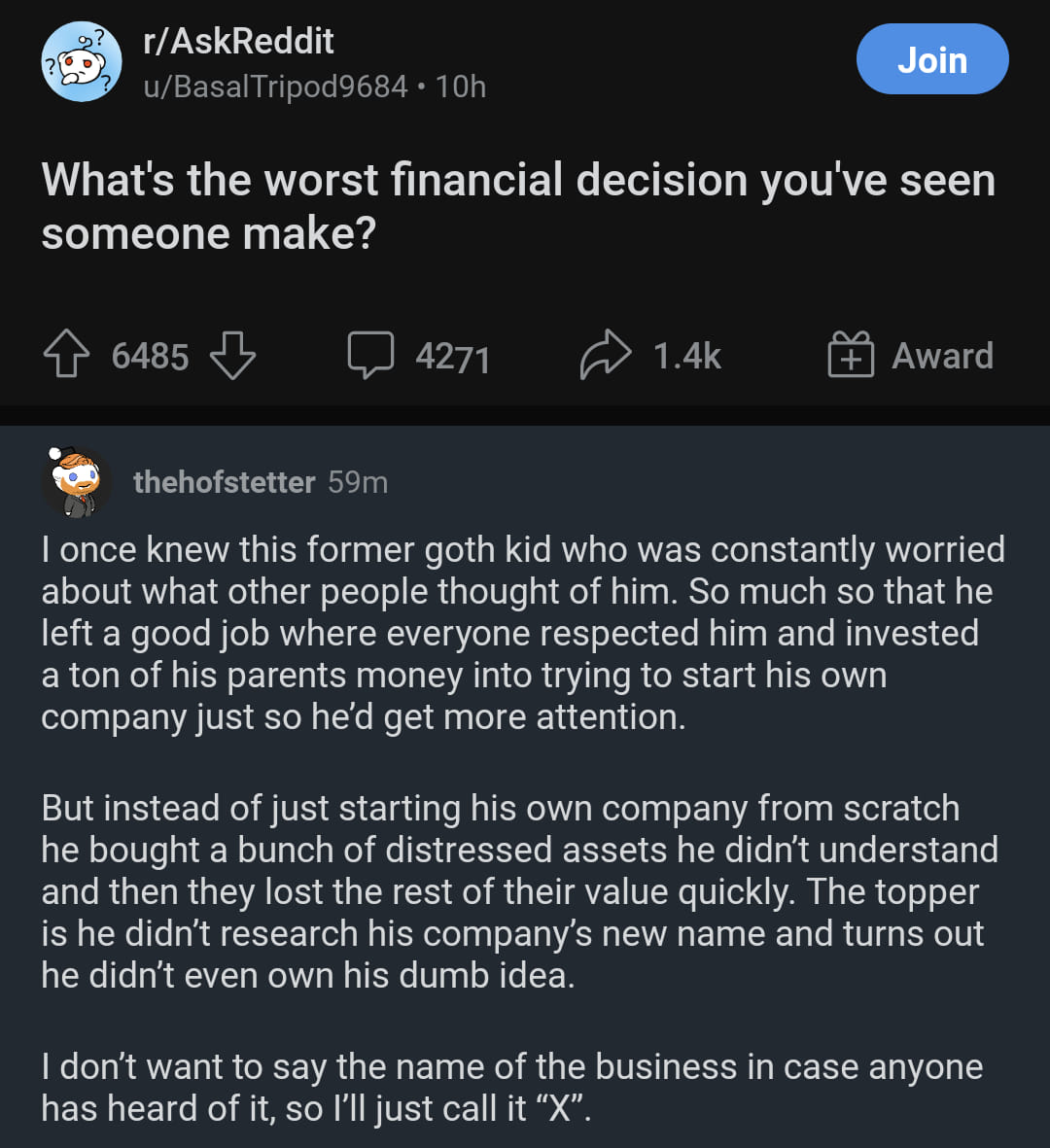
The image is a screenshot of a Reddit post on the r/AskReddit subreddit. The post, made by user BasalTripod968, asks "What's the worst financial decision you've seen someone make?". It has a sizable number of upvotes (6485) and comments (4271). The top comment is from user thehofstetter, and their response is a lengthy text block detailing a specific instance of a financially irresponsible decision. The overall aesthetic is typical of Reddit—clean but unadorned. The image is primarily text based.
Foucauldian Genealogical Discourse Analysis
This post presents a fascinating case study for Foucault. The narrative reveals how discourses surrounding success, self-worth, and recognition shape an individual’s behavior. Let's unpack this:
- Discourse of Success: The story hinges on a drive for "attention." This is not purely ego; it's deeply embedded in a discourse of success that equates visibility with worth. Our "goth kid" internalized a system where being seen, being noticed, is inherently valuable. He wasn't pursuing genuine entrepreneurship; he was performing a role defined by the desire for external validation.
- Genealogy of the Entrepreneur: We can trace the genealogy of the "entrepreneur" figure. Once a marker of innovation and independence, the story suggests it’s become increasingly conflated with spectacle and self-promotion. The protagonist isn’t interested in building something, but in being seen as someone who builds something.
- Power/Knowledge: The protagonist’s actions demonstrate how power/knowledge operates. He lacked knowledge of business fundamentals (researching names, assessing asset value), but believed he possessed the power to succeed simply by leveraging his parents' wealth and a desire for attention. This shows a disconnect between perceived authority and actual competence.
- Discipline: The drive for external recognition and the pursuit of creating a business to achieve this can be seen as a form of self-discipline – but a misguided one, as it leads to financial loss.
Critical Theory
The post clearly lends itself to a Critical Theory lens, particularly in regard to societal pressures and the construction of self.
- The Culture Industry: The protagonist’s obsession with “attention” is indicative of the effects of the Culture Industry. He’s internalized the need to be spectacular and visible, a byproduct of media and consumer culture. He is performing a pre-scripted role rather than engaging in authentic self-expression or entrepreneurship.
- Alienation: While not explicitly stated, the story hints at alienation. He’s disconnected from the genuine work of building a business and focuses solely on the external perception of success.
- False Consciousness: The protagonist’s belief that he could succeed simply by leveraging his parents' money and pursuing attention can be seen as a form of false consciousness. He’s unaware of the underlying systemic factors that contribute to success (knowledge, skill, planning) and believes that visibility alone will be enough.
Marxist Conflict Theory
This post is a subtle example of the inherent contradictions within capitalism.
- Class and Privilege: The protagonist’s access to parental wealth is a key element. This highlights the advantage afforded to those from privileged backgrounds, allowing them to pursue risky ventures without facing the same consequences as others. The ease with which he invests without understanding the fundamentals underscores this privilege.
- Commodification of Self: The desire for "attention" can be seen as a form of commodification of self. In a capitalist system, everything—including personal qualities and identity—can be turned into a commodity. The protagonist is attempting to market himself as a successful entrepreneur, even without the skills or knowledge to back it up.
- Exploitation (potential): The story implies a potential for exploitation if this business involved employees or partners. The protagonist’s reckless decision-making could harm others financially.
Postmodernism
The post resonates with postmodern ideas about simulation, superficiality, and the blurring of reality.
- Hyperreality: The pursuit of "attention" can be seen as a step into hyperreality, where the simulation of success becomes more important than actual success. The protagonist is chasing an image rather than engaging in genuine creation.
- Deconstruction of the Entrepreneur: The story deconstructs the traditional image of the entrepreneur. The protagonist isn’t driven by innovation or a desire to solve a problem, but by a need for validation. This undermines the myth of the self-made entrepreneur.
- Loss of Authenticity: The focus on external perception indicates a loss of authenticity. The protagonist is performing a role, rather than being true to himself or pursuing genuine interests.
Queer Feminist Intersectional Analysis
This framework is the least applicable, but we can stretch it somewhat:
- Performance & Gender: The desire for "attention" could be read as a performance of masculinity, where visibility and success are equated with power and dominance. (This is a weaker connection, as the story doesn't explicitly address gender).
- Intersection of Privilege: The protagonist’s access to wealth (class privilege) intersects with his perceived social standing (potentially influenced by his "goth" identity – though the text doesn't explore this fully). The intersection of these privileges allows him to take risks others wouldn't be able to afford.
Let me know if you'd like me to elaborate on any of these analyses!
simple-description (llama3.2-vision)
The meme is a screenshot from the Reddit forum "Ask Reddit" where a user is sharing a story about their former friend who was known for being a "titan" (a wealthy person) who had a huge amount of money. The story is told in a series of short, humorous, and sarcastic comments about the friend's behavior, such as "I once knew this former goth kid" and "I don't know what it’s like to be a 24 year old with a 100k income". The user is asking for advice on how to handle a friend who is making a 100k income.
tesseract-ocr
@) r/AskReddit re u/BasalTripod9684 + 10h What's the worst financial decision you've seen ro) ane) AM Lats. C 4 7 oo 0 Vy PSE 6. te thehofstetter 59m | once knew this former goth kid who was constantly worried about what other people thought of him. So much so that he left a good job where everyone respected him and invested a ton of his parents money into trying to start his own company just so he'd get more attention. But instead of just starting his own company from scratch he bought a bunch of distressed assets he didn't understand and then they lost the rest of their value quickly. The topper is he didn't research his company’s new name and turns out he didn’t even own his dumb idea. | don't want to say the name of the business in case anyone has heard of it, so I'll just call it “X”.