First Seen
2023-09-29T21:03:57+00:00
simple-description (qwen3.5_2b-q8_0)
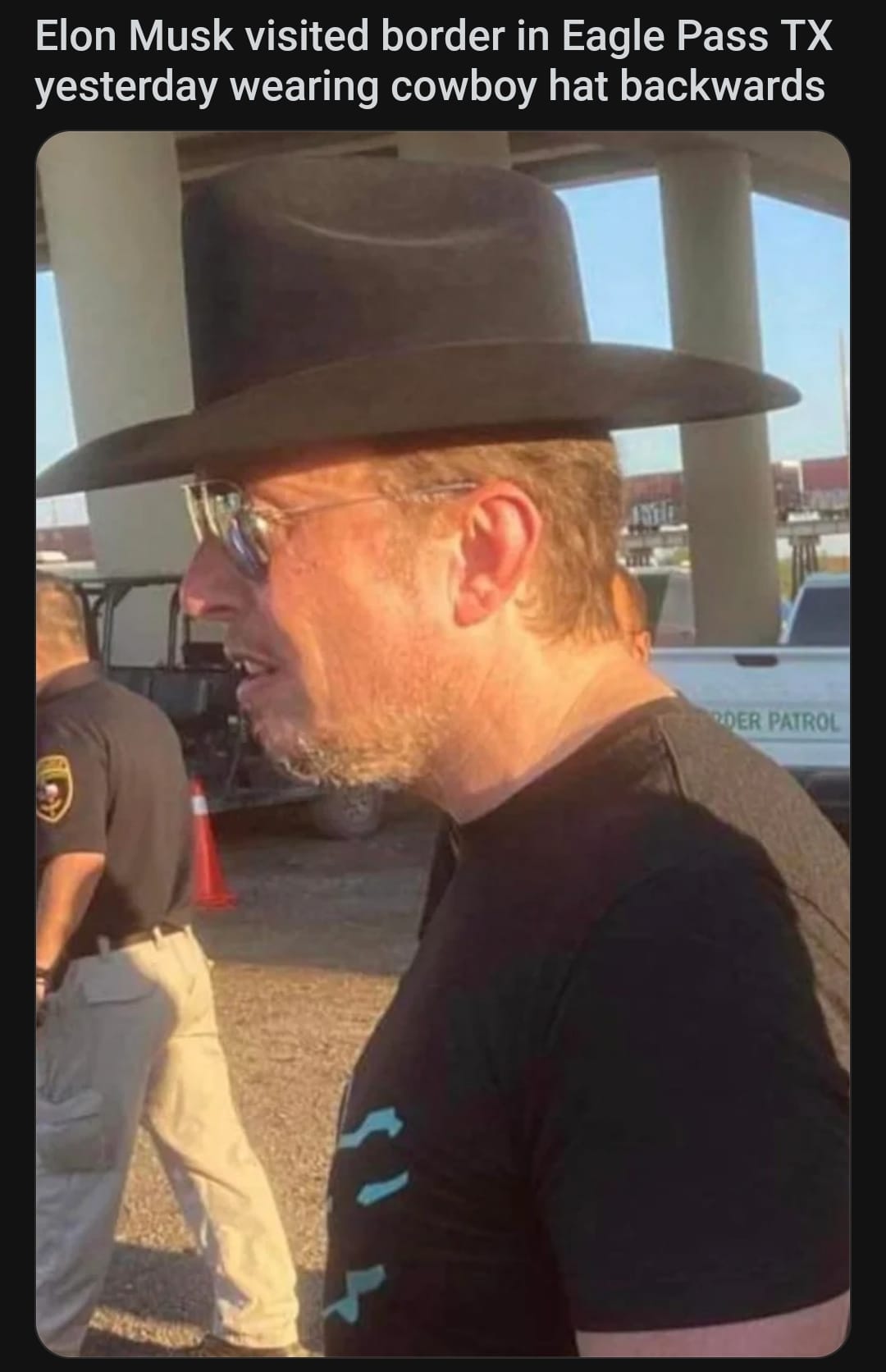
This meme portrays Elon Musk as a defiant rebel against the political establishment or "oligarchy." He is shown at the Eagle Pass border wearing a cowboy hat backwards, symbolizing a rejection of the rigid norms and conformity he usually represents. The text highlights his arrival as a figure who is unyielding to the strict rules of the border patrol, treating the system with a casual, anti-establishment attitude.
simple-description (llama3.2-vision_11b)
The meme is a photo of Elon Musk wearing a cowboy hat, but with the image flipped horizontally, making it look like he's wearing a "Elon Oligarch" hat, a play on the phrase "Elon Musk" with a nod to the term "oligarch," implying that Musk's wealth and influence are akin to those of a wealthy elite. The image is captioned "Elon Oligarch" and is likely meant to be humorous and satirical.
detailed-analysis (gemma3-27b-vision)
Okay, let's break down this image of Elon Musk at the border in Eagle Pass, Texas, through the requested theoretical lenses. Keep in mind that applying these frameworks can be complex and sometimes speculative, as images don't inherently carry meaning; we construct meaning through these frameworks.
1. Visual Description
The image is a close-up shot of Elon Musk. He is wearing a large, black cowboy hat, notably worn backwards. His face is partially obscured by the hat's brim, casting a shadow across his eyes. He is wearing a dark shirt with what appears to be a badge or patch on it, bearing the words "BORDER PATROL" in white. The background is blurred, but it seems to depict a parking lot with SUVs and a building, indicating a border security context. The overall effect of the image is somewhat dramatic and intended to draw attention to the hat and Musk himself.
2. Foucauldian Genealogical Discourse Analysis
- Discourse of Borders and Security: The image is embedded in the discourse of border security, national identity, and control. The presence of "BORDER PATROL" on Musk’s attire immediately situates him within this discourse. This isn’t just about physical boundaries, but about the construction of who “belongs” and who is considered “other.”
- Genealogy of the Cowboy Hat: The cowboy hat is a culturally loaded symbol in the United States. Its origins are tied to ranching, but it's become deeply intertwined with ideas of rugged individualism, American exceptionalism, and frontier spirit. Musk's wearing it (backwards) can be seen as a re-appropriation of this symbol.
- Power/Knowledge: Musk, as a powerful figure (CEO of Tesla and X), performs a role by dressing as he does, asserting a certain type of authority. The image creates a power dynamic, suggesting he has access and agency within this highly controlled space. The backwards hat can be seen as a deliberate destabilization of the traditional symbolism, implying he's a non-conformist or challenging the established norms of border security.
- Disciplinary Power: By associating himself with the border patrol, Musk implicitly reinforces the disciplinary mechanisms that govern the border – surveillance, control, and the categorization of people.
3. Critical Theory
- Culture Industry & Spectacle: This image functions as a spectacle, designed to attract attention and reinforce Musk's brand. It's likely disseminated through social media, feeding into the "culture industry" that creates and perpetuates certain narratives. The backward hat adds a layer of calculated eccentricity, making it more shareable and memorable.
- Commodification of Identity: Musk's persona is carefully constructed and marketed. He presents himself as an innovator, a visionary, and now, implicitly, a defender of the border. This image further commodifies his identity, turning it into a symbol for sale.
- Ideology: The image subtly reinforces an ideology of national security and control. It presents a certain perspective on the border crisis, framing it as a matter of needing protection and strong enforcement.
4. Marxist Conflict Theory
- Class & Power: Musk represents the ruling class – the ultra-wealthy who wield immense economic and political power. His visit to the border and association with the border patrol can be interpreted as an attempt to align himself with state power and legitimize the existing system of border control, which often disproportionately affects marginalized communities.
- Exploitation & Control: The image can be linked to the broader issue of labor exploitation and control. The border is a site where labor is often exploited, and the enforcement of strict border policies can contribute to the suppression of workers' rights.
- False Consciousness: The image serves to create a distraction from the real problems at the border, such as the humanitarian crisis, systemic racism, and the root causes of migration.
5. Postmodernism
- Simulacra & Hyperreality: The image can be seen as a simulacrum – a copy without an original. Musk is playing a role, embodying a certain archetype of the “strong protector” or “concerned citizen.” The image is more about representation than reality. It exists within a hyperreal space of social media, where images are constantly circulated and divorced from their original context.
- Deconstruction of Symbols: The backwards hat can be interpreted as a deconstruction of traditional symbols. It challenges the conventional meaning of the cowboy hat and subverts expectations.
- Fragmentation & Fluidity: The image is part of a fragmented and fluid media landscape, where meaning is constantly negotiated and contested. The image itself does not have a fixed meaning but is open to multiple interpretations.
6. Queer Feminist Intersectional Analysis
- Masculinity & Performance: Musk’s performance of the “cowboy” can be read as a deliberate construction of hypermasculinity. The backwards hat can be seen as an attempt to subvert or play with traditional notions of masculinity, but ultimately it reinforces patriarchal structures.
- Border as a Site of Gendered Violence: The border is a particularly dangerous space for women and LGBTQ+ migrants who are often subjected to gender-based violence, sexual assault, and discrimination. Musk’s presence there, even if unintended, can be seen as contributing to the normalization of these oppressive structures.
- Intersectionality: This image illustrates how race, class, gender, and migration status intersect to create unique forms of oppression. The individuals affected by border policies are not a homogenous group, and their experiences are shaped by multiple intersecting factors.
Important Considerations:
- Subjectivity: These interpretations are subjective and based on the application of specific theoretical frameworks.
- Context: The meaning of the image is also shaped by the broader social and political context in which it is circulated.
- Image as Evidence: Images are not neutral; they are always constructed and carry ideological baggage.
Let me know if you would like me to elaborate on any of these points or explore other theoretical lenses.
simple-description (llama3.2-vision)
The meme is a photo of Elon Musk wearing a cowboy hat backwards, which is a humorous and unexpected sight. The image is captioned "Elon Musk visited the border in Eagle Pass, TX yesterday wearing a cowboy hat backwards". The joke is that the hat is on backwards, which is an unusual and comical sight, and the image is meant to be humorous and lighthearted.
tesseract-ocr
Elon Musk visited border in Eagle Pass TX yesterday wearing cowboy hat backwards | n : / Ss) ee Re eee : BR ii 2 a me nt | ry rT a pT ee 7 / ae oy T | a # ‘y ‘ee ie vt as aa 4 ae 4 | i ~ D) rn a , ; eae ’ of . Fie’ ' g . y if = = nae - a oe ‘ ' et oie . ‘ . ewer ' i ; \ ae ; ‘ \ Tae Was \ “a 2 fie Y me, ~