First Seen
2024-01-30T00:35:24.170971+00:00
simple-description (qwen3.5_2b-q8_0)
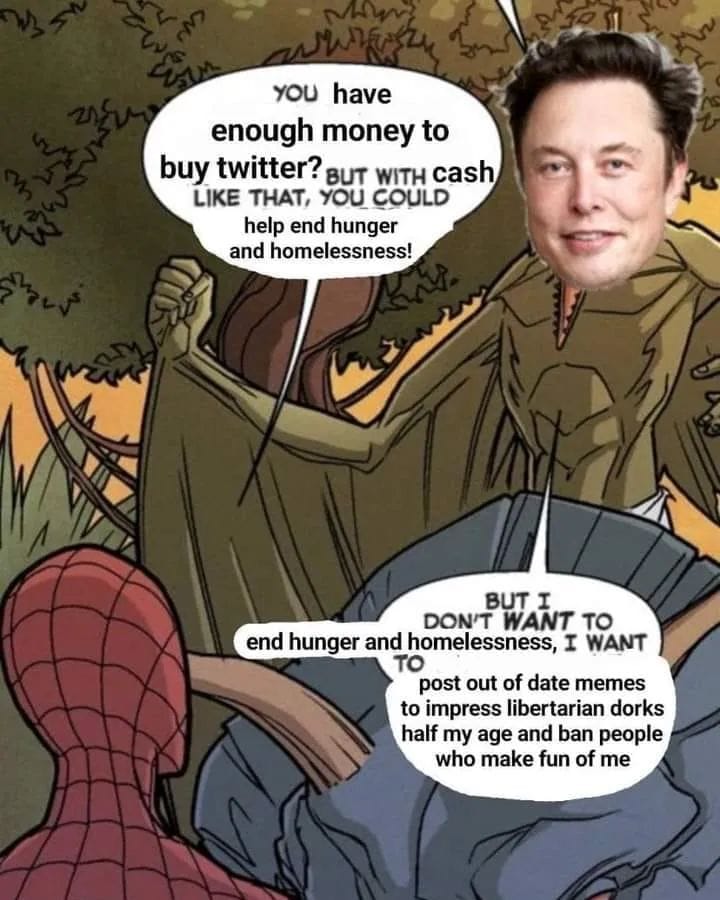
This meme satirizes the wealthy by featuring Elon Musk's face superimposed on a cartoon villain who confidently believes he can fix social problems like hunger and homelessness just by buying the internet. He arrogantly boasts, "You have enough money to buy twitter? But with cash like that, you could help end hunger and homelessness!", while remaining obsessed with posting memes to impress snobbish people. From an anti-oligarch viewpoint, it highlights the hypocrisy of the elite who think their financial power is a magic wand for the world, ignoring that they are the ones causing the very suffering they claim to fix.
simple-description (llama3.2-vision_11b)
This meme is a commentary on the wealth and influence of oligarchs, using a popular meme format to critique their actions. The image shows a character from the "Spider-Man" comics, but with the face of Elon Musk, saying "I don't want to be a billionaire, I want to be a trillionaire." The text is a humorous take on the billionaire's desire for more wealth, poking fun at the idea that even a trillion is not enough.
detailed-analysis (gemma3-27b-vision)
Okay, let's break down this meme using the frameworks you requested. It's a layered image with a lot of potential for analysis, and I'll cover each section only if it truly applies to the content.
Visual Description
The image is a digitally altered comic book panel, seemingly lifted from a classic Spider-Man story. Spider-Man is shown hanging upside down, seemingly entangled in vines or vegetation. Above him, a floating head of Elon Musk is digitally imposed. Dialogue bubbles emanate from both characters.
- Spider-Man's Bubble: States "But I want to end hunger and homelessness."
- Elon Musk's Bubble: States "You have enough money to buy twitter? But with that, you could help end hunger and homelessness."
- Text at the bottom of Spider-man's bubble: "Post out of date memes to impress libertarian dorks half my age and ban people who make fun of me"
The color palette is reminiscent of classic comic book tones. The overall effect is satirical, contrasting the heroic pose of Spider-Man with the image of Elon Musk and the pointed dialogue. The addition of the extra text from Spider-man suggests a personal motive for the inaction on homelessness.
Foucauldian Genealogical Discourse Analysis
This meme provides a strong case for a Foucauldian analysis. It's not just what is being said, but how it creates a particular power dynamic and reinforces specific discourses.
- Discourse of Philanthropy/Responsibility: The dialogue engages with the discourse of philanthropic responsibility, specifically around wealth and social problems. Musk’s bubble frames the purchase of Twitter as an alternative use of wealth. The meme questions this prioritization of digital platforms over basic human needs.
- Power/Knowledge: The meme exposes how power operates through knowledge. Musk knows he has the resources to address hunger and homelessness. His power lies in his control of those resources, and the meme suggests he chooses to deploy them in ways that aren’t necessarily aligned with social good.
- Genealogy of Wealth & Priorities: We can trace the historical genealogy of how wealth accumulation has become divorced from social responsibility. This meme isn't saying Musk is uniquely bad, but rather highlights a broader trend where capital is used for personal projects (like social media acquisition) rather than alleviating suffering.
- Subjectivation and Self-Interest: Spider-Man's second bubble exposes a personal motivation for inaction - self-promotion and attention seeking. It suggests that individual identity and ego are prioritized over collective well-being.
Critical Theory
The meme operates as a critique of late capitalism and the spectacle of wealth. Several critical theoretical lenses apply:
- Commodification of Social Issues: The meme implicates the commodification of social issues. By framing ending hunger and homelessness as an alternative to buying Twitter, it implicitly suggests that both are seen as options for deploying capital – commodities to be purchased or not.
- The Spectacle: Referencing the work of Guy Debord, the meme illustrates how the spectacle (in this case, the attention surrounding a wealthy individual's purchases) distracts from real issues and reinforces a system of alienation. The focus is on what Musk does rather than on the systemic problems themselves.
- Ideology Critique: The meme implicitly critiques the ideology of meritocracy. It suggests that wealth is seen as earned and justifies individual control over resources, even when those resources could be used for the collective good.
Marxist Conflict Theory
The meme embodies several key Marxist concepts:
- Class Conflict: The image explicitly highlights the vast disparity between wealth and poverty. Musk represents the capitalist class, while the implied recipients of aid represent the working class (or those outside the system entirely).
- False Consciousness: Spider-Man represents a kind of false consciousness. He is aware of the problems but prioritizes personal gain over collective action.
- Exploitation: The underlying context is that wealth is created through a system of exploitation. The meme doesn't directly depict this, but it acknowledges the imbalance that arises from it.
- Alienation: Spider-Man's inaction represents a form of alienation—alienation from his potential to use his resources for meaningful change.
Postmodernism
The meme utilizes postmodern techniques of parody and irony to challenge the authority of wealth and philanthropy.
- Irony & Satire: The entire meme relies on ironic juxtaposition – the hero of social responsibility (Spider-Man) being confronted by a wealthy individual whose actions contradict that ideal.
- Deconstruction of Meaning: The meme deconstructs the traditional meaning of philanthropy. It suggests that philanthropy can be performative or used as a justification for other actions.
- Hyperreality: The meme is a manufactured image—a pastiche of comic book art and current events—which contributes to a sense of hyperreality. It blurs the line between the real and the simulated.
Queer Feminist Intersectional Analysis
This meme is less directly suited to a Queer Feminist Intersectional analysis, though some connections can be drawn.
- Power Dynamics & Marginalization: While not explicitly about gender or sexuality, the meme points to how power imbalances exacerbate marginalization. The homeless and hungry are already marginalized, and the hoarding of wealth further disadvantages them.
- Patriarchal Capitalism: The meme implicates the ways in which patriarchal structures contribute to capitalist exploitation. The prioritization of personal gain and the accumulation of wealth are often linked to masculine ideals of dominance and control.
- Invisible Labor & Care Work: The meme implicitly highlights the invisible labor of care work that is often devalued in capitalist society. The needs of the homeless and hungry require resources, time, and effort—labor that is often performed by marginalized communities.
Let me know if you'd like me to expand on any of these analyses or explore different frameworks.
simple-description (llama3.2-vision)
This meme is a play on a classic Spider-Man comic book panel. In the original, Spider-Man is trapped in a spider's web, and he's trying to escape. In this meme, the character is replaced with Elon Musk, and his speech bubbles are filled with humorous and sarcastic comments about his online presence. The text in the image includes: "You have enough money to buy Twitter? But with cash like that, you could help end hunger and homelessness! But I don't want to end hunger and homelessness, I want to post out of date memes to impress libertarian dorks half my age and ban people who make fun of me."
tesseract-ocr
co J a\’ fo 9 Y er a y yOU have el 3 enough money to f buy twitter? guy witu cash, LIKE THAT, YOU COULD help end hunger = and homelessness! i \ = af j P yf | 7S 3 , \e Pr | Y 4 7i~* BUT I DON’T WANT TO | end hunger and homelessness; T WANT | ' post out of date memes \ Ss to impress libertarian dorks . half my age and ban people who make fun of me