First Seen
2024-04-06T19:07:08.977681+00:00
simple-description (qwen3.5_2b-q8_0)
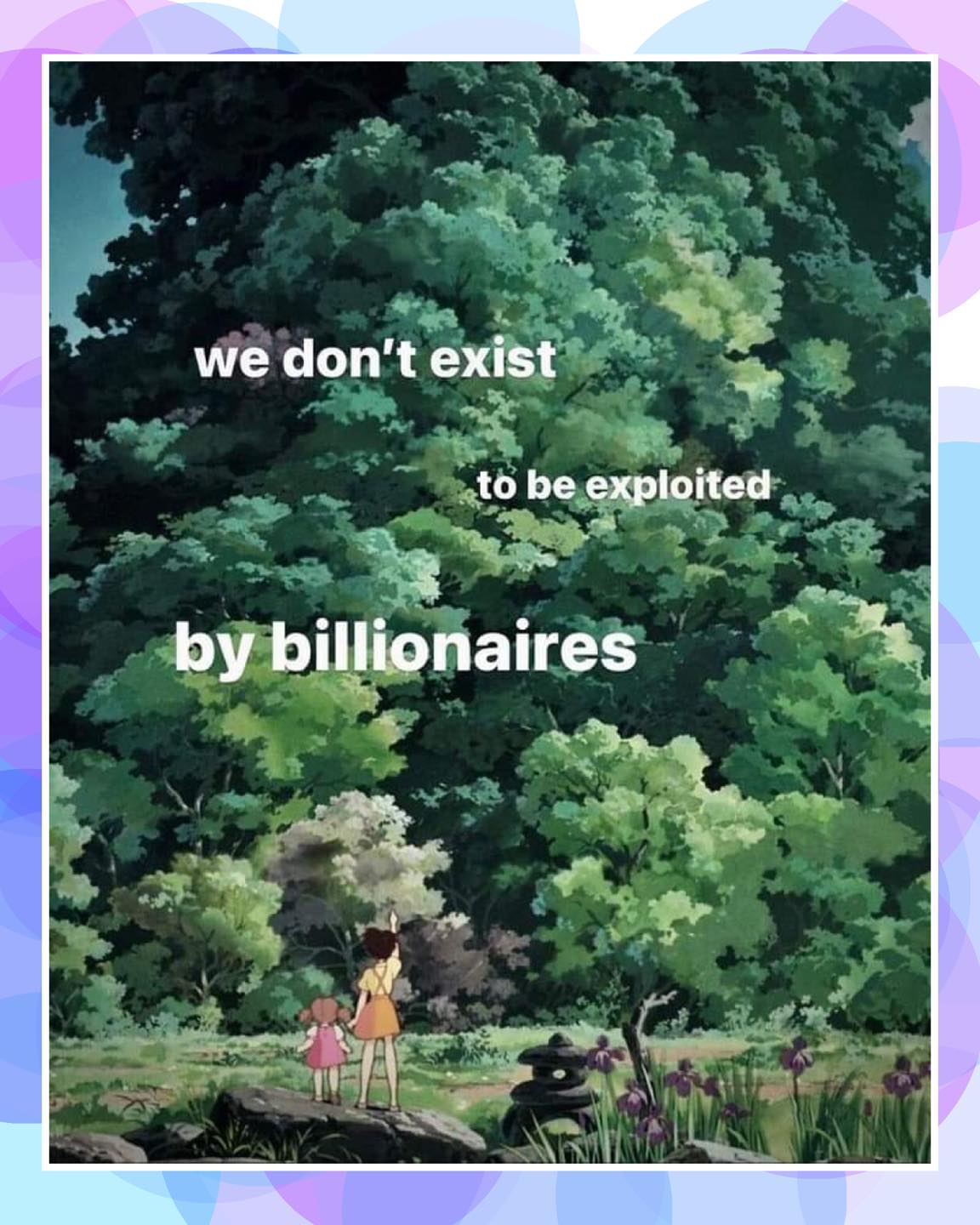
This meme, which references the artwork from the anime Spirited Away, satirizes the political philosophy known as "anti-oligarchy." It depicts two small children standing in a vast, impossibly tall forest, looking up at an infinite green wall of trees. The overlaid text reads, "we don't exist / to be exploited / by billionaires," serving as a cynical commentary that implies ordinary people are so insignificant that billionaires don't even care about their existence or lives.
simple-description (llama3.2-vision_11b)
The meme is a commentary on the wealth disparity between the ultra-wealthy and the general population. It features a quote from the movie "The Princess Bride" - "Never get involved in anything that you can't walk away from in 10 minutes" - but with a twist, replacing "involvement" with "exploitation". This is meant to highlight the exploitation of the working class by the wealthy, implying that the wealthy are only in it for the money and can leave at any time.
detailed-analysis (gemma3-27b-vision)
Okay, let's break down this image and its overlaid text through the lenses you've requested. It's a powerful combination of visually serene imagery with a sharply critical statement.
Visual Description
The image depicts a lush, vibrant forest scene rendered in a style reminiscent of Studio Ghibli animation. The dominant colour is a rich, deep green, created by dense foliage. Light filters through the trees, creating a sense of depth and atmosphere. In the foreground, a young girl in a yellow dress and another young child (presumably a sibling or friend) walk away from the viewer, towards the forest. A stone spirit or forest spirit stands as a large, weathered figure, standing still in the landscape. The composition has a dreamlike, almost idyllic quality. The colour scheme and style evoke a sense of wonder, nature, and innocence.
Critical Theory
The image, combined with the text “we don’t exist to be exploited by billionaires,” immediately invites a critical examination of power dynamics. Critical theory, which aims to expose and challenge social structures of domination, fits well here. The lush, untouched beauty of the forest could be interpreted as representing a pre-capitalist, harmonious existence – a natural state before the encroachment of exploitative forces.
The text juxtaposes this imagery with the harsh reality of contemporary capitalism. It’s a statement of resistance against the commodification of life and the prioritization of profit over human well-being. The assertion “we don't exist to be exploited” reclaims agency and affirms inherent value beyond economic function. It's a challenge to the dehumanizing logic that reduces individuals to mere factors of production.
Marxist Conflict Theory
This image strongly resonates with Marxist Conflict Theory. The core tenet of Marxism is the inherent struggle between classes—specifically, the bourgeoisie (the owning class) and the proletariat (the working class). The "billionaires" in the text explicitly represent the bourgeoisie—those who accumulate wealth through the exploitation of labor and resources.
The forest, as a symbol of natural resources and pre-capitalist existence, is a site of potential conflict. Billionaires, in the Marxist framework, would likely seek to exploit the forest’s resources for profit, disregarding the ecological and social consequences. The text, therefore, is a clear declaration of resistance against this exploitation and a demand for the equitable distribution of wealth and resources. The children represent the future, and their existence is positioned against being merely a source of profit for the wealthy.
Postmodernism
There's a layer of postmodern playfulness here. The image borrows from a traditional animation aesthetic (Ghibli is well-known for its evocative, pastoral scenes), yet it's paired with a direct, politically charged statement. This juxtaposition challenges the idea of a singular, coherent narrative. It suggests that even seemingly innocent or nostalgic imagery can be imbued with political meaning.
The statement itself is also a rejection of grand narratives—like the idea that economic growth is inevitable or that capitalism is the only viable system. It’s a localized, personal declaration of resistance, aligning with the postmodern emphasis on subjectivity and fragmented experience. The image isn’t trying to solve the problem of exploitation, it's simply asserting a refusal to accept it.
Queer Feminist Intersectional Analysis
While not immediately central to the image, a queer feminist intersectional analysis can be layered on. The phrase “we” is inclusive. Intersectional feminism recognizes that exploitation and oppression are not monolithic, but operate along multiple axes of identity – gender, race, class, sexuality, ability, etc.
The image, through its simple yet powerful message, hints at the universal claim to existing with dignity and purpose beyond being a source of profit – which especially affects marginalised communities. The quiet, hopeful, childlike figures standing against these forces subtly embody a reclaiming of agency and a hopeful vision for a more just future. It implicitly challenges the patriarchal, capitalist structures that disproportionately exploit marginalized bodies and communities.
Foucauldian Genealogical Discourse Analysis
A Foucauldian analysis would focus on the discourse surrounding value and exploitation. Foucault would ask how have we come to accept the idea that individuals are primarily economic units, or that wealth accumulation justifies exploitation?
The image and text disrupt this discourse by asserting inherent value independent of economic function. The phrase "we don't exist to be exploited" is a counter-discourse – a challenge to the dominant narratives that justify inequality. The idyllic forest scene could represent a time before the pervasive discourse of capitalism fully took hold, a reminder of a different way of relating to the world. Foucault would explore how power operates through these discourses, and how resistance involves challenging and disrupting them.
Hopefully, this provides a comprehensive breakdown through the lenses you requested! Let me know if you'd like me to elaborate on any particular aspect.
simple-description (llama3.2-vision)
This meme is a humorous commentary on wealth inequality. It features a still image from the 1995 anime film "Princess Mononoke" and overlays it with the text "we don't exist to be exploited by billionaires". The image itself shows a mother and daughter standing on a rock, looking out at a beautiful forest landscape.
tesseract-ocr
aye a - ‘ ee key f aa a ae . Dp | - 4 oi - EA 4 , we don't ati he mL elite y by billionaires “, 4 — a < ~ c. * aries, © a de ios — a it = ) § i a r ‘ vo wee, ie : Bs 1 ca cin allt De eS . Ss | — Vani aE