First Seen
2024-02-29T21:50:04.759975+00:00
simple-description (qwen3.5_2b-q8_0)
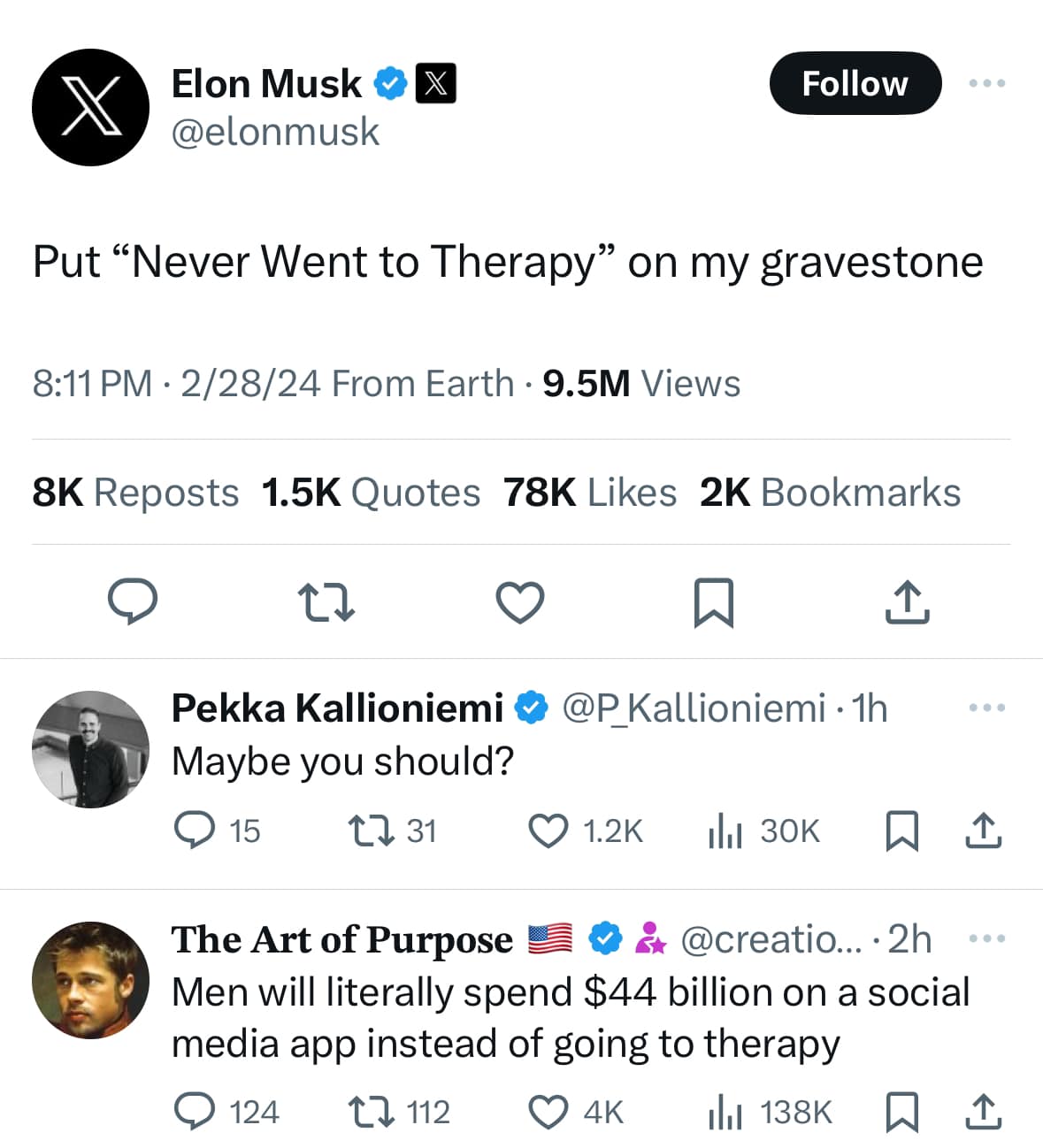
This meme is a critique of how social media platforms, run by "oligarchs" like Elon Musk, have monetized human mental health to the point where users prefer consuming apps over seeking care. The original tweet claims a lack of need for therapy, but the "Anti-Oligarch" interpretation highlights that people are willing to spend $44 billion on social media apps just to feel better, mocking the idea that the platforms are the ultimate beneficiaries of the public's desire for attention.
simple-description (llama3.2-vision_11b)
The meme is a screenshot of Elon Musk's Twitter post, where he jokingly says "I'm going to put this on my tombstone: 'I'm going to die, but at least I'll have a good tweet'". This is a humorous take on the idea of a final message or epitaph, poking fun at the idea of legacy and the importance of a good tweet in the afterlife.
detailed-analysis (gemma3-27b-vision)
Okay, let's break down this X (formerly Twitter) post and its immediate replies through the lenses of the frameworks you requested. It's important to note that applying these frameworks to a short social media exchange is necessarily interpretive and highlights potential avenues of analysis, not definitive conclusions. Some frameworks will be more applicable than others.
I. Visual Description
The image displays a screenshot of a series of posts on X.
- Top Post: Elon Musk’s profile picture (a stylized “X”) accompanies a post stating "Put 'Never Went to Therapy' on my gravestone." This post has high engagement metrics (8K Reposts, 1.5K Quotes, 78K Likes, 2K Bookmarks) shown below it.
- Second Post: A reply from Pekka Kallioniemi, showing his profile picture and the message "Maybe you should?". The post has engagement metrics (15 Reposts, 31 Quotes, 1.2K Likes, 30K views).
- Third Post: A reply from “The Art of Purpose” showing a profile picture of a Black man and the message "Men will literally spend $44 billion on a social media app instead of going to therapy.” The post has engagement metrics (124 Reposts, 112 Quotes, 4K Likes, 138K views).
The visual arrangement immediately establishes a conversational dynamic – Musk makes a provocative statement, and others respond. The high engagement metrics underscore the post’s reach and potential impact.
II. Foucauldian Genealogical Discourse Analysis
This is very applicable here. Foucault would be interested in how “therapy” and “mental health” as concepts came to be understood and regulated within a specific historical context.
- Discourse of Mental Health: Musk’s post can be seen as a rejection of the modern discourse around mental health and therapy. It subtly positions therapy as weakness or unnecessary. The very need for therapy is presented as something to be avoided, and framed as a personal achievement to "never have gone".
- Power/Knowledge: The post performs a power dynamic. Musk, as a prominent figure, wields the power to shape a narrative about mental well-being. His statement attempts to normalize a lack of self-reflection and potentially discourages others from seeking help. The fact that so many engage with the post demonstrates the reach of his power.
- Genealogy of "Self-Improvement": Foucault might trace the history of how the “self” became an object of constant work and improvement. The expectation to "fix" oneself through therapy is presented as something undesirable.
- Normalizing Non-Therapy: The post works to construct “not going to therapy” as a possible legitimate lifestyle.
III. Critical Theory
This is also highly applicable. Critical Theory, especially as rooted in the Frankfurt School, focuses on how power structures are maintained through culture and ideology.
- Ideology of Stoicism/Toughness: Musk’s statement embodies a particular ideology – a hyper-individualistic and stoic approach to life, often prevalent in certain corners of technology culture. This ideology devalues vulnerability and emotional expression, positioning them as weaknesses. The "gravestone" aspect suggests a desire to be remembered for this perceived strength.
- Culture of Overwork/Success: This links into the culture surrounding tech and entrepreneurship, where "grinding" and relentless pursuit of success are often glorified, potentially at the expense of mental well-being. The post can be seen as reinforcing this harmful norm.
- Commodification of Identity: The statement becomes a performance of identity—a deliberate presentation of oneself as someone who does not need therapy, which subtly signals superiority or resilience. This aligns with the idea that identity is increasingly constructed through consumption and displays of status.
IV. Marxist Conflict Theory
This has some applicability, though less direct.
- Class & Access to Mental Healthcare: While not explicitly stated, there's an underlying assumption that mental healthcare is a luxury or a privilege. The juxtaposition with the $44 billion purchase of X (formerly Twitter) suggests that resources are allocated to superficial pursuits (social media) instead of addressing fundamental needs like mental well-being.
- Alienation & the "Self": Marxist thought explores how capitalist systems can alienate individuals from themselves and from each other. The emphasis on self-reliance and avoiding vulnerability can be seen as a symptom of this alienation. The post implicitly suggests that success (and thus power) can insulate one from the need for connection or emotional support.
- The Role of Ideology: The post can be interpreted as serving the interests of a system that values productivity over well-being. By normalizing a lack of self-care, it reinforces the expectation that individuals should prioritize work and achievement at all costs.
V. Postmodernism
Applicable, but requires a nuanced reading.
- Deconstruction of "Self": Postmodern thought challenges the notion of a stable, coherent "self." Musk’s statement could be interpreted as a rejection of the therapeutic process of self-discovery, suggesting a belief that the "self" is fluid and doesn’t require fixing.
- Simulation & Hyperreality: The statement itself is a performance, a constructed image projected onto social media. This aligns with the postmodern idea that reality is increasingly mediated by simulation and representation.
- Irony & Parody: There is a layer of irony in the statement. Musk is known for eccentric behavior and provocative posts. The statement can be seen as a playful subversion of expectations, challenging conventional norms around mental health.
VI. Queer Feminist Intersectional Analysis
This has limited direct applicability to this specific post, but can still offer some insights.
- Masculinity & Emotional Suppression: The post reinforces traditional masculine norms that discourage emotional expression and vulnerability. The act of "never going to therapy" can be seen as a performance of hyper-masculinity.
- Access & Privilege: The implicit suggestion that therapy is a luxury underscores the intersectional barriers to accessing mental healthcare. Factors like race, class, gender identity, and sexual orientation can all impact access to these resources.
- Normalization of Harmful Behaviors: By normalizing the avoidance of therapy, the post can contribute to a culture that silences and marginalizes individuals who are struggling with mental health issues.
Important Considerations:
- Context: The full context of Musk’s online persona and his history of provocative statements is crucial for understanding this post.
- Interpretation: These analyses are necessarily interpretive and open to debate.
- Complexity: Social media exchanges are often complex and multi-layered, making it difficult to apply any single theoretical framework comprehensively.
Let me know if you'd like me to expand on any particular aspect of this analysis or explore another theoretical lens.
simple-description (llama3.2-vision)
The meme is a screenshot of a Twitter post from Elon Musk's account. The post reads: "Put 'Never Went to Therapy' on my gravestone." Below the post, there are several replies, including one from a user named Pekka Kallio, who responds with "Maybe you should?" The meme is a humorous take on the idea of someone not wanting to seek help for mental health issues.
tesseract-ocr
Elon Musk @&@ Gz @elonmusk Put “Never Went to Therapy” on my gravestone 8:11 PM - 2/28/24 From Earth: 9.5M Views 8K Reposts 1.5K Quotes 78K Likes 2K Bookmarks QO td Qo A 4% Pekka Kallioniemi @ @P Kallioniemi - th Maybe you should? © 15 tT) 31 012k in 30K WL & The Art of Purpose @ @ & @creatio...-2h Men will literally spend $44 billion on a social media app instead of going to therapy O24 th12 0 4k ii13sk fl &