First Seen
2024-07-30T19:59:46.790823+00:00
simple-description (qwen3.5_2b-q8_0)
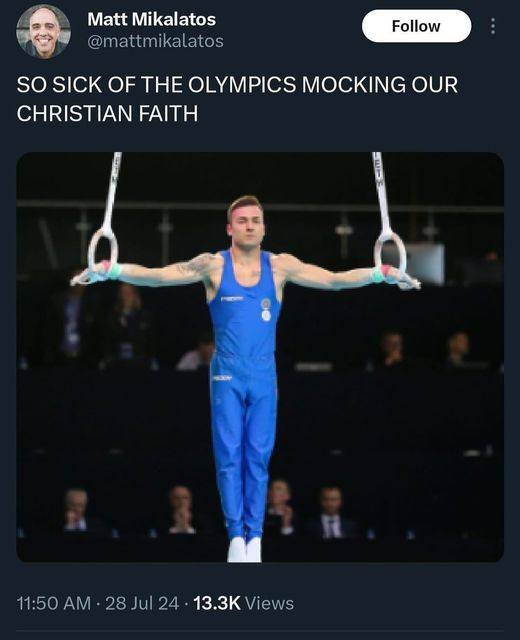
In an anti-oligarch context, the meme personifies the wealthy elite as "gymnasts"—powerful figures using the Olympics as a platform to mock the common people's religious beliefs. The text "SO SICK OF THE OLYMPICS MOCKING OUR CHRISTIAN FAITH" expresses a defiant refusal to stand by while the oligarchs (the rich/powerful) disrespect the faith of the masses by treating their beliefs with contempt. The visual of the dignified athlete highlights the absurdity of the elite mocking the "weak" faith of the people.
simple-description (llama3.2-vision_11b)
The meme is a photo of a gymnast performing a routine on the rings, but with a twist. The caption "So I'm just going to go ahead and say it" is a play on words, implying that the gymnast is about to reveal a shocking truth, but instead, they're just going through the motions of their routine. The meme is poking fun at the idea that someone is going to reveal a deep secret, but it's actually just a mundane task.
detailed-analysis (gemma3-27b-vision)
Okay, here's an analysis of the image and tweet, broken down into the requested theoretical frameworks, with clear headings for each. It's important to note that applying these theories to a single image/tweet requires some interpretive stretching and focuses on potential readings.
Image Description
The image depicts a male gymnast performing on the rings. He's wearing a blue gymnastics leotard. The background is dark, suggesting an indoor arena, and there are blurred figures of spectators in the distance. The lighting is dramatic, highlighting the gymnast and the rings. He is in a strong, suspended position, demonstrating strength and control. The composition focuses on the physical prowess and athleticism of the athlete.
Foucauldian Genealogical Discourse Analysis
This post can be viewed through a Foucauldian lens examining the discourse surrounding religion, athleticism, and national identity.
- Power/Knowledge: The tweet implies a power dynamic where the Olympics are perceived to be exerting a form of 'power' over, and even actively undermining, Christian faith. It positions the Olympics as an institution wielding a particular "knowledge" (or, in this case, an implied secular worldview) that contradicts religious beliefs. This isn’t about literal power but about the influence of institutional narratives.
- Genealogy: Historically, the modern Olympics emerged alongside the rise of secularism and scientific rationalism. A genealogical approach would trace the historical shifts that have positioned sport as a separate sphere from religion, perhaps even a competing one for individuals’ loyalty and identity. It would also examine how discourses around physical perfection and national pride have evolved over time.
- Discipline & Subjectivation: Gymnastics, with its emphasis on precise body control, discipline, and repetitive training, embodies a form of “discipline” in the Foucauldian sense. The athlete is “subjected” to these regimes of training and evaluation, shaping their body and self-understanding. The tweet's author projects a grievance onto this disciplined spectacle, seeing it as an affront to their own self-understanding rooted in religious faith.
Critical Theory
From a Critical Theory perspective, this tweet exposes a concern about the culture industry and its impact on values.
- Commodification of Spectacle: The Olympics are a heavily commodified spectacle. The tweet's author seemingly perceives this spectacle as prioritizing secular, athletic achievement over traditional religious values. They feel that the focus on physical prowess and national competition is actively displacing a religious worldview.
- Ideological Critique: The author's statement suggests a critique of the underlying ideology of modern society – one that prioritizes material achievement, physical prowess, and national identity over spiritual values. They see the Olympics as a manifestation of this ideology.
- False Consciousness: One could argue the author might be experiencing a form of "false consciousness," failing to recognize the complex relationship between sport, culture, and religion. The focus on spectacle could distract from deeper social and political issues.
Marxist Conflict Theory
Through a Marxist lens, the tweet can be interpreted as an expression of cultural conflict arising from the contradictions of late-stage capitalism.
- Superstructure vs. Base: The Olympics represent a part of the "superstructure" of society (cultural institutions, ideologies) built upon the "base" (economic relations). The tweet suggests a conflict between the dominant ideology promoted by the Olympics (individual achievement, national pride) and the author's religious beliefs.
- Alienation: The author might feel "alienated" from the dominant culture, perceiving the Olympics as a symbol of a society that has abandoned traditional religious values in favor of materialism and spectacle.
- Class & Culture: Though not explicitly stated, there could be an implicit critique of the elitism and commercialization of the Olympics, which often cater to wealthy sponsors and spectators. This is a stretch, but aligns with Marxist concern of unequal access.
Postmodernism
A postmodern reading centers on the fragmentation of meaning and the rejection of grand narratives.
- Deconstruction of Values: The tweet indicates a resistance to what the author perceives as the imposition of secular values onto a religious worldview. It points to the breakdown of shared moral frameworks, where one person's "truth" (religious faith) is challenged by another's (secular athletic achievement).
- Rejection of Metanarratives: The author implicitly rejects the “metanarrative” of progress and secularization often associated with modernity. They resist the idea that secular values are inherently superior to religious ones.
- Simulation & Hyperreality: The spectacle of the Olympics can be seen as a form of “simulation” – a representation of reality that has become detached from the “real.” The tweet suggests a discomfort with this hyperreality, a feeling that authentic values are being replaced by artificial displays.
Queer Feminist Intersectional Analysis
This is the most difficult framework to apply directly, but potential interpretations exist:
- Contested Bodies: Gymnastics is a sport that often involves highly scrutinized and disciplined bodies. The sport places demands on the body and can be related to issues of body image, objectification, and gender performance. This is further compounded by historical associations between hyper-masculinity and gymnastics (though this is changing).
- Dominant Norms: The tweet could be interpreted as a defense of traditional religious values against what the author perceives as the encroachment of secular norms. However, this could also be seen as upholding patriarchal or heteronormative values that marginalize other identities.
- Intersection of Identities: The author’s religious identity intersects with their other identities (gender, race, class, nationality). The tweet reflects a specific positionality and worldview that is shaped by these intersecting identities. It is important to note the lack of inclusivity. This post does not address the plight of LGBTQ+ athletes, nor women in sports.
Disclaimer: These analyses are interpretations based on the image and tweet provided. There are many possible readings, and these are just a few perspectives. Applying these complex theoretical frameworks often involves a degree of speculation.
simple-description (llama3.2-vision)
The meme features a photo of a gymnast performing on the rings, with his arms outstretched and his body in a stretched position. The image is accompanied by the text "SO SICK OF THE OLYMPICS MOCKING OUR CHRISTIAN FAITH". The meme is likely making a joke about the Olympics being too secular and not acknowledging the Christian faith, with the gymnast's pose being a humorous representation of the Olympics' lack of Christianity.