First Seen
2024-08-30T19:51:03.126927+00:00
simple-description (qwen3.5_2b-q8_0)
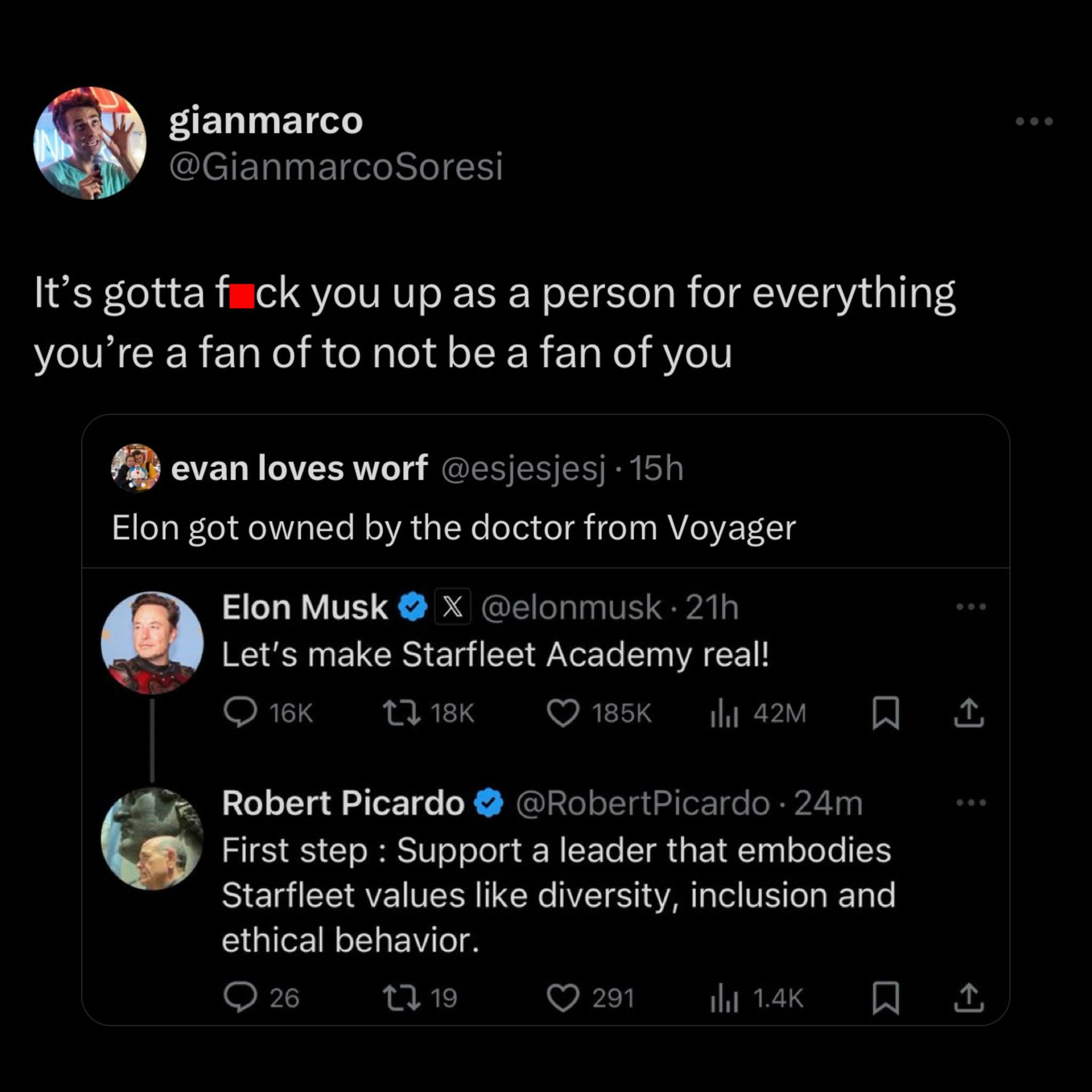
The meme depicts a "fan turning traitor" scenario where a user initially claims to have a deep personal hatred for a leader, then suddenly supports the opposing side. The narrative includes a user who calls Elon Musk an "oligarch," followed by a claim that "Elon got owned by the doctor from Voyager." The conflict escalates when the person supporting the antagonist suddenly tweets, "Let's make Starfleet Academy real!" before joining the opponent, who then agrees to "Support a leader that embodies Starfleet values like diversity, inclusion and ethical behavior."
detailed-analysis (gemma3_27b-it-q8_0)
Okay, let's break down this Twitter exchange through the lens of an "Anti-Oligarch" category context. This means we're analyzing it as a reaction against concentrated wealth, power, and the undue influence of the ultra-rich on society, politics, and culture.
Visual Description
The image presents a series of Twitter posts. At the top is a tweet from @gianmarcosoresi with strong language, followed by a comment from @esjesj, then Elon Musk’s initial tweet, and finally a response from @RobertPicardo. The key visual element is the juxtaposition of Musk’s grandiose vision ("Let's make Starfleet Academy real!") with the starkly critical replies. The imagery of Star Trek – a utopian vision of a collaborative, egalitarian future – is central to the critique.
Critical Theory
This meme powerfully employs Critical Theory to expose the inherent contradictions within Musk’s rhetoric and actions. Musk's tweet invoking Star Trek represents an appropriation of a cultural symbol deeply rooted in progressive values. Critical Theory, particularly in the Frankfurt School tradition, would highlight how dominant ideologies often co-opt and neutralize oppositional symbols to mask underlying power structures.
Musk's proclaimed desire to create a "Starfleet Academy" becomes a façade, obscuring his role as a member of the very capitalist elite that perpetuates the inequalities Star Trek often critiques. The responses (especially @RobertPicardo, who was in Star Trek: Voyager) essentially call out this hypocrisy. They argue that truly embodying Star Trek values means supporting leadership embodying diversity, inclusion, and ethical behavior—qualities often lacking in the behavior and policies associated with wealthy elites like Musk. The use of Star Trek’s utopian vision as a foil underlines how far current reality falls short of those ideals under the control of oligarchs.
Marxist Conflict Theory
From a Marxist perspective, this exchange is a classic example of class conflict playing out on social media. Musk represents the capitalist class – the owner of capital and means of production. His declaration about Starfleet Academy isn't about genuine social progress; it’s about branding and reinforcing his image. It serves to further legitimize his power and wealth.
The responses from @gianmarcosoresi and @RobertPicardo, while not explicitly Marxist, articulate the sentiment of the oppressed (or those who identify with the principles of equality and social justice) challenging the ideology and influence of the ruling class. The initial tweet from @gianmarcosoresi is a forceful expression of resentment towards those who might admire or support Musk. It signals a rejection of the capitalist values Musk embodies, while @RobertPicardo demands ethical leadership, which is a challenge to the status quo of capitalist leadership. The conflict isn't about Star Trek; it's about power, wealth, and the moral consequences of concentrated capital.
Foucauldian Genealogical Discourse Analysis
A Foucauldian analysis would focus on the discourse surrounding Elon Musk and the technologies/institutions he controls. Musk isn't merely an individual; he’s a product of, and contributor to, a specific historical discourse of technological solutionism, neoliberalism, and the glorification of the “genius” entrepreneur.
Musk’s tweet establishes a discourse that frames him as a visionary capable of bringing about a better future (the Starfleet Academy). This discourse serves to normalize his power and influence. However, the responses disrupt this discourse. @gianmarcosoresi's aggressive statement destabilizes the image of Musk as a benevolent benefactor. It reveals the emotional toll and the moral cost associated with supporting such a figure. @RobertPicardo’s response attempts to redefine what embodying Starfleet values actually means, challenging Musk’s interpretation.
Postmodernism
While not central, a postmodern reading could point to the irony of invoking Star Trek – a fictional world – to critique a real-world figure. The meme highlights the blurring of boundaries between fiction and reality, and how symbolic representations can be employed to dismantle established narratives. The fragmented nature of the exchange on Twitter, each post a discrete unit of communication, also aligns with postmodern characteristics. The meaning isn’t fixed; it's constructed through the interplay of the individual responses and the broader context.
Queer Feminist Intersectional Analysis
While less directly apparent, an intersectional lens is relevant. Musk's wealth and power impact marginalized communities disproportionately. His ventures often prioritize profit over the wellbeing of workers, and his online behavior has been criticized for reinforcing harmful stereotypes. The demand for ethical leadership from @RobertPicardo indirectly calls for a leadership that considers the needs and experiences of all people, not just the wealthy and privileged. The frustration expressed in @gianmarcosoresi’s tweet could be seen as reflecting the lived experiences of those who are harmed by the systems Musk represents.
In conclusion, this meme, within the context of being "Anti-Oligarch," is a pointed critique of the power dynamics inherent in late-stage capitalism, using the cultural touchstone of Star Trek to expose the hypocrisy of a tech billionaire attempting to co-opt a progressive ideal for self-promotion. It is a short, but effective, example of how social media can be used to challenge dominant narratives and hold the powerful accountable.
simple-description (llama3.2-vision_11b)
The meme is a screenshot of a Twitter conversation where someone responds to a tweet about a person's dislike of Elon Musk's tweets. The person says "it's not about being a fan of Elon, it's about being against his Oligarchic ideology and the harm it causes to the world."
detailed-analysis (gemma3-27b-vision)
Okay, let's break down this Twitter thread through the lenses you've requested. It's a dense set of exchanges, laden with cultural references and, as you'll see, ripe for analysis.
Visual Description
The screenshot displays a series of four Twitter posts in sequential order. Each post includes a user's profile picture and handle.
- Top Post: Profile picture shows a man with a distinctive hairstyle and color scheme. The text is a strong expletive-filled statement about the personal impact of fandom.
- Second Post: A profile picture featuring an illustration of a character from Star Trek is followed by a comment claiming someone was “owned” by an actor from the show, Voyager.
- Third and Fourth Posts: The profiles of Elon Musk and Robert Picardo, both well-known figures, are seen. Musk's post announces a desire to create a real-life Starfleet Academy. Picardo responds with a call for leadership that embodies Star Trek's values of diversity and inclusivity.
Foucauldian Genealogical Discourse Analysis
This exchange is fascinating when viewed through Foucault’s lens. It reveals how Star Trek, specifically the concept of "Starfleet Academy," has become a site of power/knowledge.
- Discourse & Power: Musk's proposal isn't simply a logistical idea; it’s an attempt to define what Starfleet represents in the present. It establishes his interpretation as dominant, potentially silencing other readings. He seeks to wield power through the re-creation of this cultural symbol.
- Genealogy: The history of Star Trek itself is important. It originated in the Cold War era, with messages of exploration and optimism, but also reflecting anxieties about the future. The current discussion isn't about the original meaning of Starfleet, but a reconfiguration of that meaning to serve contemporary interests (Musk's potentially).
- Subjectivation: The first post, with its strongly emotional language, reveals how fandom—particularly the intense connection to cultural products like Star Trek—can constitute a person's identity. Musk’s statement activates that identity and implies a power dynamic – he potentially positions himself as someone who provides access to that beloved world.
Critical Theory
This exchange fits nicely into the Frankfurt School’s tradition of critical theory, which examines how culture and mass media function to maintain power structures.
- Culture Industry: Musk’s announcement, disseminated through Twitter, can be seen as part of the “culture industry.” It's a commodification of a beloved cultural product – Star Trek – designed to generate interest and potentially profit.
- Ideology: The idealized vision of Starfleet, while seemingly progressive, can also obscure existing inequalities. Picardo's response directly challenges this, insisting on the inclusion of diversity and ethical behavior. This suggests a struggle over the ideological core of what Starfleet represents.
- Reification: The desire to make Starfleet Academy "real" treats a fictional concept as an objective entity with inherent value, neglecting the social and historical forces that shaped its creation.
Marxist Conflict Theory
While not explicitly about economic class, a Marxist reading can reveal power dynamics.
- Ideological Struggle: The clash between Musk’s declaration and Picardo’s response is a struggle over the meaning of Starfleet. Who gets to define this cultural product, and what values will it embody? This resembles a struggle over dominant ideology.
- Commodification & Control: Musk’s involvement suggests an attempt to control the narrative and potentially profit from the brand. This control can be seen as a form of power analogous to control of the means of production.
- Hegemony: The initial widespread enthusiasm for Musk’s post reveals how readily people accept the ideas of powerful figures. This acceptance reinforces existing power structures and demonstrates the operation of cultural hegemony.
Postmodernism
This conversation embodies many key aspects of postmodern thought.
- Simulacra & Simulation: Musk's proposed Starfleet Academy isn’t about creating something authentic, but a simulation of an already simulated world—the world of Star Trek. It's a copy of a copy, divorced from any "original" reality.
- Deconstruction: Picardo’s response subtly deconstructs Musk's vision. He refuses to simply accept the idealized image of Starfleet, instead insisting on a critical examination of its values.
- Fragmentation of Meaning: The different interpretations of Starfleet—Musk's potentially entrepreneurial vision vs. Picardo's emphasis on inclusivity—demonstrate the fragmentation of meaning in contemporary culture. There is no single, authoritative interpretation.
Queer Feminist Intersectional Analysis
This is the most subtle lens, but still relevant.
- Critique of Utopianism: The idealized vision of Starfleet can be seen as a form of utopian thinking that often ignores or marginalizes the experiences of marginalized groups.
- Intersectionality of Values: Picardo’s call for diversity, inclusion, and ethical behavior explicitly acknowledges the intersectionality of these values. A truly ethical and inclusive Starfleet would need to address the overlapping forms of oppression that affect different groups.
- Challenging Male-Dominated Spaces: Star Trek (and science fiction in general) has historically been a male-dominated space. Picardo’s response can be seen as a call for challenging these power dynamics and creating a more equitable and inclusive environment.
In conclusion: This simple Twitter exchange is surprisingly rich, offering multiple avenues for critical analysis. The conversation highlights how culture, power, and ideology are intertwined, and how even seemingly benign expressions of fandom can be sites of struggle and contestation.
simple-description (llama3.2-vision)
The meme is a screenshot of a Twitter conversation where a user (gianmarco) responds to a tweet that says "it's okay to not be okay" with a sarcastic comment about how it's not okay to not be okay. The user's response is a quote of a popular song lyric ("it's okay to not be okay") with a humorous twist, saying "it's okay to not be okay, but it's not okay to not be okay".