First Seen
2023-05-10T21:03:24+00:00
simple-description (llama3.2-vision_11b)
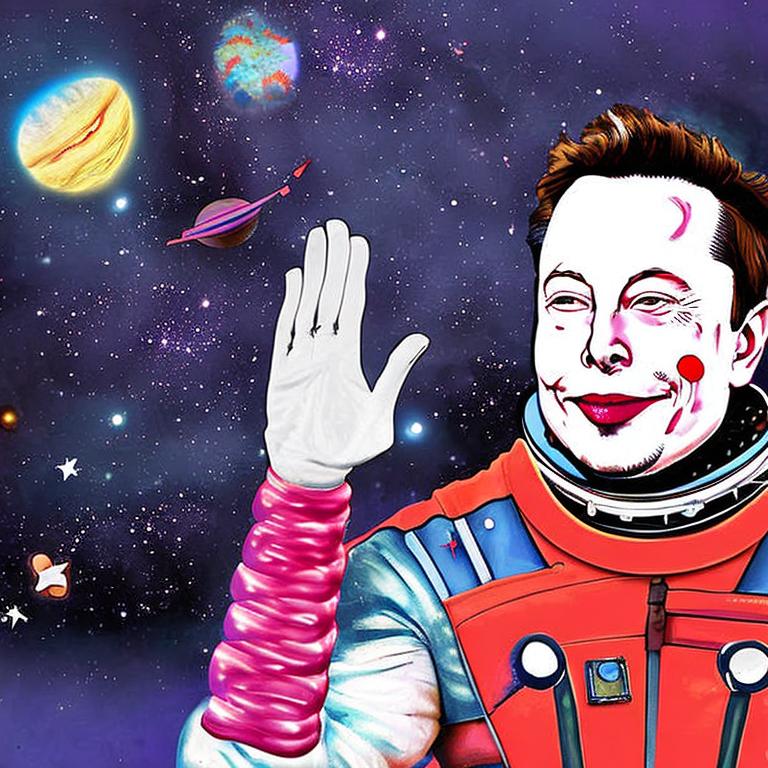
The meme depicts a cartoon image of a man with a mischievous grin, wearing a red and blue superhero suit, with a bold, red "X" marked through his face. The text "I can see your X" is written above the image. The meme is a play on the phrase "I see your X" which is a sarcastic way of saying "I know what you're trying to do" or "I'm not falling for it."
detailed-analysis (gemma3-27b-vision)
Okay, let's break down this striking image using the frameworks you've requested. It's a rich visual and opens to several lines of analysis.
Visual Description
The image is a digital painting depicting Elon Musk, but not in a straightforward manner. His face is painted with clown makeup – exaggerated red lips, a single red circle on one cheek, and overall pale, doll-like features. He is depicted wearing a retro-futuristic, bright red and blue spacesuit, the style reminiscent of 1950s sci-fi imagery. He raises a gloved hand in a greeting or wave.
The background is a vibrant, speckled space scene with planets and stars. The planets are stylized, colorful, and seem to suggest a whimsical, almost cartoonish cosmos. Overall, the artwork combines a recognizable portrait with elements of performance, satire, and futuristic fantasy. The contrast between Musk's celebrity status, the clown makeup, and the space setting creates a jarring and thought-provoking visual.
Foucauldian Genealogical Discourse Analysis
This image begs for a Foucauldian reading. The clown makeup isn’t just a stylistic choice; it's a discursive marker. The clown figure has a rich history as both a figure of entertainment and one of societal critique, often positioned as the "fool" who can speak truth to power because they are not bound by societal norms.
Here's how a genealogical approach might unfold:
- Historical Power/Knowledge: Historically, the figure of the "entrepreneur" (like Musk) is constructed through discourses of innovation, progress, and wealth accumulation. These discourses create the power/knowledge relationship – the way in which knowledge is linked to power, and how power dictates what is considered legitimate knowledge.
- The Disruptive Discourse of the Clown: The clown disrupts this discourse. The clown represents chaos, subversion, and a refusal to take things seriously. It exposes the absurdity of systems. By applying the clown persona to Musk, the artwork asks us to question the legitimacy of his power and the narratives surrounding him.
- Archeology of the "Tech Bro": The image could be seen as excavating the archetype of the "tech bro" – the often-unaccountable, hyper-masculine, and idealistic founder/CEO figure. The clown makeup strips away the veneer of seriousness, revealing the potential for performance and artifice at the core of this persona.
- Genealogical Trajectory: Tracing the trajectory of this discourse, one might see a shift in public perception of tech leaders. Initially celebrated as visionaries, there's growing critique of their unchecked power and potential for exploitation. This image can be viewed as a symptom of that shift – a questioning of the foundations of that power.
Critical Theory
From a Critical Theory perspective, this image is a clear example of art as a form of social commentary. The artist is not simply presenting a portrait but is critiquing the power structures surrounding a prominent figure like Elon Musk.
- Ideology and Power: The image challenges the ideology of techno-utopianism often associated with Musk and Silicon Valley. Techno-utopianism suggests that technology can solve all of humanity's problems, often ignoring the social, economic, and political factors at play. The clown imagery subverts this optimistic narrative. It suggests that technology, like all tools, can be used for both good and ill and is often driven by self-interest.
- Deconstruction of the Persona: The painting deconstructs Musk's carefully cultivated public persona. He's often presented as a serious, visionary leader. By painting him as a clown, the artist exposes the constructed nature of this image. The makeup emphasizes artifice and performance, suggesting that Musk is playing a role.
- Cultural Critique: The image can be seen as a broader critique of celebrity culture and the way in which powerful figures are often idolized and shielded from accountability. The artist is asking us to look beyond the hype and examine the real consequences of Musk's actions.
- The Spectacle: This work evokes Guy Debord's concept of the spectacle, where images and appearances become more important than reality. Musk, as a public figure, exists within a mediated spectacle, and the clown makeup highlights the theatricality and constructed nature of his image.
Marxist Conflict Theory
A Marxist reading would focus on the inherent class conflict and power dynamics at play:
- The Bourgeoisie and the Proletariat: Elon Musk represents the epitome of the modern capitalist, the owner of vast wealth and the means of production (Tesla, SpaceX, etc.). The clown makeup ironically highlights the absurdity of extreme wealth disparity. Clowns traditionally occupy a space outside the established social order, representing a rejection of conventional power structures.
- Commodification of Identity: Musk's personal brand is heavily commodified. He sells a vision of the future through his companies. The clown makeup deconstructs this branding, suggesting that it is a performance.
- False Consciousness: The artwork might be interpreted as an attempt to pierce through the "false consciousness" of those who uncritically accept the narratives promoted by powerful figures like Musk. It forces viewers to question the motivations behind his actions and the impact of his companies on workers and society.
- Alienation: The image could be interpreted as a comment on the alienation of labor and the dehumanizing effects of capitalism. The clown represents a loss of authenticity and a reduction to a spectacle.
Postmodernism
The image embodies many characteristics of Postmodernism:
- Pastiche and Irony: The combination of a realistic portrait, clown makeup, and retro-futuristic spacesuit is a clear example of pastiche – a playful imitation of different styles and eras. The irony lies in juxtaposing the seriousness of space exploration with the silliness of the clown figure.
- Deconstruction of Grand Narratives: Postmodernism rejects "grand narratives" – overarching explanations of history or reality. The image challenges the techno-utopian narrative often associated with Musk, suggesting that it is a flawed and incomplete vision of the future.
- Simulation and Hyperreality: The image creates a hyperreal effect – a simulation of reality that is more intense and artificial than the real thing. This reflects the postmodern condition, where media and technology have blurred the lines between reality and representation.
- Subjectivity and Fragmentation: The image reflects the postmodern emphasis on subjectivity and fragmentation. There is no single, authoritative interpretation of the work. The meaning is open-ended and depends on the viewer's own perspective.
Queer Feminist Intersectional Analysis
This is arguably the most complex application but potentially insightful.
- Disrupting Masculinity: Elon Musk, as a hyper-masculine tech mogul, embodies a specific performance of traditional power. The clown makeup, historically a performance of gender and often transgression, disrupts this, queering his image.
- The Grotesque and the Subversive: The clown figure, leaning into the grotesque, is a long-standing tradition of social commentary. It allows for the critique of authority figures without directly confronting them, allowing a kind of sideways attack. This can be seen as aligning with feminist strategies of subversion.
- Intersectionality of Power: The image subtly nods to the intersectionality of power. Musk's wealth, privilege, and status intersect to create a particularly potent form of dominance. The clown makeup can be interpreted as an attempt to dismantle this structure, exposing the underlying artifice.
- Reclaiming the Spectacle: Feminist and queer artists often reclaim the spectacle – using it as a space for visibility and resistance. This image can be seen as a similar gesture – using the figure of a powerful man to create a disruptive and provocative work of art.
Important Note: These are interpretations. The artwork is open to many readings, and the artist's intent may differ from these analyses. The power of the work lies in its ability to provoke thought and challenge assumptions.
simple-description (llama3.2-vision)
The meme is an image of Elon Musk, but his face has been replaced with a clown's, and his suit is also modified to look like a clown's. The image is captioned "I'm not a clown, I'm a space clown". The image is meant to be humorous and absurd, poking fun at Elon Musk's eccentric personality and his ambitions in space exploration.
tesseract-ocr
oo) ee “Y 2 e. ip - PZ