First Seen
2024-11-13T08:05:43.340219+00:00
simple-description (qwen3.5_2b-q8_0)
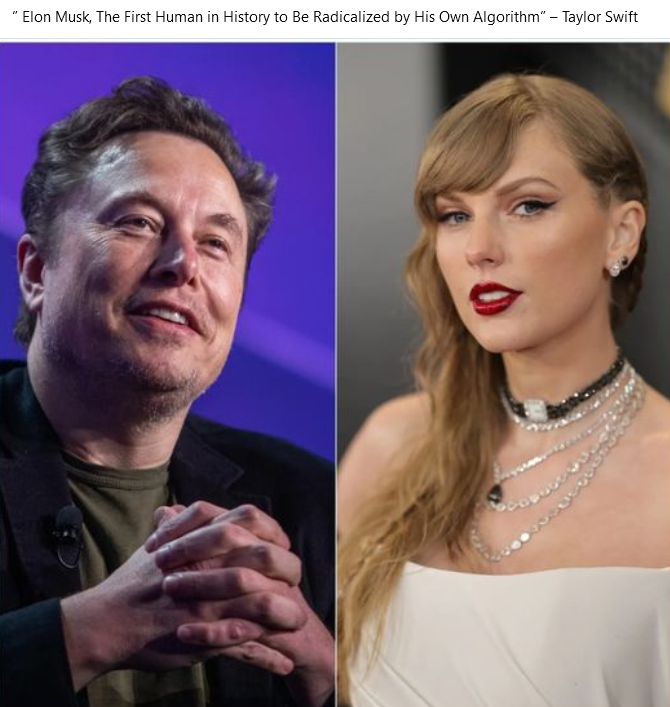
This meme is a satirical take on the "anti-oligarch" movement, which criticizes the tech elite for creating a self-serving power structure that manipulates democracy. By suggesting Elon Musk was the first human "radicalized" by his own algorithm, the image frames his company as the sole source of modern political chaos and polarization. It argues that because their algorithms dictate the political landscape, the tech oligarchy's influence is the defining feature of the current era, and the "first human" was the first victim of this destructive tech-driven oligarchy.
detailed-analysis (gemma3_27b-it-q8_0)
Okay, let's break down this meme – "Elon Musk, The First Human in History to Be Radicalized By His Own Algorithm" – through the lens of an "Anti-Oligarch" category, utilizing relevant theoretical frameworks where applicable.
Overall Category Context: An "Anti-Oligarch" perspective focuses on critique of concentrated wealth and power, often examining how individuals accumulate excessive control over resources, institutions, and public discourse. It highlights the risks this poses to democracy, social equity, and individual freedoms. This meme is playing into that critique by suggesting the ultimate irony of a billionaire being shaped, or 'radicalized', by the tools he controls.
1. Visual Description
The meme juxtaposes two images. On the left, we have Elon Musk, depicted in a fairly casual pose, hands clasped, a slight smile playing on his lips. The framing suggests a confident, approachable, and potentially disarming image. On the right is Taylor Swift, styled in a glamorous and polished manner, appearing assertive and poised. The contrast is deliberate: Musk, the archetype of tech-bro disruptor, versus Swift, a popular and increasingly outspoken cultural figure. The visual choice immediately sets up a power dynamic (or a perceived shift in power).
2. Foucauldian Genealogical Discourse Analysis
Michel Foucault's work is highly relevant here. His concept of discourse describes systems of thought, language, and practices that shape our understanding of the world and ourselves. The meme highlights a new discourse forming around Musk – a discourse of self-radicalization driven by the very tools of control he wields (specifically, algorithms).
- Genealogy: We can see a lineage of power manifesting in this meme. Historically, those in positions of wealth and power often dictated narratives. But this meme suggests a disruption: Musk’s own algorithms, designed for control, have ironically created an echo chamber that has amplified extreme viewpoints to Musk himself. It's a perversion of the power dynamic; the tool turns on its master.
- Power/Knowledge: Foucault argues that power and knowledge are inextricably linked. Musk possesses immense economic and technological power, and this gives him a platform to disseminate knowledge (or misinformation). But the algorithm itself has become a source of knowledge for him, shaping his perspective. This challenges the idea of Musk as simply a creator of knowledge – he is also a subject of it.
3. Critical Theory
From a Critical Theory perspective (drawing from the Frankfurt School), the meme is a critique of the instrumentalization of reason. This means that reason, instead of being used for emancipation and human flourishing, is employed purely to achieve goals of power and control.
- The Culture Industry: The algorithm, as a key component of the "culture industry" (the production and commodification of culture), isn't simply providing information, but is shaping desires, perceptions, and ultimately, even the beliefs of those who own it. Musk's ‘radicalization’ illustrates this point – his own creation is dictating his worldview.
- Ideology: The meme implicates the potential for a self-reinforcing ideology within Musk's algorithmic bubble. He's not being subjected to diverse viewpoints; instead, he’s being fed a curated stream of information that validates and amplifies his existing biases, potentially leading to extreme positions.
4. Marxist Conflict Theory
This meme can be examined through the lens of class conflict and the inherent contradictions within capitalism.
- The Bourgeoisie and Ideology: Musk represents the bourgeoisie (the owning class) within a capitalist system. Traditionally, the bourgeoisie control the means of production and the ideological apparatus that justifies their power. But here, the "means of ideological production" – the algorithm – is seemingly acting independently, leading to a situation where even the owner of capital is subject to its influences.
- Alienation: A Marxist reading might also suggest a form of alienation. Musk, despite his control, is becoming alienated from rational discourse and objective reality, trapped within a self-created echo chamber. The algorithm has become a force against his rational self-interest, driven solely by engagement metrics and profit.
5. Postmodernism
Postmodern thought deals with the breakdown of grand narratives, the relativity of truth, and the power of simulacra (copies without originals).
- Simulacrum & Simulation: The algorithmic feed becomes a hyperreality – a simulation of reality that increasingly replaces and defines actual experience. Musk is being radicalized by a representation of reality, not reality itself.
- The Death of the Author: Ironically, in a way, the meme suggests a "death of the author" scenario for Musk. He is no longer the sole architect of his own ideology; the algorithm has become a co-creator, or even a dominant influence.
In conclusion: The meme’s power within the "Anti-Oligarch" category resides in its biting irony. It suggests that even those with the most control over technology and information are not immune to its potentially destabilizing effects. It's a cautionary tale about the dangers of unchecked power, algorithmic bias, and the potential for self-radicalization in a hyper-connected world. The inclusion of Taylor Swift adds another layer – hinting at the rise of cultural figures challenging the authority of tech billionaires.
simple-description (llama3.2-vision_11b)
The meme is a satirical image of Elon Musk and Taylor Swift, with a quote from Musk saying "I'm not a billionaire, I'm a trillionaire" and a caption implying that he's not a billionaire, but a trillionaire, in the same way that Taylor Swift is not just a singer, but a "Swiftie" (a fan of her music). The meme is poking fun at the idea that Musk's wealth is so enormous that he's not just a billionaire, but a trillionaire, and that he's using this to compare himself to Taylor Swift's devoted fan base.
detailed-analysis (gemma3-27b-vision)
Okay, let's break down this image and the accompanying text ("Elon Musk, The First Human to Be Radicalized By His Own Algorithm" - Taylor Swift) through several critical theory lenses. It’s a provocative claim, and the visual juxtaposition adds layers to its interpretation.
Please Note: This is interpretation, and critical theory allows for multiple readings. I'll provide explanations based on common understandings of these frameworks.
1. Visual Description
The image is a side-by-side comparison.
- Elon Musk: Appears in a relatively casual setting, potentially a speaking event. He is smiling, with clasped hands. The lighting and composition portray a sense of assuredness and perhaps power. His demeanor is friendly, despite his sometimes controversial online presence.
- Taylor Swift: A close-up portrait. She is glamorously made up, with a bold red lip and jewelry. Her gaze is direct and confident. Her appearance leans into a polished, carefully constructed image.
The contrast between the two is significant. Musk is presented as more approachable (though still powerful), while Swift embodies a highly curated, polished persona. The arrangement subtly positions them as contrasting figures in a current discourse.
2. Foucauldian Genealogical Discourse Analysis
This image and caption demand a Foucault-inspired analysis. The claim of being “radicalized by his own algorithm” is powerfully suggestive within a Foucauldian framework.
- Discourse & Power/Knowledge: Foucault argued power operates through discourses—systems of thought, language, and practice. Musk, through platforms like X (formerly Twitter), actively shapes discourses around technology, space exploration, and politics. The algorithm is a key mechanism of this discourse.
- Genealogy: The idea of ‘radicalization’ itself is historically specific. Traditionally, it's been associated with political or religious extremism. To apply it to Musk being influenced by his own algorithm suggests a new form of power/knowledge formation. It implies that the systems he created have, in turn, created him as a figure, shaping his beliefs and actions.
- Panopticism & Self-Surveillance: Though not direct, the algorithm, as a form of surveillance and data collection, creates a system where Musk is being constantly observed, fed information, and thus shaped by the very systems he controls. It’s a twisted form of the panopticon, where the prisoner (Musk) designs and operates the prison.
- The Subject is Constructed: The claim suggests that Musk is not a pre-existing subject with inherent beliefs, but rather a product of the algorithmic forces he unleashed.
3. Critical Theory (Frankfurt School)
From a Frankfurt School perspective (think Adorno, Horkheimer, Marcuse), the image and claim fit neatly into their critique of the ‘culture industry’ and the instrumentalization of reason.
- Commodification of the Self: Swift, in this context, can be seen as a product of the culture industry, a highly manufactured image designed for consumption. While Musk is not a performer in the same sense, his online persona and narratives are also carefully curated for specific purposes.
- One-Dimensional Man: The claim of being radicalized by the algorithm suggests a loss of critical thinking, a falling into the pre-determined patterns and echoes of the algorithmic system. It is a loss of autonomy and independent thought.
- Technological Determinism: The statement implies that technology (the algorithm) is not a neutral tool, but a force actively shaping human consciousness and behavior. It's a suggestion that humans are becoming passive recipients of technologically mediated reality.
- The Erosion of the Authentic: The image may hint at the loss of genuine human connection, with both figures being presented as manufactured representations.
4. Marxist Conflict Theory
From a Marxist perspective, the image highlights the dynamics of power and class within a technologically advanced capitalist society.
- Means of Production & Ideology: Musk owns (or controls) the "means of production" of the algorithm (the platform). This allows him to control the flow of information and shape public opinion. The algorithm, therefore, becomes an instrument of ideological control.
- Class Conflict: Musk, as a representative of the capitalist class, benefits from the algorithmic system. The image may suggest that the algorithm exacerbates existing inequalities and concentrates power in the hands of a few.
- Commodification of Culture: Taylor Swift, while incredibly successful, represents a commodified form of culture within the capitalist system. Her image and music are produced and sold for profit, reinforcing the values of consumerism.
- Alienation: The idea of being "radicalized" by an algorithm suggests a form of alienation from one's own thoughts and beliefs, a loss of agency and control.
5. Postmodernism
Postmodernism allows for the reading of the image as a playful subversion of traditional notions of self and identity.
- Simulacra & Simulation: The idea of being "radicalized" by an algorithm suggests that reality itself is becoming increasingly mediated and simulated. The algorithm creates a hyperreality, where the distinction between real and artificial becomes blurred.
- Deconstruction of Meaning: The claim can be read as a deconstruction of the traditional idea of the autonomous subject. It challenges the notion of a stable, coherent self, suggesting that identity is fluid, fragmented, and constructed through external forces.
- Meta-Narratives: The image challenges the grand narratives of progress and rationality. It suggests that technology is not necessarily a force for good, but rather a complex and ambiguous phenomenon with unintended consequences.
- Intertextuality: The juxtaposition of Musk and Swift is an example of intertextuality, where different cultural texts (their public images, their online personas) are brought together to create a new meaning.
6. Queer Feminist Intersectional Analysis
This lens is the most complex to apply directly, but not entirely irrelevant.
- Algorithmic Bias & Power Structures: Algorithms are created by humans and inevitably reflect existing biases. This can reinforce patriarchal, racist, and other oppressive structures. Musk's platform may contribute to the spread of harmful ideologies.
- Visibility & Control: Swift’s intensely curated image, while successful, is an example of the pressures placed on women to conform to specific beauty standards and gender roles. The algorithm can both amplify and constrain female voices.
- Intersectionality: The interplay of algorithms, power, and identity is complex. Algorithms can reinforce inequalities based on race, gender, class, and other social categories.
- Challenging Dominant Narratives: From a queer/feminist perspective, challenging the dominant narratives of power and control is crucial. The image can be read as a provocation to question the ways in which technology is shaping our lives and identities.
In Conclusion:
The image and caption are layered with meaning, offering multiple avenues for critical analysis. The provocative claim about Musk being “radicalized by his own algorithm” serves as a starting point for examining the complex interplay of power, technology, and identity in the 21st century. Each theoretical framework offers unique insights into the underlying dynamics at play.
simple-description (llama3.2-vision)
This meme is a split image of Elon Musk and Taylor Swift. The text at the top of the image reads: "Elon Musk, The First Human in History to be Radicalized by His Own Algorithm".