First Seen
2023-09-07T15:42:52+00:00
simple-description (qwen3.5_2b-q8_0)
This meme satirizes the power dynamics of a modern oligarch like Elon Musk. It mocks the idea of "restriction" as something a regular person feels, suggesting they are powerless to communicate with someone they have no authority over. The caption, "@elonmusk blocked you," plays on the irony of a user being treated with such severity by someone they can mock, highlighting the extreme imbalance of wealth and influence. It references the specific text that Musk "blocked" the user, using a visual gag to show how easily one can be shut down by a figure with the power to control the entire internet.
simple-description (llama3.2-vision_11b)
The meme is a screenshot of a Twitter conversation where Elon Musk blocks a user named "Anti-Oligarch" who is criticizing his ownership of Twitter. The user is saying that Musk's actions as a billionaire owner of the platform are similar to those of an oligarch, who is a person with a high level of power and influence in a particular country or region, often used to describe a small group of wealthy individuals who control a country's government or economy.
The text in the image reads: "I am blocking you because you are spreading misinformation about me and my role as the owner of Twitter. I will not engage in a conversation with someone who is spreading lies about me."
detailed-analysis (gemma3-27b-vision)
Okay, here's a breakdown of the provided image/screenshot (Bret Weinstein’s X/Twitter post) analyzed through several theoretical lenses, as requested. I'll indicate where a lens doesn't quite apply or is less strong.
Visual Description
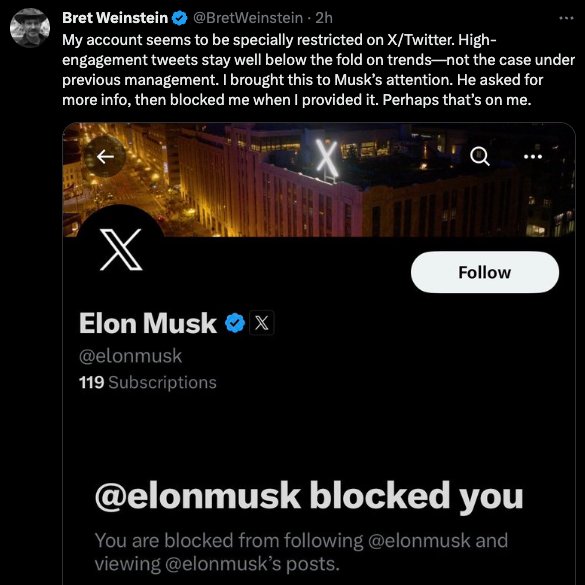
The screenshot depicts a Twitter/X post by Bret Weinstein. The top portion shows his tweet complaining about his account being “specially restricted” on the platform, specifically regarding lower engagement on his posts. He states he brought this issue to Elon Musk's attention, and Musk then blocked him. He ends with a self-deprecating “perhaps that's on me.”
Below this is a stark notification that @elonmusk blocked the user viewing this post. A "Follow" button is present, but disabled, visually highlighting the barrier to access. The background is dark, emphasizing the message "blocked". The X logo is prominent, now replacing the blue bird of the old Twitter brand. The overall aesthetic is minimalist and stark, driving home the sense of exclusion.
Foucauldian Genealogical Discourse Analysis
This screenshot is highly fertile ground for Foucault.
- Power/Knowledge: The blocking function is a key mechanism of power/knowledge. It's not merely a technical act; it actively shapes what can be known and by whom. Blocking doesn't just prevent viewing; it creates a hierarchy of access and reinforces who controls the narrative within the platform. Musk, as owner of X, wields this power. The “restriction” of engagement, according to Weinstein, is another layer – a subtle form of control shaping visibility.
- Discipline and Surveillance: X, like other social media platforms, operates as a disciplinary institution. Users are constantly monitored (surveilled) through algorithms, data collection, and content moderation (or lack thereof). The blocking function is a direct disciplinary action – a punishment or silencing for perceived infractions (even if unstated).
- Genealogy of ‘Blocking’: A genealogical analysis could trace the history of "blocking" as a social practice – from literal physical barriers to social ostracism, to the digital form we see here. This would reveal how the concept of exclusion has evolved and been re-appropriated within digital contexts.
- Normalization: Blocking as a function normalizes the idea of digital exclusion, and even punishment. While it is framed as a user-to-user feature, it is ultimately controlled by platform owners and their interpretations of “harmful” content.
Critical Theory
Critical Theory, particularly in the vein of the Frankfurt School, provides a relevant framework.
- Domination & Control: The situation epitomizes the themes of domination and control inherent in technological systems. Musk, as the owner, controls the platform's infrastructure and thus the flow of information, effectively wielding power over users.
- The Culture Industry: X can be viewed as part of the "culture industry", producing and distributing information (and selectively restricting access to it). The blocking function, in this context, is a form of censorship, albeit a decentralized and user-initiated one, but still shaped by the owner's overall policies and inclinations.
- Instrumental Rationality: The blocking function might be framed as an example of "instrumental rationality" – a purely means-end calculation based on maintaining platform "order" (as defined by Musk) without ethical or broader societal considerations.
- Loss of Public Sphere: The blocking function actively fragments the potential public sphere. Users who are blocked are excluded from the conversations and debates happening on the platform, contributing to echo chambers and polarization.
Marxist Conflict Theory
While less central than the Foucauldian or Critical Theory lenses, Marxist Conflict Theory can still be applied.
- Class Struggle (Digital Edition): The dynamic between Musk (representing the “ownership” class) and Weinstein (a public intellectual, perhaps representing a dissenting voice) can be seen as a microcosm of class struggle. Musk controls the means of communication (the platform) and can silence voices that challenge his worldview or agenda.
- Ideological Control: Blocking, as a form of censorship, can be viewed as an attempt to maintain ideological control. By suppressing dissenting voices, the platform attempts to reinforce a dominant ideology.
- Commodification of Attention: X (formerly Twitter) is a platform driven by profit, generated through user attention. Blocking and algorithmic manipulation influence whose voices get attention, and therefore whose ideology gains traction, becoming part of the means of production.
Postmodernism
A Postmodern lens provides a certain amount of insight.
- Deconstruction of Authority: The situation highlights the instability of authority in the digital age. While Musk is a powerful figure, his control over the platform is constantly being challenged and negotiated (e.g., through user resistance, media criticism).
- Hyperreality and Simulation: The platform itself is a simulation of social interaction, and blocking is a meta-level simulation – the appearance of exclusion. The "reality" of being blocked may be less about the actual loss of information access and more about the symbolic meaning of being silenced.
- Fragmented Narratives: Blocking contributes to the fragmentation of narratives online. Different users experience different versions of reality depending on who they are blocked from.
Queer Feminist Intersectional Analysis
This lens is the least directly applicable but can provide a nuanced understanding.
- Silencing Marginalized Voices: While Weinstein is not a marginalized individual in the traditional sense, the blocking function, in general, is often used to silence marginalized voices. This analysis examines how the tool (blocking) can be weaponized against those who are already vulnerable.
- Power Dynamics and Vulnerability: The situation exposes the power dynamics inherent in online spaces. Those with more power (like Musk) have the ability to silence others, while those with less power are more vulnerable to censorship.
- Intersectional Layers: If we expand the analysis beyond this specific incident, it’s important to consider how blocking disproportionately affects individuals belonging to multiple marginalized groups (e.g., LGBTQ+ individuals, people of color, women), who are already facing online harassment and abuse.
- Algorithmic Bias: Algorithms, combined with blocking functions, can exacerbate existing biases and further marginalize vulnerable communities.
I hope this comprehensive breakdown meets your requirements. Let me know if you'd like me to elaborate on any specific aspect or theoretical lens.
simple-description (llama3.2-vision)
This meme is a screenshot of a Twitter conversation between Bret Weinstein and Elon Musk. Bret Weinstein's tweet says "My account seems to be specially restricted on X/Twitter. High-engagement tweets stay well below the fold on trends - not the case under previous management. I brought this to Musk's attention. He asked for more info, then blocked me when I provided it. Perhaps that's on me." The image also shows that Musk has blocked Weinstein, as indicated by the "You are blocked" message.
tesseract-ocr
Bret Weinstein @ @BretWeinstein - 2h co wee My account seems to be specially restricted on X/Twitter. High- ‘engagement tweets stay well below the fold on trends—not the case under eee uae nee CCM ECs DRC I oe Ree eT aM ion" wh Clee 5 XG 3 LL es PT eds @elonmusk SCR ou tenny @elonmusk blocked you You are blocked from following @elonmusk and viewing @elonmusk’s posts.