First Seen
2023-05-10T20:59:59+00:00
simple-description (llama3.2-vision_11b)
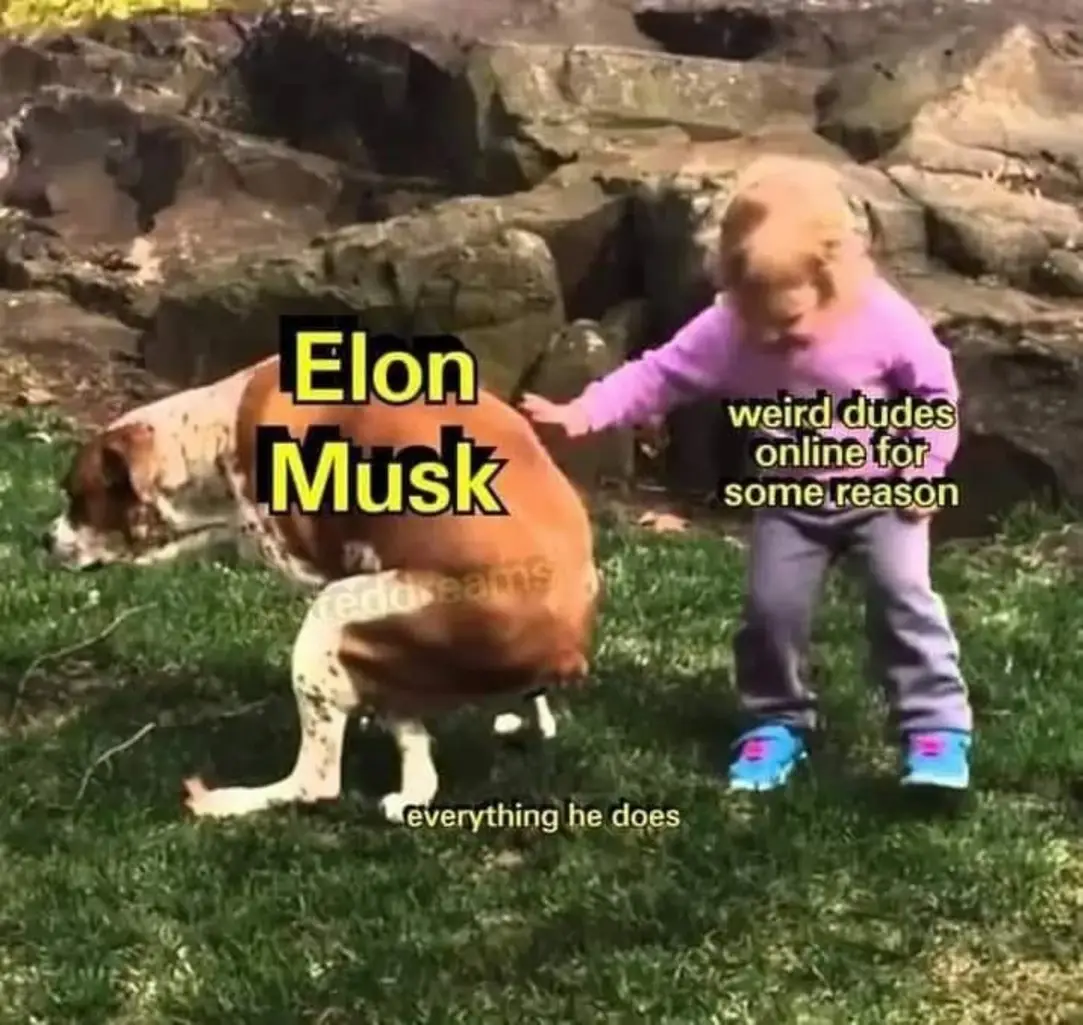
This meme is a commentary on the contrast between the public persona of Elon Musk, who is known for his innovative and forward-thinking ideas, and the online community's perception of him as a "weird" and "dumb" individual. The image shows a child playing with a dog, with the text "Elon Musk" written above the child and "weird dudes online for some reason" written above the dog. The caption "everything he does" is written below the image, implying that the online community's perception of Musk is a reflection of his actions, not his actual personality.
detailed-analysis (gemma3-27b-vision)
Okay, let's break down this meme through the requested theoretical lenses. It's a highly charged image, and depending on interpretation, several lenses could be applied.
1. Visual Description
The image is a screenshot from what appears to be an older nature documentary. A young child (appearing to be around 3-5 years old), wearing somewhat mismatched clothing (blue overalls and mismatched shoes), is enthusiastically dragging a reluctant and potentially injured Pointer dog across a rocky terrain. The child is smiling and looking forward. The dog is stumbling and appears distressed.
Text overlays are present:
- "Elon Musk" is positioned over the dog.
- "weird dudes online for some reason" is positioned over the child.
- "everything he does" is at the very bottom of the image.
The overall impression is one of forced movement and imbalance, contrasting a seemingly energetic initiator with a resistant and possibly harmed subject. The juxtaposition of the cute child and distressed dog, combined with the political figure being associated with the dog, creates a disturbing comedic effect.
2. Foucauldian Genealogical Discourse Analysis
This meme can be read through a Foucauldian lens as a commentary on the power dynamics surrounding "innovation" and "progress" often associated with Elon Musk.
- Discourse & Power: The meme participates in a discourse surrounding Musk, one that is often characterized by unquestioning adoration alongside criticism of his methods and goals. The meme disrupts that discourse, challenging the narrative of Musk as a visionary.
- Genealogy: We can trace the genealogy of the “innovator” trope—the idea that a single powerful figure can impose change on the world, regardless of consequence. The meme points to the darker side of this trope, suggesting that this pursuit of progress can be forceful, exploitative, and disregard the well-being of others. The child is not considering the harm being done to the dog.
- Power/Knowledge: The image suggests that the power dynamics inherent in Musk’s actions are often masked by the “knowledge” or narrative of innovation and progress. The meme is challenging the legitimacy of this narrative, suggesting that the "innovation" is being imposed on others.
The meme is not about Musk as an individual, but about the discourse surrounding his power and the way that discourse silences or disregards those who may be harmed by his actions.
3. Critical Theory
A critical theory perspective would focus on how the meme challenges established power structures and norms.
- Ideology: The meme subverts the "techno-utopian" ideology often associated with figures like Musk, which posits that technology will inevitably lead to a better future. By portraying the "innovator" as forcibly dragging a harmed entity, the meme suggests that this progress comes at a cost and is often imposed, not freely accepted.
- Domination & Resistance: The dog could be seen as representing a subjugated group or a vulnerable entity being exploited for the goals of the "innovator". The resistance of the dog, though physically failing, embodies the struggle against domination.
- Emancipatory Potential: The meme’s power lies in its ability to expose the potential harms of unchecked power and challenge the dominant narrative surrounding innovation.
4. Marxist Conflict Theory
Applying a Marxist lens, the meme can be understood as highlighting the exploitative nature of capitalist innovation and the power imbalances inherent in it.
- Class Struggle: The "innovator" (Musk) represents the capitalist class, driven by the pursuit of profit and expansion. The dog, representing the exploited worker or the general population, is being dragged along in service of this pursuit, regardless of its own well-being.
- Alienation: The dog’s lack of agency and suffering symbolize the alienation experienced by the working class under capitalism—being reduced to a means of production and having one’s humanity disregarded.
- Ideological Critique: The meme challenges the ideology of "progress" as a universally beneficial force, exposing it as a justification for exploitation.
5. Postmodernism
A postmodern reading of this meme focuses on its disruption of meaning, embrace of irony, and commentary on simulacra.
- Hyperreality: The meme presents a distorted reality, blurring the line between reality and representation. Musk is not literally dragging a dog, but the meme evokes a feeling of forced imposition and exploitation.
- Deconstruction: The meme deconstructs the traditional image of the “innovator” as a benevolent leader, revealing the potential for abuse and harm.
- Irony and Parody: The use of a cute child and a distressed dog creates a jarring contrast, amplifying the ironic commentary on Musk's actions.
6. Queer Feminist Intersectional Analysis
While not immediately obvious, an intersectional analysis can be applied.
- Power Dynamics & Vulnerability: The dog can be seen as a metaphor for any marginalized group (based on gender, sexuality, race, disability, etc.) being subjected to the whims of a dominant force. The power imbalance is clear.
- Consent & Agency: The dog is clearly unwilling and without agency. This aligns with feminist concerns about bodily autonomy and the violation of consent.
- Critique of Masculinity: Elon Musk's persona is often tied to a specific, powerful, often reckless form of masculinity. The meme subtly critiques this persona by associating it with forceful control and disregard for vulnerability.
- Interlocking Systems of Oppression: The meme suggests how systems of power (capitalism, patriarchy, etc.) can intersect to create conditions of exploitation and harm.
In conclusion: This seemingly simple meme is surprisingly rich in potential interpretations. It engages with complex theoretical frameworks, offering a subversive critique of power, ideology, and the pursuit of “progress”. The effectiveness of the meme lies in its ability to tap into existing anxieties and critiques of powerful figures and systems.
simple-description (llama3.2-vision)
This meme is a humorous take on the public's perception of Elon Musk, the CEO of Tesla and other companies. The image shows a child trying to take a selfie with a dog, but the dog is not cooperating. The text "Elon Musk" is written on the child's shirt, while the dog's name is "everything he does". The meme is a play on the idea that Elon Musk is always in the news for something, and this image is a humorous way of saying that he is always in the news for something.
tesseract-ocr
enn’? | ad 7 ia aie ets e, 7 , 5 oe % eS > C54 — ~ es = cree. = < an ' we * : zg. . on ss vs -y J - - ee _ —— 5 \ — om yo ‘ . be : a« vies fe = ie ™ bat na = > 7 Ss Se Pr Aaa) E ne | a Ce etice Cele : Wy y ie b Ta mr tee VIUSK emo oe ae ee +P . A i! a oy eg 3 A nw f “re . she P Bix « ge ra 1 a li Se a Mere 1A ow rs . eb - “7 “a”, = PP oe | hedoes © , Hist: ee NE ae oe, ed Rie: RNC AL vnpichel ge et ee nn a et eae o pt bh eas > Oe oe aa : ee ss EN US a C ahs a Gas + in ot one eee