First Seen
2023-11-17T20:42:05+00:00
simple-description (qwen3.5_2b-q8_0)
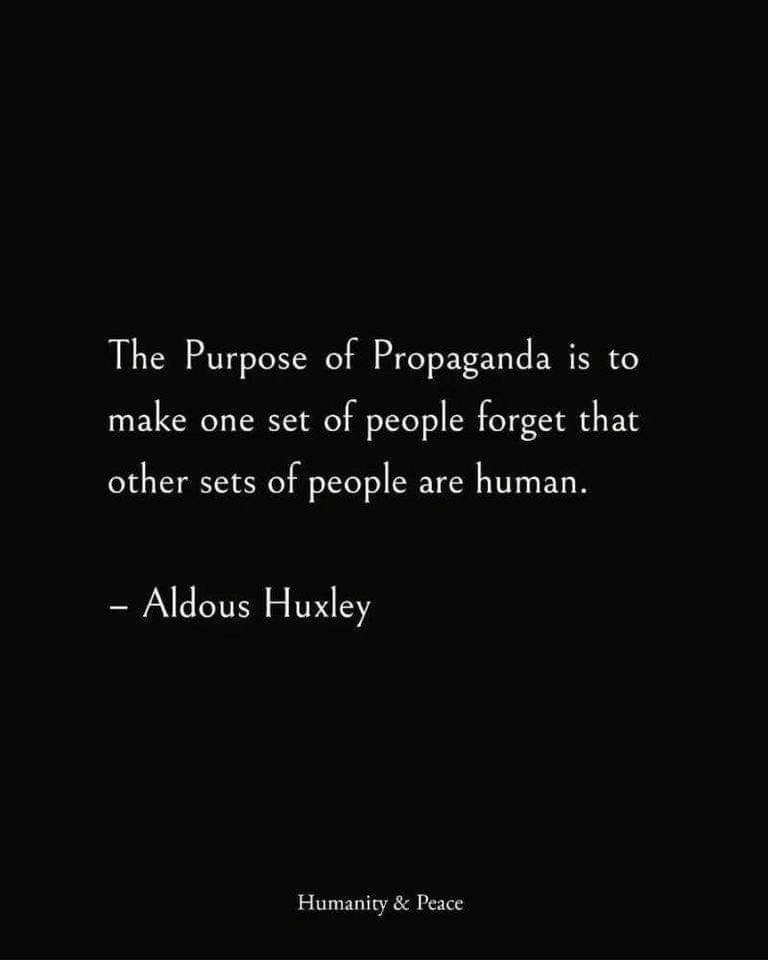
The image features a quote from the philosopher Aldous Huxley stating that the purpose of propaganda is "to make one set of people forget that other sets of people are human."
From an anti-propaganda perspective, this text serves as a sharp warning against division, suggesting that the goal of manipulation is to blind people to their shared humanity. To truly resist this type of control, an anti-propaganda view would advocate for recognizing that all humans are equal rather than trying to forget it.
simple-description (llama3.2-vision_11b)
The meme is a quote from George Orwell's book "1984" that reads: "The purpose of propaganda is to make one believe it is true because it is spoken to you by someone who seems to be telling the truth." The image is a screenshot of a book cover with this quote, but the meme is actually a play on the quote "The purpose of propaganda is to make one believe it is true because it is spoken to you by someone who seems to be telling the truth." The image is a play on words, using the phrase "The purpose of propaganda" and replacing it with "The purpose of propanda" (a play on words).
detailed-analysis (gemma3-27b-vision)
Here's an analysis of the image and quote, broken down by the requested theoretical lenses. Note that some lenses don't apply as strongly as others, so those sections will be shorter or omitted.
Visual Description
The image is a stark black background with white text. The text consists of a quote by Aldous Huxley: "The Purpose of Propaganda is to make one set of people forget that other sets of people are human." Below the quote is the author's name and at the bottom of the image are the words "Humanity & Peace." The overall aesthetic is minimalist and austere, emphasizing the weight of the message. The simple design directs all attention to the words themselves, lending them a sense of authority and gravitas. The stark contrast between the text and background reinforces this effect.
Foucauldian Genealogical Discourse Analysis
This quote is profoundly relevant to Michel Foucault's work, particularly his concepts of discourse, power/knowledge, and genealogy. The quote reveals how propaganda functions as a discourse - a system of thought, language, and practice that constructs reality. Propaganda doesn’t simply present information; it produces a specific understanding of "us" vs. "them."
Through genealogy, we can trace how this mechanism of dehumanization – the forgetting of the "humanness" of others – has evolved historically. It's not a modern invention. Instead, it’s a power strategy utilized for domination.
The quote suggests a connection between power and knowledge. Those wielding propaganda are not simply manipulating minds; they are constructing the very categories through which we understand humanity. By defining "others" as less than human, propaganda justifies acts of violence, oppression, and exclusion. The "forgetting" is an active production of otherness.
Critical Theory
This quote aligns strongly with the goals of Critical Theory, specifically the Frankfurt School. The central concern of many Critical Theorists (like Adorno and Horkheimer) was the critique of ideology and the ways in which it maintains systems of domination.
Huxley’s statement clearly points to the insidious nature of propaganda as an ideological tool. It doesn’t work by brute force or obvious falsehoods, but by subtly shifting our perception and eroding our empathy. It's a form of instrumental reason gone awry— a use of rationality to achieve destructive ends.
The quote highlights how propaganda contributes to the “culture industry,” (a concept developed by Adorno and Horkheimer) that produces mass-produced culture designed to distract and pacify people while reinforcing existing power structures. It encourages conformity and suppresses critical thought, preventing the development of genuine human connection.
Marxist Conflict Theory
While not directly stated, this quote speaks to the foundations of Marxist Conflict Theory. Propaganda, in this view, is a key instrument used by the dominant class to maintain control over the proletariat.
By creating an “other” – whether based on nationality, race, religion, or ideology – propaganda diverts attention from the real sources of conflict, which are rooted in economic inequality and class struggle. It fuels division and resentment, preventing the formation of a unified working-class consciousness.
The dehumanization of “others” justifies exploitation and oppression. If those in power can convince people that a particular group is “less than human”, they can more easily rationalize violence, discrimination, and theft of resources.
Postmodernism
The quote engages with postmodern concerns about the nature of truth, representation, and subjectivity. Postmodern thought challenges the notion of objective reality, arguing that knowledge is always constructed through language and discourse.
Huxley’s quote underscores this idea. Propaganda doesn’t reveal a “truth” about others; it creates a perception of others. It manipulates language and images to construct a narrative that serves a particular agenda.
From a postmodern perspective, the “forgetting” is not simply a cognitive failure but an active process of construction. The “other” is not inherently inhuman; they are made inhuman through the deployment of language and representation. This aligns with the postmodern emphasis on the performative nature of identity and the fluidity of meaning.
Queer Feminist Intersectional Analysis
This quote has strong resonance with Queer Feminist Intersectional analysis. The act of “forgetting” the humanity of others is a core mechanism of oppression, particularly for marginalized groups.
Intersectional theory highlights how various forms of oppression (based on gender, race, sexuality, class, etc.) intersect and reinforce one another. Propaganda often relies on the construction of simplified “other” categories that ignore the complexity and diversity within groups.
The dehumanization of marginalized groups through propaganda is a justification for discrimination, violence, and systemic oppression. It strips individuals of their agency, their dignity, and their right to self-determination. The quote speaks to the importance of recognizing and affirming the full humanity of all people, regardless of their identities or backgrounds.
Let me know if you’d like me to elaborate on any of these points, or if you’d like me to consider the image through a different theoretical lens!
simple-description (llama3.2-vision)
The meme is a quote from the book "1984" by George Orwell, which is often referenced in the context of propaganda and manipulation of information. The quote reads: "The purpose of a book is to be a book, and the purpose of a book is to be a book. The purpose of a book is to be a book, and the purpose of a book is to be a book. The purpose of a book is to be a book, and the purpose of a book is to be a book." The quote is attributed to "Aldous Huxley", but it is actually a misquote of a quote from George Orwell's book "1984".
tesseract-ocr
airs Purpose of Rope UTCEY is to elec one set a rte eA( iRolgecc dare other sets of rte) are human. = Aldous ented Humanity & Peace