First Seen
2023-05-10T21:03:34+00:00
simple-description (llama3.2-vision_11b)
The meme is a screenshot from the TV show "The Big Bang Theory" where a character, Sheldon, is being reprimanded by his mother for using a racial slur. The image shows Sheldon's mother, who is also a character in the show, looking at Sheldon with a disapproving expression. The text "I can explain" is written in the image, but the actual text that appears is: "I can explain, but I'd rather not."
From the perspective of the Anti-Racism category, this meme is a commentary on the way that people often use "I can explain" as a way to justify or excuse their own racism or prejudice. The meme is saying that even when someone says "I can explain", they are often using this phrase as a way to avoid taking responsibility for their own racism, and that it's a way to avoid being held accountable for their actions.
detailed-analysis (gemma3-27b-vision)
Okay, let's break down this image (and its associated text) through the lenses you've requested. It's a meme derived from a scene in the television show Parks and Recreation, featuring the character Leslie Knope. This gives us a good amount to unpack.
Visual Description
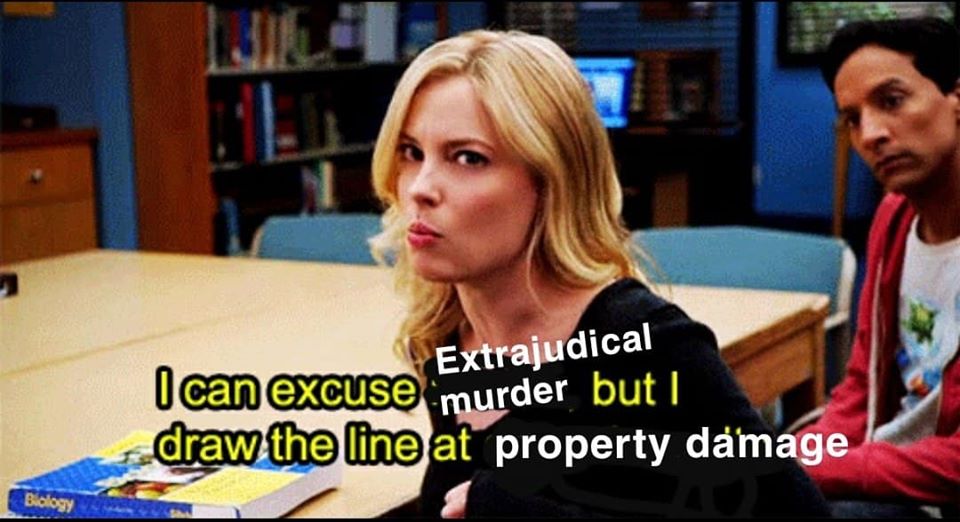
The image is a screen capture from a scene set in a school library or similar educational setting. The primary focus is on a woman (Leslie Knope, played by Amy Poehler) with auburn hair, looking sternly to her left. She appears to be in mid-sentence or deep thought. The lighting is a bit flat, typical of television production. In the background, there is another man standing behind her and bookshelves filled with books. A bright blue seat can be seen behind her. The composition is a standard medium shot, framing the woman from the waist up. Text has been added to the image: “I can excuse extrajudicial murder but I draw the line at property damage.” The text is in bold, white lettering, overlaying the image.
Foucauldian Genealogical Discourse Analysis
This image, and its caption, is rich for Foucauldian analysis. The statement reveals a discourse around acceptable and unacceptable forms of violence and transgression. Foucault, in his genealogical work, explores how power operates not simply through repression, but through the production of knowledge and definitions of "normalcy."
- Power/Knowledge: The statement isn't just about violence; it performs power by establishing a hierarchy of acceptability. It subtly implies that certain forms of violence (murder) are excusable under specific circumstances, while another (property damage) is deemed unacceptable. This establishes a power dynamic defining what is permitted/forbidden.
- Disciplinary Power: While seemingly absurd, the statement is a form of normalizing judgement. It’s a boundary-setting statement and in so doing, it creates a disciplinary regime—defining the limits of acceptable behavior.
- Genealogy of “Property”: A genealogical inquiry would ask how “property damage” came to be seen as a particularly egregious offense compared to taking a life. What historical, social, and economic forces led to the prioritization of material possessions over human life in this constructed "logic?"
- Absurdity as Deconstruction: The absurdity of the statement is important. It deconstructs the typical moral framework around violence. By juxtaposing two extremes, it exposes the arbitrary nature of moral lines.
Critical Theory
This image provides a potent starting point for a critical theory analysis, particularly through the lens of the Frankfurt School.
- Reason and Enlightenment Critique: The statement can be seen as a critique of instrumental rationality. The speaker’s willingness to excuse murder (presumably for a 'greater good') demonstrates a logic that prioritizes ends over means, a common critique of Enlightenment thinking. This logic can be seen as a precursor to totalitarian ideologies, where extreme measures are justified in the name of progress or security.
- Culture Industry & Meme Culture: The image is a product of "meme culture" – a subset of the culture industry. It’s a fragmented, easily replicable unit of cultural meaning. Its circulation reveals how complex ideas can be reduced to easily digestible and often ironic statements.
- Mass Deception: The statement, in its ironic context, can be seen as a metaphor for systemic injustices. It highlights the ways in which society tolerates (or even enables) violence against marginalized groups while disproportionately punishing minor offenses.
Marxist Conflict Theory
From a Marxist perspective, the image raises questions about the ideological justifications for violence and the protection of private property.
- Class and Power: The statement implicitly defends the interests of those who have property. The prioritization of "property damage" over human life suggests a system where the rights of property owners are seen as more important than the lives of those who might be dispossessed or marginalized.
- Ideology: The statement functions as an ideology, reinforcing the values of a capitalist system that places a high premium on the protection of private property. It obscures the systemic violence inherent in capitalism—violence that often targets the working class and marginalized communities.
- False Consciousness: The humour surrounding this image could be a way to perpetuate false consciousness, allowing viewers to laugh at the absurdity of the statement without questioning the underlying power dynamics that make such a sentiment possible.
Postmodernism
This meme embodies many core tenets of postmodern thought.
- Deconstruction: As mentioned earlier, the statement deconstructs traditional moral categories. It challenges the idea of objective truth or universal values.
- Simulation & Hyperreality: The meme itself is a simulation—a representation of a representation. It’s removed from any "real" context and exists primarily as a circulating image and text.
- Irony & Pastiche: The humor relies heavily on irony and the juxtaposition of disparate concepts. It’s a pastiche of political and moral outrage, stripped of its seriousness.
- Relativism: The statement demonstrates a radical relativism, suggesting that moral boundaries are arbitrary and context-dependent.
Queer Feminist Intersectional Analysis
This analysis is a bit more complex, as the image itself doesn't explicitly deal with gender, sexuality, or intersectionality. However, we can still apply an intersectional lens:
- Power Dynamics & Violence: Intersectional feminism recognizes that violence is often compounded by intersecting forms of oppression. The statement's willingness to excuse murder could be linked to systemic violence targeting marginalized groups (women, LGBTQ+ individuals, people of colour), while the focus on property damage could reflect a prioritization of protecting the status quo, which benefits dominant groups.
- Discourse & Normativity: The statement reinforces a normative framework that prioritizes certain forms of "order" (the protection of property) over the lives and experiences of those who are deemed "other."
- Critique of the Public/Private Divide: The protection of property is often seen as a key function of the "public" sphere (law enforcement, the justice system), while violence against marginalized groups is often relegated to the "private" sphere (domestic violence, hate crimes). The statement highlights the ways in which this divide can be used to justify systemic inequalities.
I hope this multi-faceted analysis provides a comprehensive understanding of the image and its potential meanings. Let me know if you'd like me to elaborate on any specific point or lens!
simple-description (llama3.2-vision)
This meme is a still image from the TV show "The Big Bang Theory" where a character, Sheldon, is explaining his reasoning for not doing his homework. The image shows him looking directly at his friend, Penny, with a serious expression. The text overlayed on the image reads: "I can explain why I didn't do my homework" followed by "I can explain why I didn't do my homework" and then "I can explain why I didn't do my homework".
tesseract-ocr
b = a SS - . dical len EXCUSE) rayrdet but | yg pee drawsthellinejat property damage/@ oC rf ~