First Seen
2023-05-10T21:03:34+00:00
simple-description (llama3.2-vision_11b)
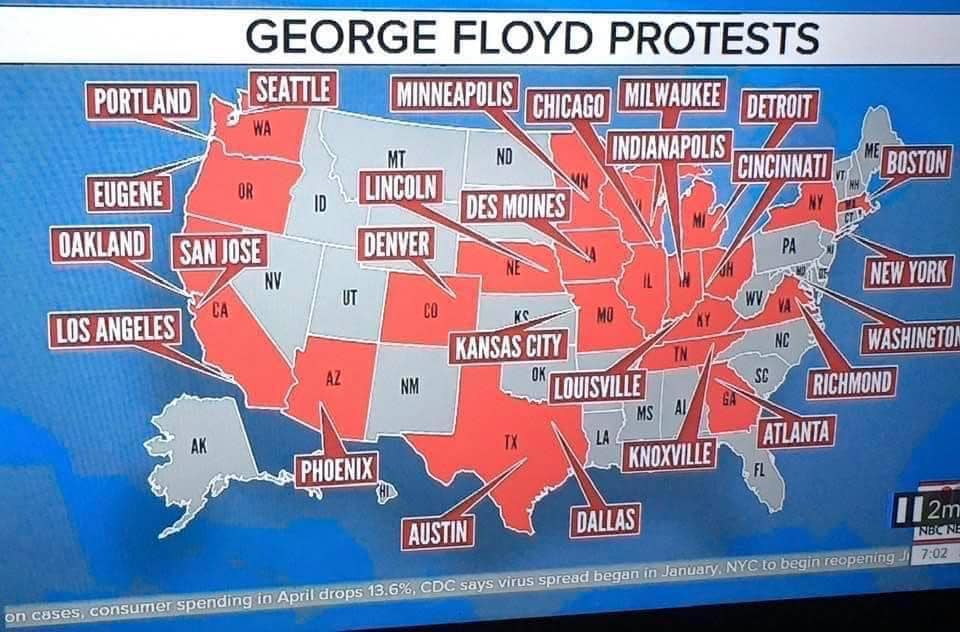
The meme is a screenshot of a news anchor's graphic illustrating the cities where protests against racism and police brutality have taken place in the United States. The graphic displays a map of the country with cities in red, indicating the locations of protests. The text "George Floyd Protests" is overlaid on the map, highlighting the widespread nature of the protests.
detailed-analysis (gemma3-27b-vision)
Okay, let's break down this image of a US map displaying cities where George Floyd protests occurred, analyzed through several theoretical lenses.
Visual Description
The image is a screenshot of a television news graphic. It features a map of the United States shaded with red and blue. Red indicates the states in which cities experienced George Floyd protests, while blue represents states where protests were not reported at this time. Major cities where protests occurred are labeled in white text. The title, “GEORGE FLOYD PROTESTS,” is prominent at the top. The map focuses on the continental US, with Alaska and Hawaii smaller and less detailed. At the bottom, there’s a news ticker displaying information about consumer spending and the spread of a virus, likely Covid-19, suggesting the protests occurred during that time. The graphic feels designed for rapid comprehension on television – it's spatially simplified and uses high-contrast colors. The map’s use of color immediately categorizes the nation into protesting and non-protesting areas, framing the issue as nationally widespread but not universal.
Foucauldian Genealogical Discourse Analysis
This map is a powerful example of how discourse constructs the narrative around the George Floyd protests. The map isn’t a neutral representation of events; it’s an inscription of power/knowledge.
- Discursive Formation: The map establishes a "discourse" around the protests by defining which locations count as participating. The choice to highlight cities and states, and to omit others, shapes the understanding of the scale and scope of the movement. What about protests in smaller towns? They are rendered invisible.
- Power/Knowledge: The map isn’t simply reporting the protests; it’s creating a knowledge regime. The graphic implies a certain level of "threat" or “disorder” across the United States. The media (and the entities that create these graphics) wield power by defining the boundaries of what is considered legitimate protest and by spatially organizing that information.
- Genealogy: Looking at how the mapping of protests has changed over time could reveal shifts in the understanding of social unrest. Earlier maps of similar movements likely employed different visual strategies, revealing evolving anxieties and political agendas.
- Normalization: By presenting protests as a geographically localized phenomenon, the map subtly normalizes them. It frames the protests as being contained within certain areas, which can diminish the urgency of addressing the underlying issues of systemic racism.
Critical Theory
From a critical theory perspective, this map reveals how systems of power and control operate within society.
- Ideology: The map can be seen as a manifestation of dominant ideology. By selectively highlighting certain cities and states, it reinforces a particular narrative about the protests. This narrative may serve to legitimize or delegitimize the protests, depending on the broader political context.
- Hegemony: The map contributes to the establishment of hegemonic control by presenting a simplified and easily digestible view of a complex social movement. This simplification can discourage critical thinking and reinforce existing power structures.
- Commodification of Protest: The graphic itself is a product of the media industry – a system driven by profit. The mapping of protests can be seen as a way to commodify social unrest, turning it into a spectacle for consumption.
- Spatialization of Power: The graphic spatially organizes protest, indicating where resistance is happening. This visualization implicitly suggests that protest is contained and manageable, which reinforces existing power dynamics.
Marxist Conflict Theory
From a Marxist perspective, this map illustrates the inherent contradictions and class struggles within US society.
- Class & Geography: The cities highlighted on the map tend to be major urban centers, which often have higher concentrations of marginalized communities and a history of labor unrest. This suggests a correlation between economic inequality, social injustice, and protest activity.
- State Power: The map implicitly demonstrates the state’s capacity for surveillance and control. The ability to map protests in real-time indicates a sophisticated infrastructure for monitoring and responding to social unrest.
- Ideological Struggle: The map can be seen as part of the broader ideological struggle between the ruling class and the oppressed. The map's framing of the protests can be used to justify repression or to co-opt the movement.
- Resource Control: The protests were linked to systematic racism and economic disenfranchisement. The map indirectly highlights the uneven distribution of resources and power within the US.
Postmodernism
A postmodern reading of this map would focus on its deconstruction of meaning and its challenge to grand narratives.
- Fragmentation: The map’s focus on individual cities and states emphasizes fragmentation and the lack of a unified national response to the protests. It underscores the idea that there is no single, coherent narrative of the events.
- Simulation: The map itself is a simulation of reality – a constructed representation that is divorced from the lived experiences of protesters. It raises questions about the authenticity and accuracy of media representations.
- Loss of Grand Narratives: The map challenges the idea of a single, overarching narrative of American progress or justice. It acknowledges the diversity of experiences and perspectives within the US, and the difficulty of constructing a universal truth.
- The Power of Representation: The map exemplifies the power of representation to shape our understanding of the world. It demonstrates how images and symbols can be used to create meaning and influence perceptions.
Queer Feminist Intersectional Analysis
From a queer feminist intersectional perspective, the map reveals how power operates at the intersections of race, gender, sexuality, and class.
- Marginalized Communities: Many of the cities highlighted on the map have significant LGBTQ+ and/or communities of color, suggesting that the protests were driven by concerns related to intersectional oppression.
- Systemic Violence: The protests were sparked by police brutality against a Black man, highlighting the systemic violence faced by marginalized communities.
- Resistance and Solidarity: The map implicitly demonstrates the power of resistance and solidarity among marginalized groups. The protests were a collective effort to challenge oppressive structures.
- Representation and Visibility: The map’s selective representation of cities and states can reinforce existing power imbalances. It’s important to consider whose voices are being amplified and whose are being silenced.
I hope this multi-layered analysis is helpful. Let me know if you'd like me to expand on any of these perspectives, or apply a different theoretical lens to the image.
simple-description (llama3.2-vision)
This meme is a map of the United States with many of its major cities highlighted in red. The text at the top reads "George Floyd Protests" and the text at the bottom reads "In 2-3 sentences, describe this meme for someone who cannot see it: This meme is a map of the United States with many of its major cities highlighted in red, indicating that they were sites of protests following the death of George Floyd in 2020. The red coloration is meant to convey the widespread nature of the protests, which were not just limited to one or two cities, but were a national phenomenon."
tesseract-ocr
ee CE ORGE FLOYD PROTESTS CET eed TT a ee = PN nomaraus se stay i \ \ a ry Cys oy ea aN . Moy Seen "og PS) Weg Tn as cosa - gr * X@UNTEE a “TN SS ST) AK a / k= min) i proae. PN og Bt ! La LDR : r : rs DALLAS TE essere NSS Oe TP EUW a CoA aa 702