First Seen
2023-05-10T21:03:34+00:00
simple-description (llama3.2-vision_11b)
The meme is a play on the phrase "right" vs "obtuse" angles, but in the context of anti-racism, it's a clever wordplay on the phrase "right" vs "obtuse" (racism) angles. The meme is using the geometry concept to comment on the absurdity of using a geometry concept to address racism, implying that even the most basic concepts can be used to address complex issues like racism. The meme is saying that even the most basic concepts can be used to address racism, implying that even the most basic concepts can be used to address racism.
detailed-analysis (gemma3-27b-vision)
Okay, let's analyze the image using the requested theoretical frameworks. It's worth noting that applying these complex theories to a basic geometric diagram is inherently playful and potentially stretching the frameworks to fit. The goal here is to demonstrate the approach of these theories, not necessarily to arrive at profound or definitive conclusions.
Visual Description
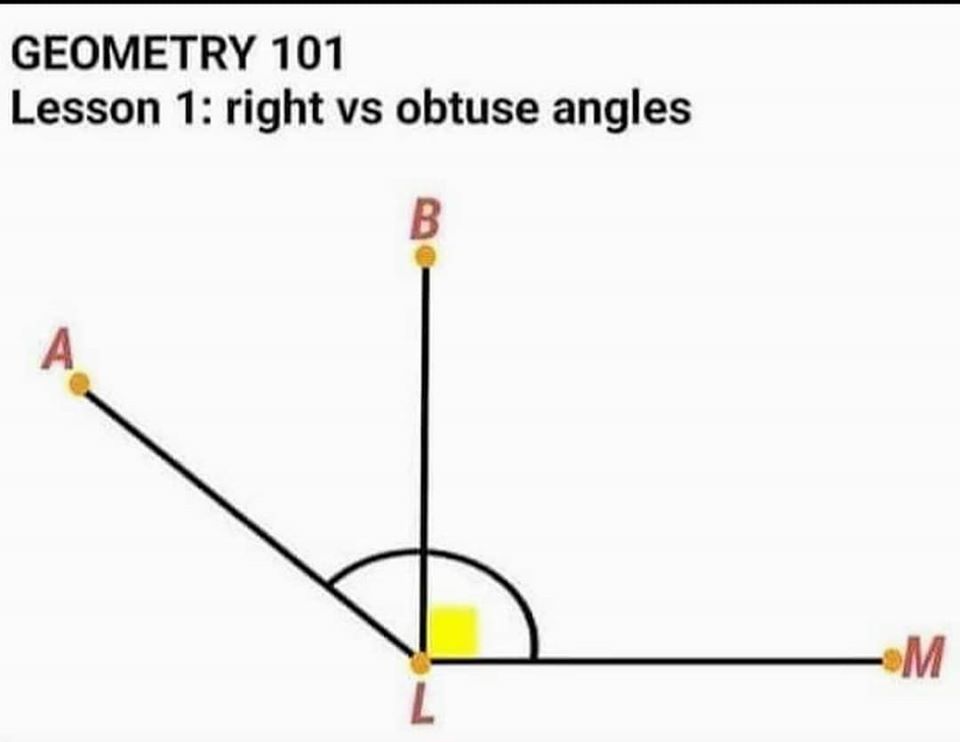
The image is a simplified diagram from a "Geometry 101" lesson, specifically focusing on the difference between right and obtuse angles. It depicts:
- Lines: Two lines intersecting at a point labeled "L." One line is horizontal, extending from L to M. The other line is vertical, extending from L to B. A third line originates at L and extends toward A.
- Angle: The angle formed by the horizontal line and the line going to A is shaded with a curved line, suggesting an obtuse angle, as it is greater than 90 degrees.
- Labels: Points on the lines are labeled with letters: A, B, L, and M.
- Color: The lines are black and shaded angle is in cyan. Points are colored orange and red.
- Text: The title reads "Geometry 101" with the lesson title "Lesson 1: right vs obtuse angles".
Foucauldian Genealogical Discourse Analysis
This image, as a component of a "Geometry 101" lesson, represents a discourse – a system of thought, language, and practice that shapes our understanding of space and form. A Foucauldian analysis would trace the genealogy of this discourse.
- Historical Development: The concepts of angles and geometric proofs have a long history rooted in ancient Greece (Euclid), through Arabic scholarship, and then re-integrated into Western education. This image is a distillation of centuries of mathematical development.
- Power/Knowledge: The image exercises power by defining what constitutes "correct" understanding of geometry. It positions certain ways of seeing (e.g., recognizing obtuse vs. right angles) as valid and others as incorrect. The authority to define these concepts resides in the historical development of the mathematical discourse and its institutionalized reproduction through education.
- Normalization: Through repeated presentation of diagrams like this, certain visual and conceptual norms are established. We learn to categorize angles in specific ways, which influences how we perceive and interact with the physical world.
- Disciplinary Effect: The lesson, and this image, contribute to a disciplinary effect – shaping students to conform to the established rules and logic of geometric thinking.
Critical Theory
From a critical theory perspective, the image can be seen as an example of how abstract systems of knowledge (like geometry) can serve to reinforce certain ways of thinking and perceiving the world.
- Rationalization: Geometry, as a system of rational thought, contributes to the broader project of Western rationalization – an attempt to impose order and predictability on the world.
- Objectification: The diagram objectifies space, reducing it to measurable, quantifiable properties. This can obscure other ways of knowing or experiencing space – those based on intuition, feeling, or cultural context.
- Ideology: The seemingly neutral presentation of geometry can mask underlying ideological assumptions about order, control, and the nature of reality.
- Domination of Abstract Thought: The emphasis on abstract geometric thinking could be seen as privileging certain forms of intelligence over others, contributing to a hierarchy of knowledge.
Postmodernism
A postmodern reading would challenge the idea of a fixed, objective truth about geometry, and deconstruct the meaning of the diagram.
- Relativity of Meaning: The meaning of "right" or "obtuse" is not inherent in the angle itself, but is constructed through the language and conventions of geometry. There are other possible ways of categorizing angles (e.g., based on their aesthetic qualities).
- Deconstruction of Binary Oppositions: The image presents a binary opposition between "right" and "obtuse" angles. A postmodern analysis would seek to destabilize this binary, demonstrating how the concepts are interconnected and mutually defining. What is ‘right’ relies on the existence of ‘obtuse’.
- Simulation and Hyperreality: The diagram is a simulation of reality – a simplified representation that is not the same as the actual angles found in the physical world. As such, it contributes to a hyperreality, where representations become more real than the real.
- Play of Signifiers: The image can be read as a "play of signifiers" – where the meaning of the diagram is constantly shifting and depends on the context and the interpreter's perspective.
Important Notes:
- This is a playful application of complex theories. It's meant to demonstrate how these frameworks could be used to analyze even the simplest images, not to provide definitive or profound interpretations.
- Each theory has nuances and internal debates that are beyond the scope of this analysis.
- The effectiveness of these analyses depends on the specific questions being asked and the theoretical goals of the researcher.
Let me know if you'd like me to elaborate on any of these points, or explore other theoretical perspectives!
simple-description (llama3.2-vision)
This meme is a humorous illustration of a geometry lesson gone wrong. The image shows a diagram of a triangle with the labels "A", "B", and "C", but the angles are labeled as "A", "B", and "C" in a humorous way, with "A" being "Always", "B" being "Boring", and "C" being "Crazy". The text at the top of the image reads "GEOMETRY 101" and "Lesson 1: right vs obtuse angles".
tesseract-ocr
GEOMETRY 101 Lesson 1: right vs obtuse angles B Nb L