First Seen
2023-05-10T21:03:34+00:00
simple-description (llama3.2-vision_11b)
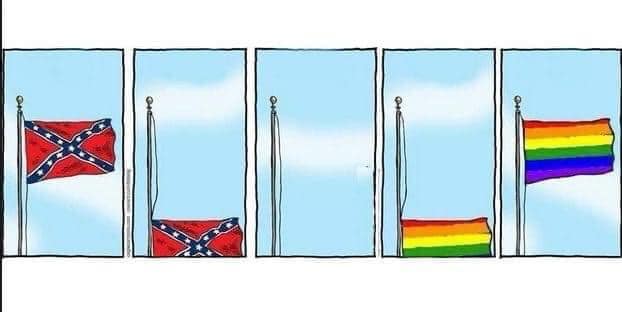
The meme is a humorous comparison of the Confederate flag and the rainbow flag, with the latter being a symbol of LGBTQ+ pride. The image shows a series of images with the Confederate flag being torn apart and replaced with the rainbow flag, implying that the former's racist and hateful connotations are being replaced with a symbol of inclusivity and diversity. The text "I'm not saying it's a good idea to burn the confederate flag... but" is likely included to add a humorous and ironic tone to the meme.
detailed-analysis (gemma3-27b-vision)
Okay, let's break down the image with the requested theoretical frameworks.
Visual Description
The image consists of five panels, each framed like a window or a separate vignette. Each panel features a flagpole. Three flagpoles display the Confederate Battle Flag, while the other two display the Pride/Rainbow flag. The background is a light blue, resembling a sky. The style appears to be simple, illustrative, with outlined features and flat colors. The juxtaposition of the Confederate Battle Flag and the Pride Flag is immediately striking and implies a clear contrast and potential conflict.
Foucauldian Genealogical Discourse Analysis
This image lends itself well to a Foucauldian analysis. Michel Foucault argued that power operates through discourse – the systems of thought, language, and practices that shape our understanding of the world. This image stages a discursive battle.
- Genealogy of the Flags: We can trace the historical "genealogy" of each flag. The Confederate flag isn’t simply a symbol of “Southern heritage.” Its history is deeply intertwined with slavery, white supremacy, and a specific form of resistance to federal power rooted in preserving a racial hierarchy. The Pride flag, conversely, emerged from the LGBTQ+ rights movement, a fight for recognition, equality, and against systemic oppression.
- Power/Knowledge: The image demonstrates how power and knowledge are linked. The Confederate flag represents a specific power structure and ideology that historically marginalized and oppressed African Americans. The Pride flag challenges that power structure and signifies resistance.
- Discursive Struggle: The juxtaposition suggests a contemporary struggle over meaning and the “right” to representation. Which flag is allowed to be displayed? How are they interpreted? This image can be seen as a visual manifestation of ongoing debates about history, identity, and power dynamics.
Critical Theory
From a Critical Theory perspective (drawing on thinkers like the Frankfurt School), the image exposes inherent social power structures and the construction of ideology.
- Ideology: The Confederate flag, despite attempts to rebrand it, carries strong ideological baggage related to racial hierarchy and historical injustice. Critical theorists would argue that the persistence of the Confederate flag represents a form of ideological hegemony – the dominance of one set of ideas over others.
- Hegemony & Resistance: The Pride flag, in contrast, represents a challenge to dominant ideologies. It’s a visual manifestation of marginalized groups asserting their rights and claiming space in society. The image displays the contest between dominant and counter-hegemonic forces.
- Critique of Representation: The image can be critiqued as a simplification of complex issues. However, it also prompts us to ask: Who controls the narrative? What symbols are given prominence? How are historical narratives constructed to uphold or challenge power structures?
Marxist Conflict Theory
A Marxist analysis would focus on the image as a representation of class and power struggles.
- Oppressor/Oppressed: The Confederate flag, linked to the historical preservation of slavery, can be seen as representing the interests of a ruling class seeking to maintain its power and privilege. The Pride flag, as a symbol of a marginalized group, represents resistance to that power structure.
- Ideological Struggle: The image illustrates an ideological battle over resources and power. The Confederate flag, historically, defended a system of labor (slavery) based on exploitation. The Pride flag represents a demand for equal rights and recognition, challenging the existing economic and social order.
- False Consciousness: A Marxist critic might argue that the continued display of the Confederate flag represents a form of “false consciousness” – a way in which the ruling class maintains its power by obscuring the true nature of exploitation and oppression.
Postmodernism
A postmodern lens would focus on the instability of meaning, the rejection of grand narratives, and the construction of identity.
- Deconstruction of Symbols: Postmodernism would challenge any fixed or essential meaning of either flag. The Confederate flag, rather than being a straightforward symbol of “heritage,” is a fluid signifier that can be interpreted in multiple ways (and often contested). The Pride flag, similarly, is not a monolithic symbol but a representation of diverse identities and experiences within the LGBTQ+ community.
- Rejection of Grand Narratives: Postmodernism rejects the idea of universal historical progress or overarching truths. The image suggests that history is not a linear narrative but a fragmented and contested collection of stories.
- Simulation & Hyperreality: One could argue that the image is a simulation of a conflict, a visual representation of debates that are happening in the “real world.” In a hyperreal world, symbols like these lose their original connection to reality and become more about the representation of meaning.
Queer Feminist Intersectional Analysis
This approach combines queer theory, feminist thought, and intersectionality to analyze the power dynamics at play.
- Intersectionality: The image highlights the intersection of race, gender, and sexuality. The Confederate flag represents a history of white supremacy that disproportionately affected Black women and queer people. The Pride flag represents a challenge to heteronormative and cisnormative power structures.
- Challenging Normativity: The Pride flag, as a symbol of LGBTQ+ rights, explicitly challenges the norms of heterosexuality and traditional gender roles. This directly clashes with the historical ideology represented by the Confederate flag, which often reinforced rigid gender roles and patriarchal structures.
- Queering History: The image invites a “queering” of history – a re-examination of the past to uncover the experiences of marginalized groups who have been excluded from dominant narratives. This includes recognizing the intersections of racism, sexism, and homophobia in the historical context of the Confederacy.
- Power and Representation: The image asks whose stories are being told, and who has the power to define history and represent identity. The juxtaposition of the flags reveals a struggle for representation and a demand for recognition.
Disclaimer: These analyses are interpretations, and the image is open to multiple readings. The specific frameworks applied offer different perspectives on the meaning and significance of the image.
simple-description (llama3.2-vision)
This meme is a humorous comparison between the American Civil War and the LGBTQ+ movement. The image shows a Confederate flag (representing the South's struggle to preserve slavery) and a rainbow flag (representing the LGBTQ+ community's struggle for equality) both being torn apart by the same wind, implying that both struggles are being "torn apart" by the same forces. The text at the bottom reads "Same wind".
tesseract-ocr
BLL