First Seen
2023-05-10T21:03:34+00:00
simple-description (llama3.2-vision_11b)
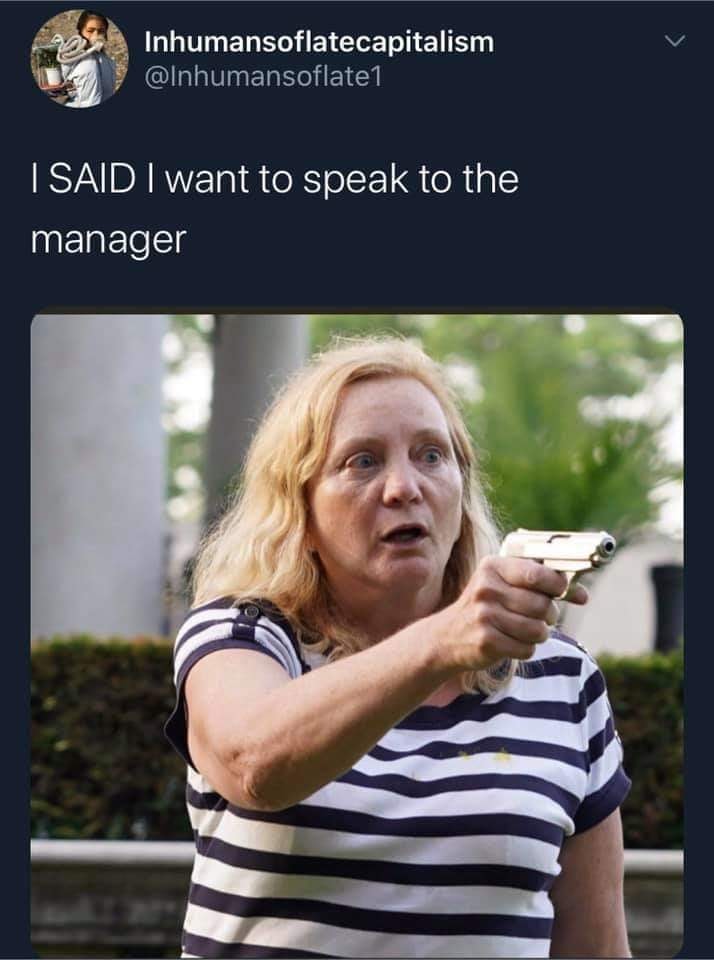
This meme is from the "Anti-Racism" category, specifically addressing the topic of police brutality and systemic racism. The meme features a photo of a woman holding a gun, with the caption "I said I wanted to speak to the manager" - a phrase that is often used in a humorous way to express frustration or annoyance. The image is likely referencing the 2020 George Floyd protests, where people were using the phrase to demand justice and accountability for police brutality.
detailed-analysis (gemma3-27b-vision)
Okay, here's an analysis of the image and its caption, broken down into the requested theoretical lenses. I'll indicate where a section doesn't apply.
Image Description: The image depicts an older woman, seemingly in a suburban or public outdoor setting. She is blonde, and appears to be in mid-gesture, pointing a handgun directly at the viewer (or, symbolically, at the target of her frustration). She looks intensely at the camera with a furrowed brow. She is wearing a striped shirt. The background is a green hedge and what appears to be a porch or the side of a building. The tweet caption reads, "I SAID I want to speak to the manager." This phrasing is a common internet meme referencing often entitled customer service interactions.
Foucauldian Genealogical Discourse Analysis
This meme lends itself well to Foucauldian analysis. The phrase "I SAID I want to speak to the manager," is a discourse – a system of thought, language, and practice that shapes how we understand and interact with certain institutions. The desire to escalate to a manager signifies a belief in a hierarchical power structure within the service/consumer system. The woman in the image takes this to an extreme, literally wielding a weapon to assert her demands.
- Power/Knowledge: The woman's act demonstrates an attempt to exercise power through a display of force, attempting to impose her will. However, it's also a display of the power of the customer service system – the idea that customers have the right to escalate demands. This right is constructed through advertising, company policies, and social norms.
- Genealogy: The 'desire to speak to the manager' can be traced genealogically through the evolution of consumerism. Originally the customer was not the primary focus, but rather the creation of goods. Through the development of marketing and advertising techniques, this shifted to become 'the customer is always right'.
- Disciplinary Power: While overt violence isn't typical, the underlying threat in the meme (and the implied expectation of 'being heard') represents a form of disciplinary power. It suggests that failing to satisfy the customer will have consequences. The meme exaggerates this to a violent level, exposing the latent power dynamics at play in seemingly mundane interactions.
Critical Theory
This meme is ripe for a Critical Theory reading, particularly drawing from the Frankfurt School.
- Culture Industry & Commodity Fetishism: The meme itself is a product of the culture industry. It’s a quickly-consumed piece of internet content, designed for engagement and shareability. It also subtly reinforces the idea that consumer satisfaction is paramount, feeding into the capitalist drive to increase consumption.
- Domination & Resistance: On a surface level, the meme can be seen as a comical expression of frustration with a system perceived as unfair. The woman is attempting to resist a perceived wrong by asserting her demands, however aggressively. However, it's a highly individualised form of resistance.
- False Consciousness: The meme could also be read as reinforcing a type of false consciousness. The focus is on individual entitlement ("I deserve to speak to the manager") rather than on systemic issues of power, exploitation, or the flaws of a consumer culture.
Marxist Conflict Theory
From a Marxist perspective, the image, while humorous, highlights several key themes.
- Class Struggle: The woman can be seen as a representative of the consuming class, asserting her demands upon the service worker (implied). This perpetuates a power dynamic where the consumer wields control over the worker's labor.
- Alienation: The extreme reaction points to a sense of alienation. The woman's frustration may stem from a sense of powerlessness in other areas of her life, leading her to overcompensate in this consumer interaction.
- Commodity Fetishism: As with Critical Theory, the focus on 'getting what I want' reinforces the fetishistic attachment to commodities, valuing them above human relationships or systemic justice.
- Exploitation: The meme subtly normalises the expectation that service workers must endure (and cater to) even unreasonable demands. The threat of escalation (even playfully implied) is a form of control.
Postmodernism
Postmodern readings see the meme as a playful deconstruction of authority and meaning.
- Hyperreality & Simulation: The image is a simulation of a situation – it’s not a genuine expression of customer service conflict, but a stylized representation. The exaggeration of the violence contributes to the hyperreal nature of the meme.
- Irony & Parody: The meme is inherently ironic. It’s a parody of entitled customer behavior, playing on the absurdity of escalating to such extremes.
- Deconstruction of Grand Narratives: It challenges the 'customer is always right' narrative by pushing it to its logical, absurd extreme.
- Fragmentation of Meaning: The combination of the image and the phrase creates a fragmented, ambiguous meaning that resists a single interpretation.
Queer Feminist Intersectional Analysis
This is arguably the hardest lens to apply, but still possible, though indirect.
- Performance of Power & Gender: The woman's aggressive posturing and assertion of dominance can be seen as a performance of power, which is often linked to patriarchal expectations of assertiveness. The meme plays with the trope of the 'Karen' – a pejorative term often applied to white women who exhibit entitled and often racist behavior.
- Intersection of Privilege: The 'Karen' stereotype often implies a level of white privilege, as it suggests an expectation of being heard and respected without facing consequences for aggressive behavior.
- Violence & Threat: The visual depiction of a woman brandishing a gun is loaded with historical and cultural significance related to gender and violence. While the meme is humorous, it can be seen as perpetuating a harmful association between women and aggression.
- Challenging Norms (but ambiguously): While the meme is often used to criticize entitled behavior, it can also be interpreted as reinforcing negative stereotypes about women.
I hope this breakdown is thorough and helpful! Let me know if you'd like me to elaborate on any of these sections.
simple-description (llama3.2-vision)
The meme is a photo of a woman with a shocked expression, holding a gun and pointing it at the camera. The text above the image reads "I SAID I WANT TO SPEAK TO THE MANAGER." The meme is likely used to express frustration or annoyance at being ignored or dismissed by someone in authority.
tesseract-ocr
EEN Inhumansoflatecapitalism NZ Te. MOE ser clean | SAID | want to speak to the manager _ é 4 hy oe oy a A J + — . ge. : ‘d —_ a — TT !