First Seen
2023-05-10T21:03:34+00:00
simple-description (llama3.2-vision_11b)
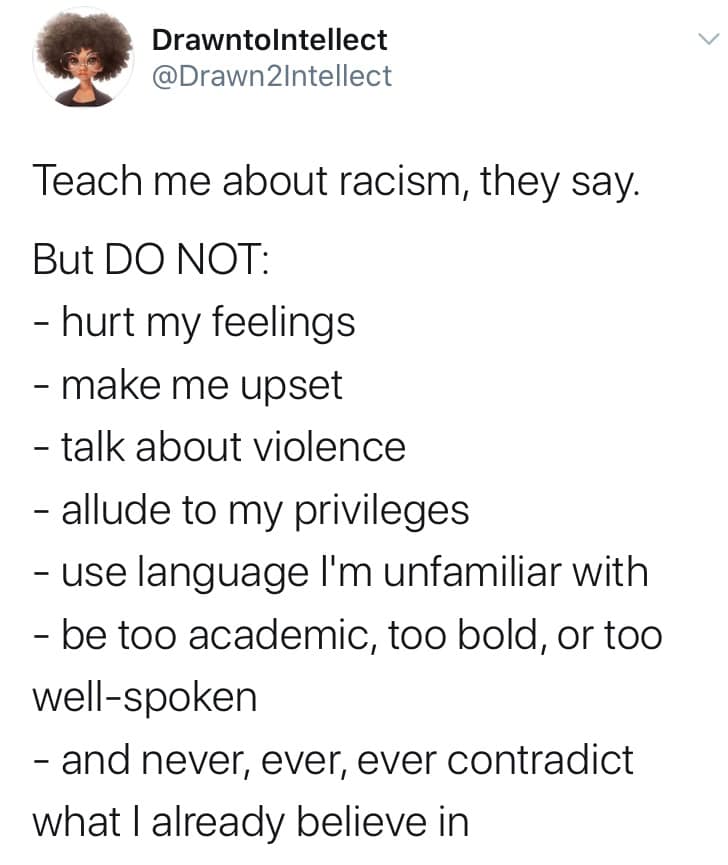
This meme is a humorous response to the common phrase "teach me about racism" with a tongue-in-cheek list of things not to do when discussing racism, including being ignorant, dismissive, and insensitive. The text reads: "Teach me about racism, they say. But DO NOT: hurt my feelings, make me angry, talk about my trauma, assume I'm okay, patronize me, or tell me how to feel. And for the love of God, don't tell me to 'just get over it' or 'be happy'."
detailed-analysis (gemma3-27b-vision)
Okay, let's break down this tweet through the lenses you requested, focusing on applicable areas.
Visual Description
The image is a screenshot of a Twitter post from the account "@Drawn2Intellect". The profile picture is of a person with natural black hair styled in a curly/textured fashion. The post itself is text-based. It begins with the phrase "Teach me about racism, they say." followed by a list of prohibitions prefaced with "But DO NOT:". The list is a series of requests for a specifically comfortable and non-challenging education about racism. The tone is sarcastic and critical.
Foucauldian Genealogical Discourse Analysis
This tweet is ripe for a Foucauldian analysis. The list of "DO NOTs" reveals a discourse around how discussions of racism are being policed.
- Power/Knowledge: The tweet highlights how power operates through the demand for a palatable, non-disruptive explanation of racism. The request isn't genuinely for education, but for the feeling of education without the risk of confronting uncomfortable truths. The demand is about maintaining the existing power structure, which benefits from ignorance or superficial understanding of racial inequality. Knowledge (about racism) is only acceptable when it doesn't threaten the speaker's comfort or worldview.
- Genealogy: A genealogical approach would trace the history of these demands. Where did this expectation come from that learning about racism should be painless? It connects to a long history of white fragility and the centering of white emotional experiences in discussions of race. The list isn’t a spontaneous request, but a manifestation of ingrained social norms.
- Disciplinary Power: The prohibitions act as forms of disciplinary power. They attempt to shape the discourse on racism, dictating what can and cannot be said, and who is allowed to say it. The list is a form of control, seeking to limit the potential for disruption and maintain the status quo.
Critical Theory
The tweet is a potent example of how systemic power imbalances operate.
- Ideology: The "DO NOT" list reveals an ideological framework that protects existing power structures. It demonstrates a desire to maintain the dominant narrative—a narrative that often minimizes or denies the existence of systemic racism.
- Hegemony: The requests reflect a subtle form of hegemony, where dominant ideologies are presented as common sense. The expectation that learning about racism should be comfortable is a normalization of privilege. It implicitly assumes that the speaker's emotional state is more important than the actual experiences of those harmed by racism.
- False Consciousness: The tweet suggests a "false consciousness" at play – the speaker believes they are open to learning, but their demands are based on assumptions that hinder genuine understanding. They may think they're being "reasonable" by asking for comfort, but this request actually reinforces oppressive systems.
Queer Feminist Intersectional Analysis
While the primary focus is on race, an intersectional analysis is very relevant.
- Interlocking Systems of Oppression: The tweet implicitly illustrates how systems of oppression are interconnected. The demand for comfort and the rejection of challenge aren't just about race; they also relate to a broader resistance to discomfort and disruption of privilege—privilege rooted in race, class, gender, etc.
- Emotional Labor: The tweet places an undue burden of emotional labor on those who might attempt to educate the speaker. The demand that explanations be “comfortable” and non-upsetting ignores the emotional toll of discussing racism, particularly for those who experience it. It expects educators to prioritize the speaker’s feelings over the subject matter itself.
- Silencing: The demands essentially aim to silence voices that challenge the status quo. Asking not to be contradicted or challenged is a rejection of critical thinking and a demand for affirmation.
Important Note: Marxist Conflict Theory doesn't fit as strongly here, though you could stretch it to see the "conflict" as being between those who benefit from the status quo and those who seek to challenge it. But the tweet isn't primarily about economic class struggle; it’s about ideological control and power dynamics within racial discourse.
Let me know if you'd like me to elaborate on any of these points or explore a different theoretical lens!
simple-description (llama3.2-vision)
This meme is a humorous take on the phrase "teach me about racism, they say." It presents a list of "do not" instructions, poking fun at the idea that people are often told to learn about racism but not to actually do so. The text includes a list of humorous "do not" instructions, such as "do not make me feel like you're better than me" and "do not assume I'm not a good person."
tesseract-ocr
6 Drawntolintellect @Drawn2Intellect Teach me about racism, they say. But DO NOT: - hurt my feelings - make me upset - talk about violence - allude to my privileges - use language I'm unfamiliar with - be too academic, too bold, or too well-spoken - and never, ever, ever contradict what | already believe in