First Seen
2023-05-10T21:03:34+00:00
simple-description (llama3.2-vision_11b)
This meme is a satirical commentary on the historical context of the United States' founding fathers and their views on slavery. The meme juxtaposes quotes from prominent figures such as George Washington, Thomas Jefferson, and Abraham Lincoln with a quote from a modern-day politician, highlighting the hypocrisy of their statements on slavery and the treatment of African Americans.
The text in the image reads: "I have no more than a few hours to get through to you before I am sent to the next world. I am a slave, and I have no idea how to get to the next world."
detailed-analysis (gemma3-27b-vision)
Okay, let's break down the image and analyze the quotes presented through the requested theoretical lenses. It's a challenging text, loaded with historical and ideological weight.
Visual Description
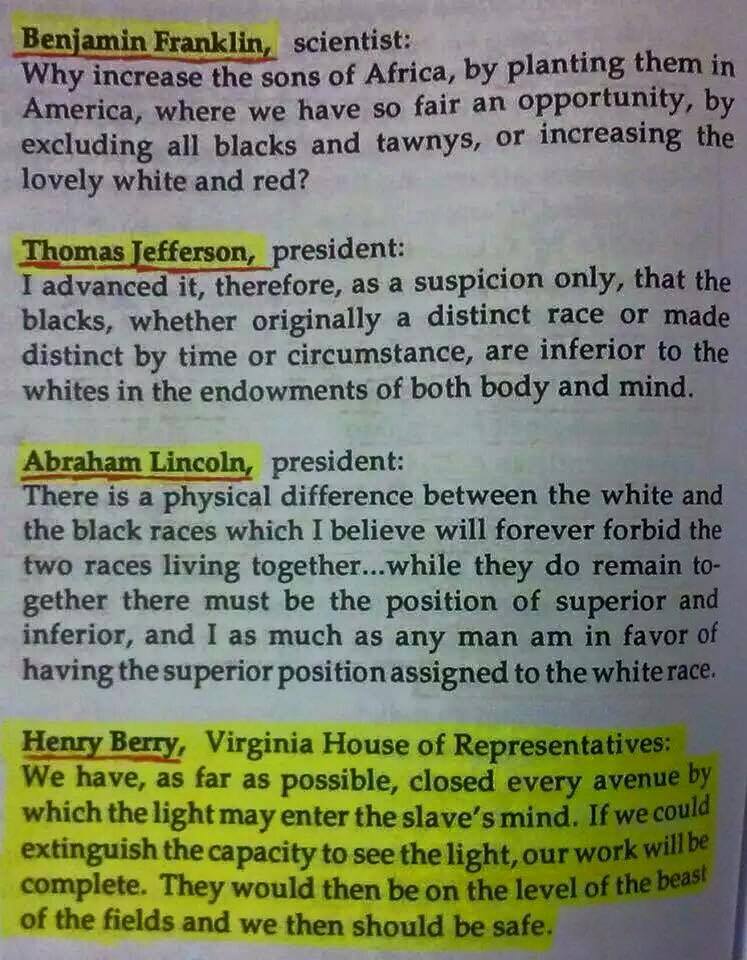
The image appears to be a photograph of a printed page, likely from a book or document. The text is neatly arranged in columns, with quotes attributed to prominent historical figures: Benjamin Franklin, Thomas Jefferson, Abraham Lincoln, and Henry Berry. The font is classic and the paper looks aged. The format suggests that these quotes are being presented as representative of historical thought on race and slavery. The document itself is a collection of direct quotations.
Foucauldian Genealogical Discourse Analysis
This document is prime material for a Foucauldian analysis. Michel Foucault focused on how discourses (systems of thought, language, and practice) create knowledge and power relations.
- Discourse of Race: The quotes reveal a central discourse around race that emerged and solidified during the period of colonization and slavery. These aren't simply individual opinions; they represent a network of ideas and assumptions about inherent differences between "whites" and "blacks."
- Power/Knowledge: The powerful status of these figures (scientists, presidents, representatives) means their statements become knowledge. They aren't just describing racial differences; they are constituting those differences as real and natural. This power/knowledge dynamic legitimized racial hierarchies and justified systems of oppression.
- Genealogy: A genealogical approach would trace the historical development of these ideas – where did the concepts of "white" and "black" as distinct races originate? How did these concepts evolve and become tied to notions of superiority and inferiority? Foucault would be interested in how these classifications created the very categories they claim to describe.
- "Visibility" and Control: Henry Berry’s quote about extinguishing the “light” in the slave’s mind is particularly telling. This is about controlling not just bodies, but also consciousness. The desire to eliminate a slave’s capacity for thought and independent agency is a fundamental element of power.
Critical Theory
The quotes align strongly with the themes explored by Critical Theory, particularly the Frankfurt School.
- Ideology: These statements are powerful examples of ideology – belief systems that justify and maintain existing power structures. The idea of inherent racial inferiority serves to rationalize slavery and systemic oppression. The "naturalness" of white superiority is a constructed idea, but one that is presented as objective truth.
- Domination: The core theme is domination. The quotes articulate a belief in the necessity of white dominance over black people. This dominance is not framed as a matter of choice, but as a natural or inevitable outcome of inherent differences.
- Instrumental Reason: While less explicit, the quotes hint at the application of "instrumental reason" – the use of logic and rationality solely to achieve specific goals (in this case, maintaining a system of exploitation). The “scientific” language implied by Franklin (scientist) gives a veneer of objectivity to what is fundamentally a political and economic project.
Marxist Conflict Theory
The text is deeply intertwined with Marxist concerns, though it goes beyond pure economic analysis.
- Class and Race as Interlocking Systems: While slavery is an economic system predicated on forced labor, these quotes demonstrate how race was used to justify and maintain that economic system. Race became a key tool for dividing the working class and preventing solidarity.
- Means of Production and Control: Slavery, as a system, fundamentally involves control over the means of production (land, labor, resources) and the bodies of enslaved people. These quotes reveal a desire to control not only labor but also the minds and souls of those being exploited.
- Ideological Hegemony: The propagation of ideas about racial inferiority contributes to ideological hegemony – the dominance of one set of beliefs (in this case, white supremacy) that shapes the consciousness of both the oppressors and the oppressed.
- False Consciousness: The beliefs expressed in these quotes, particularly the assertion of inherent inferiority, can be understood as contributing to the "false consciousness" of those who uphold the system of slavery.
Postmodernism
While the quotes seem to advocate for essentialist views of race, a postmodern reading can deconstruct them.
- Deconstructing Essentialism: The quotes attempt to establish fixed categories of "white" and "black" with inherent qualities. A postmodern approach would challenge the very idea of stable categories, arguing that these are social constructions. There is no essential "whiteness" or "blackness," only fluid, historically contingent classifications.
- The Power of Discourse: Postmodernism would focus on how the language used in these quotes – the framing of differences, the assertions of superiority – creates the illusion of essential difference. The language is not a neutral description; it constitutes the reality it claims to reflect.
- Relativism and Critique: While some postmodern thinkers are accused of relativism, a critical postmodern analysis would still condemn the ideology of white supremacy as harmful and oppressive. It would simply argue that the justifications for it are based on unstable and arbitrary classifications.
Queer Feminist Intersectional Analysis
This is a more complex application, but crucial.
- Intersectional Oppression: These quotes reveal a foundational logic of oppression that extends beyond race. The desire to control, dominate, and dehumanize is a core element of patriarchal and colonial power structures. The logic of racial supremacy is often intertwined with other forms of oppression (gender, sexuality, class).
- Control of the Body & Mind: The focus on controlling the "light" in the slave's mind mirrors the historical and ongoing efforts to control women’s bodies, sexuality, and intellectual agency. The desire to "correct" or "civilize" is often a cover for domination.
- Queering the Binary: The attempt to establish clear distinctions between "white" and "black" reinforces a binary system of classification. A queer analysis would challenge this binary, highlighting the fluidity and multiplicity of identity.
- Resistance & Agency: While the quotes focus on domination, it’s important to remember that enslaved people resisted in countless ways – through acts of rebellion, cultural preservation, and the assertion of their humanity.
I hope this detailed breakdown, organized by theoretical lenses, is helpful. This is a complex topic, and there's a lot more to explore! Let me know if you'd like me to elaborate on any of these points.
simple-description (llama3.2-vision)
This meme is a quote from a 1952 speech by President Abraham Lincoln, where he discusses the importance of equality and the need to end slavery. The quote is often misattributed to Lincoln, but it is actually from a speech by Frederick Douglass, an African American abolitionist. The quote reads: "I am a slave and I am a man. I am a man and I am a slave. I am a slave and I am a man."
tesseract-ocr
Benjamin Franklin, scientist: ‘a Why increase the sons of Africa, by planting them in America, where we have so fair an Oppor tunity, by excluding all blacks and tawnys, or increasing the lovely white and red? Thomas Jefferson, president: ; I advanced it, therefore, as a suspicion only, that the blacks, whether originally a distinct race or made distinct by time or circumstance, are inferior to the whites in the endowments of both body and mind. b Abraham Lincoln, president: fate, There is a physical difference between the white and the black races which I believe will forever forl bid t the two races living together...while they do remain to- gether there must be the position of super ior anc inferior, and I as much as any man am in favor of having the superior position assigned to the whitera Henry Berry, Virginia House of Representatives: We have, as far as possible, closed every avenue by which the light may enter the slave's mind. If wecou! extinguish the capacity to see the light, our work Ww! complete. They would then be on the level of th of the fields and we then should be safe.