First Seen
2023-05-10T21:03:34+00:00
simple-description (llama3.2-vision_11b)
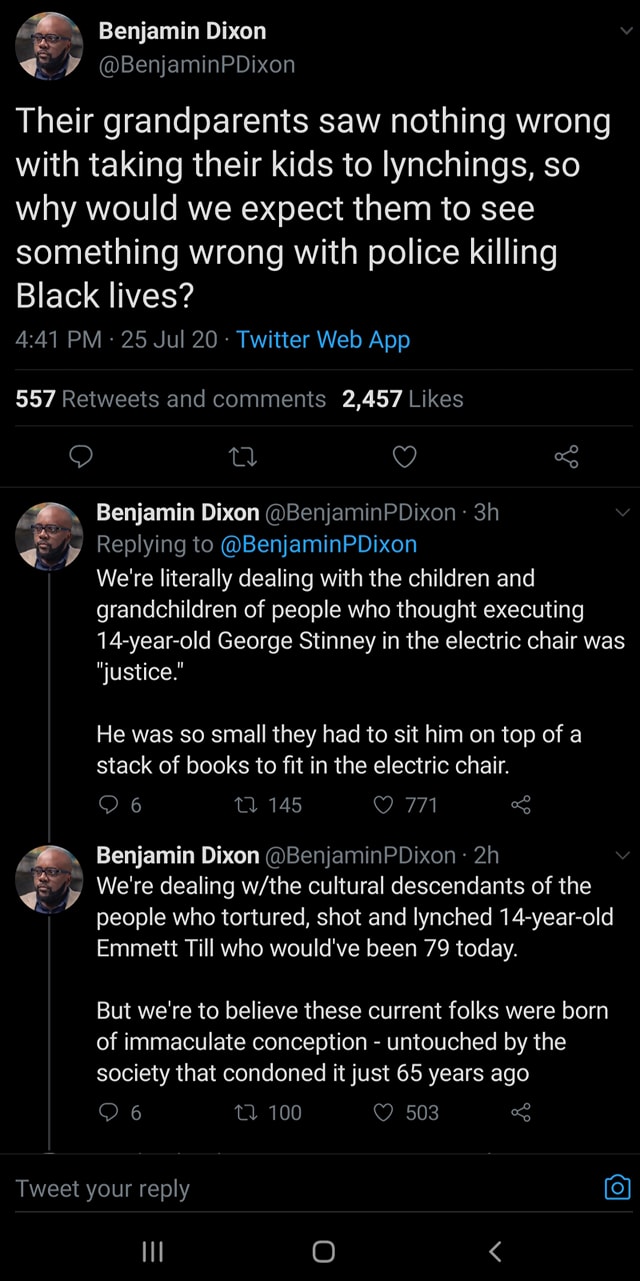
The meme is a screenshot of a Twitter thread where the user is responding to a tweet about the lack of attention to the recent lynching of Emmett Till, a 14-year-old African American boy who was murdered by a white mob in 1955. The user is expressing frustration that the story of Emmett Till's murder is not being covered by the media, and is comparing the lack of attention to the recent police killings of George Floyd and Breanna Taylor. The user is asking why the media is not covering the story of Emmett Till's murder, and is comparing the lack of attention to the recent police killings of George Floyd and Breanna Taylor.
detailed-analysis (gemma3-27b-vision)
Okay, here's an analysis of the Twitter thread by Benjamin Dixon, broken down into sections addressing the specified theoretical frameworks. Note that some frameworks are more strongly applicable than others, and I'll indicate when a section is minimal due to lack of direct applicability.
Visual Description
The image displays a series of tweets by the user @BenjaminPDixon. It is a screenshot of a Twitter thread. The first tweet is a rhetorical question asserting a connection between historical acceptance of lynching and current attitudes towards police killings of Black people. Subsequent tweets elaborate on this connection through references to specific cases of historical violence against Black youth (George Stinney, Emmett Till). The tweets are formatted within the standard Twitter interface. The bottom of the image shows interactive elements for replying and a "Tweet your reply" prompt. The screenshots appear in a vertical layout.
Foucauldian Genealogical Discourse Analysis
This thread is strongly aligned with a Foucauldian genealogical approach.
- Genealogy of Power/Knowledge: Dixon is tracing the historical construction of what is considered "justice" and “acceptable violence." He demonstrates how the understanding of violence against Black people (lynching, execution of a 14-year-old, police killings) has been historically normalized and legitimized through dominant discourses. The "truth" about violence isn’t inherent; it’s constructed and maintained by power structures.
- Discursive Formation: The thread reveals how certain discourses (“law and order,” “criminality,” “justice”) were formed to justify racial violence. The execution of George Stinney and the lynching of Emmett Till weren’t isolated incidents; they were products of a broader discursive regime that racialized criminality and dehumanized Black youth.
- Power/Knowledge Nexus: The thread highlights how power (social, political, legal) and knowledge (beliefs, narratives, ideologies) are inextricably linked. The discourse around "justice" produced the power to carry out acts of violence (lynching, executions, police brutality) while simultaneously legitimizing those acts. The “knowledge” that Black people were somehow inherently dangerous was used to justify their brutal treatment.
- Continuity & Discontinuity: Dixon isn’t arguing for a simple linear connection between historical lynching and current police brutality. He's exploring the continuities in the underlying power dynamics and discourses that enable both. He’s also subtly pointing to discontinuities – the ways in which the expression of this violence has changed over time (e.g., from extrajudicial mob violence to state-sanctioned police violence).
Critical Theory
This thread embodies core tenets of Critical Theory, particularly the Frankfurt School tradition.
- Critique of Ideology: Dixon is critiquing the dominant ideologies that conceal the systemic nature of racial violence. The question he poses challenges the assumption that current attitudes towards police violence are simply a result of individual prejudice, suggesting instead that they are rooted in a long history of racial oppression.
- Unmasking Power Relations: The thread aims to “unmask” the power relations that underpin racial injustice. By connecting historical lynching to contemporary police killings, Dixon exposes the enduring patterns of racial control and domination.
- Critique of Reason/Enlightenment: Implicitly, the thread critiques the idea that the Enlightenment project has led to universal progress and emancipation. While Enlightenment ideals of reason and justice are often invoked in debates about racial justice, Dixon’s thread suggests that these ideals have often been used to justify oppression, as in the case of the legal system’s complicity in lynching and racial profiling.
- Historical Consciousness: The thread emphasizes the importance of historical consciousness in understanding present-day social problems. By drawing attention to the historical roots of racial violence, Dixon encourages a deeper understanding of its contemporary manifestations.
Marxist Conflict Theory
This thread has some connection to Marxist Conflict Theory, but it’s not the primary lens.
- Power Imbalance: It points to an inherent power imbalance between racial groups, where the dominant group (historically and currently) perpetuates violence against marginalized groups. Lynching and police brutality can be seen as forms of social control exerted by the dominant class to maintain its position.
- Ideological Hegemony: The acceptance of historical violence (lynching) suggests a degree of ideological hegemony, where dominant narratives obscure the exploitation and oppression of marginalized groups.
- Class & Race Intersection: While the thread doesn’t explicitly discuss class, the disproportionate impact of racial violence on Black communities can be seen as a reflection of the intersection between race and class.
- Struggle & Resistance: Implicitly, the thread suggests the need for ongoing struggle and resistance to challenge the systemic nature of racial injustice.
However, the focus isn’t on economic exploitation or class struggle per se; it's more directly about racial power dynamics.
Postmodernism
Postmodernism is a less prominent framework in this analysis, but some aspects are relevant.
- Deconstruction of Grand Narratives: The thread challenges the "grand narrative" of American progress and the idea that the justice system is inherently fair and impartial. It suggests that these narratives are constructed and serve to mask underlying power relations.
- Relativism & Subjectivity: Postmodernism emphasizes the subjectivity of knowledge and the importance of multiple perspectives. The thread implicitly acknowledges that understanding racial violence requires challenging dominant narratives and listening to marginalized voices.
- Critique of Universal Truths: The thread challenges the idea that there is a single, universal definition of "justice." It suggests that justice is socially constructed and can vary depending on context and power relations.
- Emphasis on Discourse: This ties in with the Foucauldian approach mentioned earlier, as postmodernism also emphasizes the role of language and discourse in shaping reality.
However, the thread isn’t particularly focused on the deconstruction of language or the embrace of fragmentation that are characteristic of some forms of postmodernism.
Queer Feminist Intersectional Analysis
While the thread doesn’t explicitly address gender or sexuality, an intersectional lens can enrich the analysis.
- Compounded Oppression: Black women and LGBTQ+ Black individuals often experience compounded oppression, facing both racial discrimination and sexism/homophobia. The historical context of lynching included sexual violence against Black women, and contemporary police brutality disproportionately affects LGBTQ+ people of color.
- Interlocking Systems of Power: Intersectional analysis highlights how various systems of power (race, gender, sexuality, class) are interconnected and mutually reinforcing. Racial violence is not simply about race; it's embedded in broader systems of domination.
- Silencing & Marginalization: Black women and LGBTQ+ Black individuals have often been marginalized within both racial justice movements and feminist/queer movements. Their experiences are often silenced or overlooked.
- Complexity of Identity: Intersectionality recognizes the complexity of identity and the ways in which multiple social locations shape individuals’ experiences.
Although not central to the thread’s explicit argument, acknowledging the intersectional dimensions of racial violence can deepen our understanding of its impact on marginalized communities.
Let me know if you’d like me to elaborate on any of these sections or explore additional theoretical frameworks.
simple-description (llama3.2-vision)
The meme is a screenshot of a Twitter post by Benjamin Dixon, where he asks why grandparents would take their kids to a lynching, implying that they would expect to see something wrong with police killing Black lives. The post includes a quote about a 14-year-old boy being lynched in 1920, and the author's commentary on how people in the past were not aware of the "immaculate conception" of a 14-year-old boy being lynched.
tesseract-ocr
roca EC ol) €_J @BenjaminPDixon Their grandparents saw nothing wrong with taking their kids to lynchings, so why would we expect them to see something wrong with police killing Black lives? 4:41 PM - 25 Jul 20 - Twitter Web App 557 Retweets and comments 2,457 Likes 1) a 9 ~ Pe UCU sw eu cone 7 Replying to @BenjaminPDixon 7 We're literally dealing with the children and grandchildren of people who thought executing 14-year-old George Stinney in the electric chair was BTU eros He was so small they had to sit him on top of a stack of books to fit in the electric chair. ons) eG OTA) od (2B, Benjamin Dixon @BenjaminPDixon : 2h Pay We're dealing w/the cultural descendants of the a people who tortured, shot and lynched 14-year-old Emmett Till who would've been 79 today. But we're to believe these current folks were born of immaculate conception - untouched by the society that condoned it just 65 years ago om) alee} © 503 od BOL lo) ) HH O i