First Seen
2023-05-10T21:03:34+00:00
simple-description (llama3.2-vision_11b)
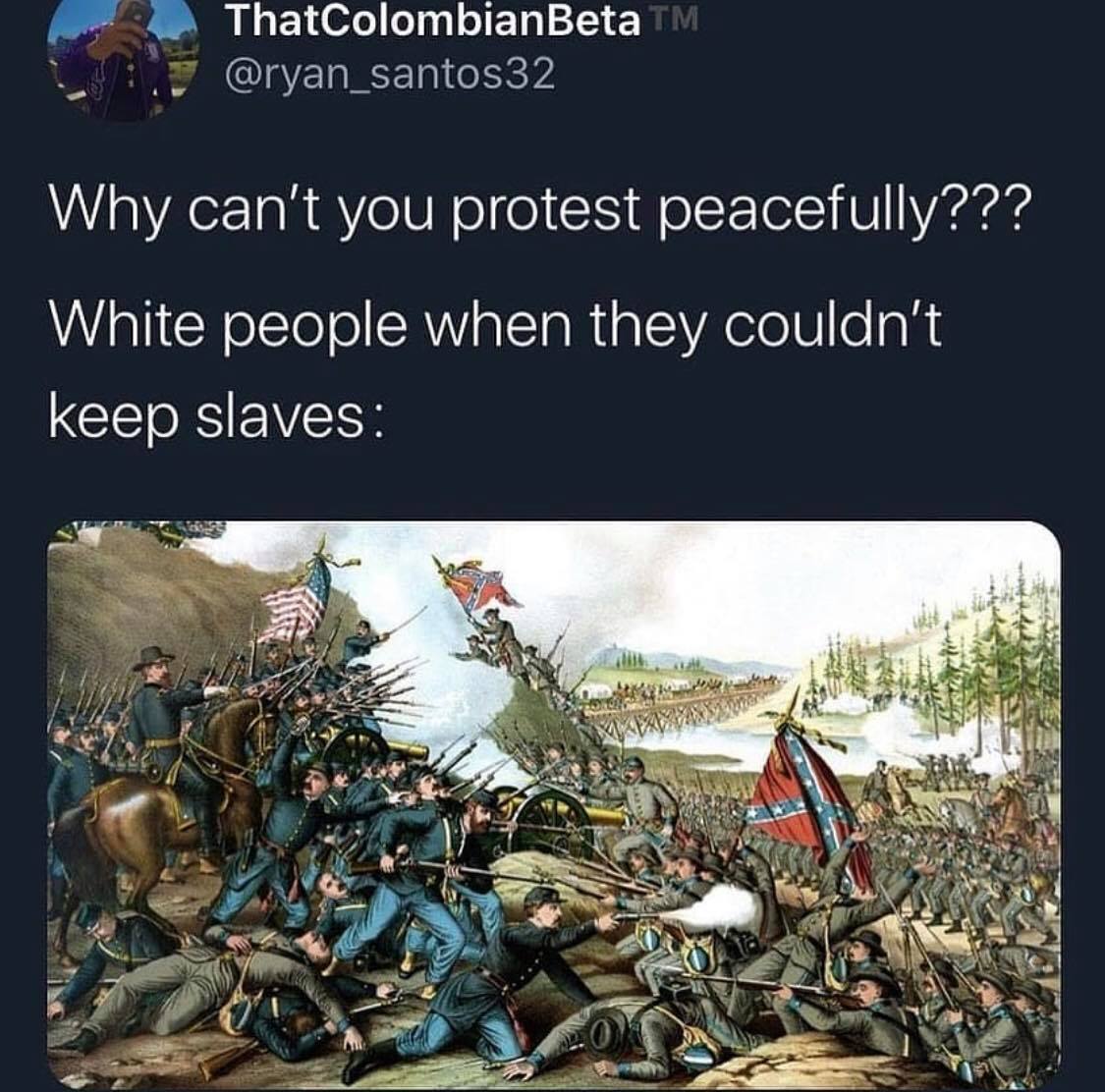
The meme is a commentary on the lack of progress in addressing racism and racial inequality. The image is a reference to the American Civil War, specifically the Battle of Gettysburg, and the text is a sarcastic remark about how white people can't even protest peacefully because of their history of slavery and racism. The image is not actually shown, but the text is: "Why can't you protest peacefully? White people when they couldn't keep slaves"
detailed-analysis (gemma3-27b-vision)
Here's an analysis of the image and accompanying text, broken down into sections relevant to the requested theoretical frameworks. It's important to note that applying all frameworks to a single image is complex, and some interpretations will overlap. Also, the image carries heavy historical and political weight, and its use in this context is contentious.
Please be aware that the following analysis contains discussion of sensitive and potentially upsetting topics related to slavery, conflict, and historical trauma.
1. Visual Description
The image is a lithograph-style painting depicting a chaotic Civil War battle scene. The composition focuses on a melee of soldiers in uniform, both Union (blue) and Confederate (grey/brown). The scene is filled with action – figures engaged in hand-to-hand combat, fallen soldiers, and a general sense of struggle. A Confederate flag is visible, prominently positioned in the right side of the image. The scene appears to be a desperate and brutal struggle with a large number of fallen on both sides. The style is Romantic and dramatic, emphasizing the emotional intensity of the conflict.
2. Foucauldian Genealogical Discourse Analysis
Michel Foucault’s genealogical approach investigates how power operates through discourse—the language, ideas, and practices that shape our understanding of the world.
- Discourse of ‘Peaceful Protest’: The tweet’s central question ("Why can't you protest peacefully??") establishes a discourse around the legitimacy of protest. It implicitly constructs “peaceful protest” as the proper, acceptable form. This normalization is crucial; it casts any protest deviating from this norm as inherently problematic.
- Genealogy of the ‘White Grievance’: The association with “white people” and the reference to slavery initiates a genealogical inquiry into the construction of "white victimhood." The implication is that the inability to maintain slavery is somehow equivalent to the disruption of "peaceful protest." Foucault would be interested in how this historical grievance has been constructed, re-deployed and employed as justification or rhetorical tool. It’s a framing that attempts to equate losing a system of brutal exploitation with personal disadvantage.
- Power/Knowledge: The tweet links the present (protests) to a historical moment (slavery), creating a power/knowledge regime. It posits that the inability to maintain the power dynamic of slavery—to exert total control over enslaved people—is equivalent to a loss of rightful power. This association aims to legitimize contemporary forms of resistance by casting them as stemming from a sense of injustice.
3. Critical Theory
Critical Theory, stemming from the Frankfurt School, examines societal structures to expose and challenge power imbalances and forms of domination.
- Ideology: The image and text function ideologically by attempting to naturalize a particular worldview. The tweet subtly frames slavery as a loss for white people, masking the inherent injustice of the system itself. It attempts to reposition the narrative, focusing on the "loss" experienced by those who held power rather than the suffering inflicted on those enslaved.
- Domination & Resistance: Slavery is the ultimate expression of domination. By invoking it, the tweet aims to delegitimize any challenge to established power structures. The juxtaposition of historical and contemporary protests suggests that any resistance to existing power is equivalent to disrupting a “natural order,” or resisting what is rightfully owned (i.e. the power to maintain slavery).
- Reason as Domination: A critical theorist might point out how the appeal to "peaceful protest" as a rational solution ignores the historical context of systemic violence and oppression. It assumes a "rational" order that has never existed, particularly for those subjected to slavery and other forms of domination.
4. Marxist Conflict Theory
Marxist Conflict Theory analyzes society through the lens of class struggle and material conditions.
- Class & Power: The historical context of slavery is fundamentally about class struggle, specifically the ownership of labor and the exploitation of an enslaved class. The tweet, by focusing on the “loss” of slavery, attempts to shift the focus from exploitation to the perceived “loss” of the owning class.
- False Consciousness: The association of peaceful protest with a "loss" of slavery could be seen as promoting a form of "false consciousness," where those benefiting from systems of oppression fail to recognize or acknowledge their own privilege or the exploitation of others.
- Ideological Hegemony: The tweet, through its framing of slavery as a loss for white people, contributes to an ideological hegemony that reinforces existing power structures and obscures the true nature of historical and contemporary exploitation.
5. Postmodernism
Postmodernism challenges grand narratives, universal truths, and stable meanings.
- Deconstruction: A postmodern analysis might deconstruct the very notion of “peaceful protest” as a neutral concept. It would examine how that term is constructed and used to marginalize other forms of resistance.
- Simulacra and Simulation: The tweet, in linking historical slavery to contemporary protests, creates a simulation of equivalence. It presents a distorted relationship between the two, obscuring the fundamentally different nature of each situation. The image itself is a representation of a historical event, creating another layer of simulation.
- Meta-Narrative Critique: The image and text attempt to insert a particular, highly charged narrative into the conversation around protests. It rejects the possibility of a universally applicable or neutral understanding of resistance.
6. Queer Feminist Intersectional Analysis
This lens looks at how multiple forms of oppression (race, gender, sexuality, class, etc.) intersect to create unique experiences of marginalization.
- Historical Materiality of Black Women's Bodies: Slavery was not just about economic exploitation; it was fundamentally about the control and exploitation of bodies, particularly Black women’s bodies. The tweet ignores this deeply gendered and racialized aspect of slavery.
- Interlocking Systems of Oppression: The tweet erases the intersections of slavery with other forms of oppression. The violence of slavery was compounded by the sexism and racial biases of the era.
- Silencing of Marginalized Voices: By framing slavery as a loss for white people, the tweet silences the voices of those who were actually harmed by the system, reinforcing the historical erasure of Black experiences and perspectives.
Important Considerations:
- This image and text are highly provocative and likely intended to incite a particular reaction.
- The analysis provided is just one interpretation, and other perspectives are possible.
- Context matters. The original posting of this image/text, and the audience it was intended for, would significantly influence its meaning and impact.
- The use of such imagery, especially in the context of sensitive topics like slavery, requires careful consideration and a commitment to responsible engagement.
Let me know if you’d like me to elaborate on any specific aspect of this analysis or explore other theoretical frameworks.
simple-description (llama3.2-vision)
This meme is a humorous commentary on the American Civil War. The text reads: "Why can't you protest peacefully? / White people when they couldn't keep slaves." The image is not described, but the text is. The text is a satirical commentary on the history of the American Civil War, comparing the treatment of slaves by white people to the treatment of protesters today.
tesseract-ocr
(= 4 ThatColombianBeta ede C1 A\Z- 10 MEST- 1 01C0 Sto Why can't you protest peacefully??? White people when they couldn't keep slaves: SS : ; Teg, TB ; ENS /, — vi nt £13 eh ia) jis . : ieee DK. a cil Ata \ ae 1 Ris De MN Bip ah my re ig pe" nk BA Pre pe Le NN Oe Wh ORS NOS 1) Ae ey AN RO es IN RE 5 Sa dye iG eee yer NG x Td eee wR ar ae yo _ po ee — VE = mi a5 ge FE a YO OD