First Seen
2023-05-10T21:03:34+00:00
simple-description (llama3.2-vision_11b)
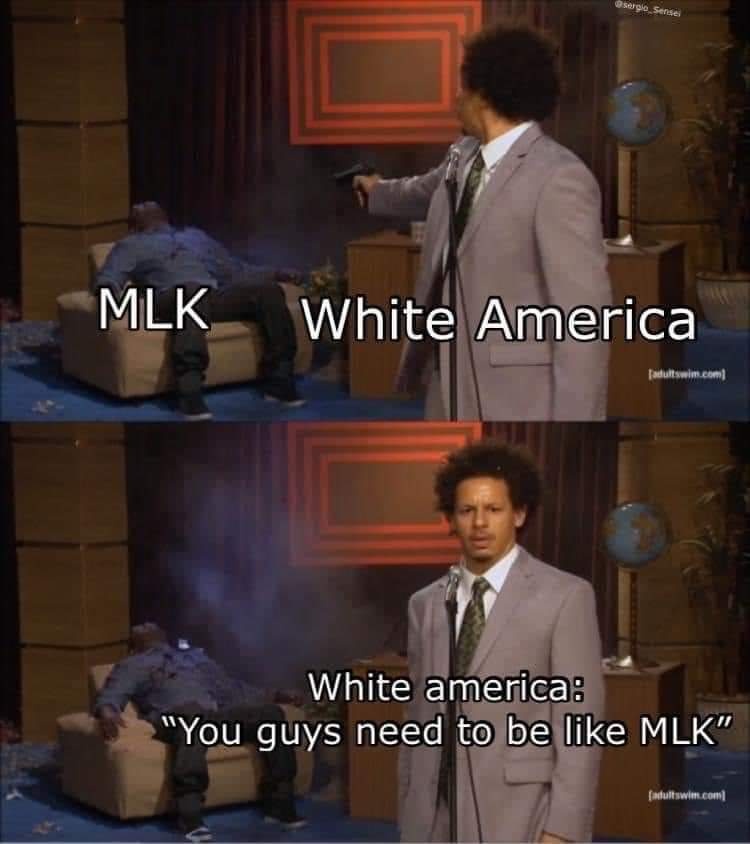
The meme is a commentary on the racist and violent history of the United States, particularly in relation to the Civil Rights Movement and the legacy of Martin Luther King Jr. The image shows a scene from the movie "Django Unchained" where a character is about to kill a slave owner, with the caption "MLK" and "White America" on either side of the character. The text "White America: You're going to need to be killed" is then added, implying that the character is saying this to the slave owner, but the context is actually a commentary on the racist and violent history of the United States, particularly in relation to the Civil Rights Movement and the legacy of Martin Luther King Jr.
detailed-analysis (gemma3-27b-vision)
Okay, let's break down this meme using the requested theoretical frameworks. It's a rich image, and we can definitely approach it from multiple angles.
Visual Description
The image is a three-panel meme constructed from a clip of Richard Pryor performing stand-up comedy.
- Panel 1: Pryor, in a suit, stands on a stage, with the text "MLK" positioned above him. He appears serious, potentially addressing a sensitive topic.
- Panel 2: The scene is the same but the text above the clip now states “White America”.
- Panel 3: Pryor is again depicted on stage with the text "White America: “You guys need to be like MLK”".
- Overall Aesthetic: The visual quality is a bit grainy and dated, consistent with a clip from a vintage stand-up routine. This nostalgic quality adds a layer to the meme’s meaning. The stage setting provides a framework for a performance of identity and commentary.
Foucauldian Genealogical Discourse Analysis
This meme is a prime example of how power operates through discourse. Foucault would be interested in how the expectation for marginalized groups to "be like MLK" functions as a disciplinary mechanism.
- Power/Knowledge: The statement “You guys need to be like MLK” implies a specific understanding of acceptable protest, one that centers non-violence and assimilation. This creates a power dynamic where the dominant group defines the terms of acceptable dissent. Those who don't conform are labeled as "radical" or "problematic" – a discursive exclusion.
- Genealogy of the Expectation: Tracing the history of this expectation, one finds that it emerged from a specific historical context—the Civil Rights Movement—and was then instrumentalized by those in power to manage and contain subsequent movements. It’s not about genuine admiration for MLK’s values but rather a strategy to control the terms of resistance.
- Disciplinary Power: The demand to be “like MLK” functions as a form of disciplinary power, shaping behavior by setting a normative ideal. It subtly discourages forms of protest that are perceived as disruptive or confrontational, even if those forms are necessary to address systemic injustice.
Critical Theory
This meme resonates strongly with themes explored by the Frankfurt School (Adorno, Horkheimer, Marcuse, etc.).
- Culture Industry: The meme can be seen as a commentary on how the "culture industry" (media, popular culture) co-opts and neutralizes revolutionary figures like MLK. His legacy is reduced to a palatable message of peaceful protest, stripped of its radical critique of systemic inequality.
- False Consciousness: The demand that marginalized groups "be like MLK" can contribute to a form of false consciousness, where people are led to believe that the existing system can be reformed through non-confrontational means, rather than being fundamentally transformed.
- Reason as Domination: The meme subtly critiques the idea of “reason” as an instrument of domination. The call for “MLK-like” behavior is framed as “reasonable” and “sensible,” masking the underlying power dynamics that perpetuate injustice. It implies that any deviation from this “reasonable” approach is irrational and therefore illegitimate.
Marxist Conflict Theory
From a Marxist perspective, the meme highlights the ongoing class and racial struggle in America.
- Ideology and Hegemony: The demand to "be like MLK" is a manifestation of the dominant ideology, designed to maintain the status quo and prevent revolutionary change. It serves to obscure the material conditions of inequality and to legitimize the existing power structure.
- False Reconciliation: The call to emulate MLK can be seen as a form of false reconciliation, where the ruling class attempts to pacify and co-opt dissent without addressing the root causes of social injustice. It's a way to appear progressive without making any meaningful concessions.
- Class Struggle: The meme subtly points to the ongoing class struggle, as the demand for "MLK-like" behavior often comes from those who benefit from the existing system and who have a vested interest in maintaining it.
Postmodernism
A postmodern reading would focus on the deconstruction of meaning and the blurring of boundaries.
- Hyperreality & Simulacra: The meme can be seen as a commentary on the hyperreal nature of contemporary American society, where symbols and images have become detached from reality. The “MLK” ideal is presented as a simulacrum, a copy without an original, used to manipulate and control.
- Deconstruction of Meaning: The meme deconstructs the meaning of MLK’s legacy, revealing how it has been reappropriated and distorted by those in power. It challenges the notion of a fixed and unified meaning, exposing the multiple interpretations and contradictions inherent in the historical figure.
- Fragmentation & Irony: The meme’s fragmented visual format and ironic juxtaposition of images convey a sense of disillusionment and skepticism towards grand narratives and universal truths.
Queer Feminist Intersectional Analysis
While less explicit, an intersectional reading would explore how the expectation to "be like MLK" impacts movements led by other marginalized groups.
- The "Respectability Politics" Trap: The demand for "MLK-like" behavior often falls into the trap of respectability politics, where marginalized groups are expected to conform to dominant norms in order to be seen as legitimate. This can be particularly harmful to queer and trans activists, who are often targeted for challenging traditional gender and sexual norms.
- Silencing Radical Voices: The expectation to be "non-violent" or "reasonable" can silence the voices of those who believe that more radical strategies are necessary to achieve justice. This can be particularly harmful to movements led by Black and Indigenous activists, who have historically faced systemic violence and oppression.
- Interlocking Systems of Oppression: The meme highlights how different forms of oppression—race, class, gender, sexuality—are interconnected and mutually reinforcing. The demand to "be like MLK" can be seen as a way to reinforce these systems of oppression by demanding conformity and silencing dissent.
Let me know if you’d like me to elaborate on any of these points or explore another theoretical framework!
simple-description (llama3.2-vision)
This meme is a humorous commentary on the perceived differences in how people of different racial backgrounds are treated by law enforcement. The image shows a scene from the TV show "Chappelle's Show" where a character is being shot by a police officer. The text "MLK" (Martin Luther King) is written on the character's body, while the text "White America" is written on the police officer. The meme suggests that the police officer is being told to shoot the character, and the text "White America: 'You guys need to be like MLK'" implies that the police officer is being told to be like the late civil rights leader, who was known for his non-violent approach to social justice.
tesseract-ocr
— a * ) s obs vail ee : { aK Se ASV niciare ie S243) ip = ae nese atciiee 5 Se ik guys need to Bali NT aa = 2B. ee - a i iF "