First Seen
2023-05-10T21:03:34+00:00
simple-description (llama3.2-vision_11b)
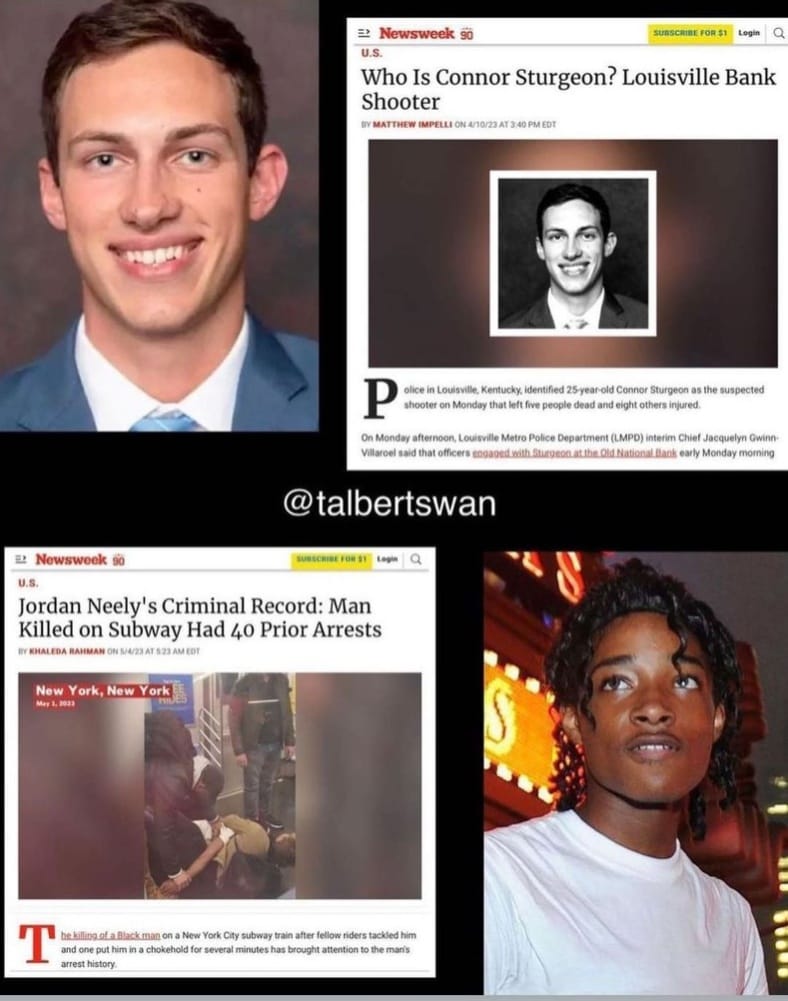
This meme uses the juxtaposition of two news headlines to comment on the lack of media attention and outrage towards the murder of a white man by a black man, in contrast to the intense media coverage and public outcry when a black man is killed by a white man. The meme highlights the racial disparity in media coverage and public reaction to violent crimes. The text "Racism is a White Problem" appears in the image, emphasizing the need for white people to acknowledge and address their own role in perpetuating racism.
detailed-analysis (gemma3-27b-vision)
Okay, here's an analysis of the images presented, broken down into the sections you requested, focusing on how these images and their surrounding headlines present a complex and often problematic framing of violence and criminality. Please be aware that this is a sensitive topic, and this analysis aims to unpack the ways power, representation, and ideology are at play. It is long, as requested.
Please Note: I'm analyzing the visual elements in conjunction with the headlines. The headlines significantly influence how the images are interpreted. The @talbertswan watermark suggests a deliberate curation of these images by someone, likely to make a specific argument, which is factored into the analysis.
Visual Description
The image is a composite of four separate images arranged in a grid-like format.
- Top Left: A close-up of a young white man, presumably Connor Sturgeon, smiling and wearing a blue blazer. The portrait is well-lit and relatively high-resolution, suggesting an official or professional photograph (perhaps a school or LinkedIn profile picture). The presentation is "clean" and "polished."
- Top Right: A Newsweek article headline and accompanying image of Connor Sturgeon. The photo is a different angle, slightly more casual. The article headline states: "Who Is Connor Sturgeon? Louisville Bank Shooter."
- Bottom Left: A Newsweek headline: "Jordan Neely's Criminal Record: Man Killed on Subway Had 40 Prior Arrests." This is paired with an image of a New York City subway car.
- Bottom Right: A photograph of Jordan Neely. The image is lower resolution and has a darker, more grainy quality. Neely is depicted in a casual setting, wearing a cap and a shirt with a logo. His facial expression is difficult to interpret.
The composition creates a clear visual dichotomy. The images of Connor Sturgeon are presented with a degree of respectability, while the image of Jordan Neely is more stark and potentially dehumanizing. The framing emphasizes a contrast in presentation, potentially subtly influencing the viewer’s perception of each individual and their actions.
Foucauldian Genealogical Discourse Analysis
Foucault's genealogical approach examines how discourses (systems of thought, language, and practice) create knowledge and power. This image set is a fertile ground for this analysis:
- Discourse of Criminality: The headlines immediately position both Sturgeon and Neely within a discourse of criminality. However, the way this is done is markedly different. Sturgeon's framing focuses on “Who Is He?” – an attempt at understanding his motivations, framing him as an individual before defining him solely by his violent act. Neely’s framing, in contrast, begins with his “Criminal Record.” This instantly reduces him to a collection of past offenses.
- Construction of the “Dangerous Subject”: Both images contribute to the construction of the “dangerous subject,” but in different ways. Sturgeon is presented as someone who became dangerous, implying a path to radicalization that is seen as somewhat understandable (though not excusable). Neely’s image, combined with the headline, presents him as inherently dangerous, a pre-existing threat.
- The Power of Documentation: The high-quality portraits of Sturgeon create a sense of official documentation and legitimacy. The grainy image of Neely suggests a less “official” record, potentially reinforcing stereotypes and biases. The choice of which images are circulated and how they are presented is an exercise of power.
- Normalization of Violence: By immediately providing details of Neely's prior arrests, the headline potentially normalizes the violence he experienced (being held in a chokehold until death). The focus on his "record" subtly shifts blame onto the victim.
The image set demonstrates how discourse creates the very categories of "criminal" and "victim," and how these categories are not neutral but are deeply embedded in power relations.
Critical Theory
Applying a critical theoretical lens, this image set reveals how dominant ideologies are reinforced through media representation:
- Hegemony: The contrasting presentations of Sturgeon and Neely exemplify how the dominant ideology (in this case, a system that privileges white narratives and often demonizes marginalized communities) maintains its power. The "humanization" of the white shooter, contrasted with the immediate focus on the Black man's criminal record, reinforces existing power imbalances.
- Ideology and Representation: The images are not neutral representations of reality; they are constructed to uphold specific ideological beliefs. The emphasis on Sturgeon's background suggests a desire to understand the “why” behind his actions, while the emphasis on Neely’s past reinforces negative stereotypes and obscures the circumstances of his death.
- The Gaze: The presentation of these images also relates to the concept of the gaze. The images of Sturgeon invite empathy and understanding, while the image of Neely appears more distant and potentially judgmental, aligning with a surveillance-based gaze.
- Power Dynamics: The use of contrasting images reinforces the power dynamics inherent in these narratives. The higher quality image and emphasis on understanding Sturgeon demonstrate a certain level of respect and value assigned to his life, while the lower quality image and focus on Neely’s record can contribute to dehumanization and the justification of violence against him.
Marxist Conflict Theory
From a Marxist perspective, this image set illustrates the underlying class and racial conflicts within society:
- Class and Media Control: The production and dissemination of these images are controlled by media outlets, which are often owned and influenced by powerful economic interests. The choice of which stories to cover, how to frame them, and which images to use reflect these interests.
- Ideological State Apparatus: The media acts as an “Ideological State Apparatus” (as theorized by Louis Althusser), reinforcing the dominant ideology and maintaining the status quo. The presentation of these two cases arguably serves to reinforce existing class and racial hierarchies.
- The Criminalization of Poverty: Neely’s prior arrests, many for minor offenses, may be linked to systemic issues like poverty, homelessness, and lack of access to mental healthcare. Focusing solely on his “record” ignores these root causes.
- Diversionary Tactics: The extensive coverage of the Louisville shooting, while tragic, could potentially serve as a diversionary tactic, distracting from other pressing social and economic issues.
Postmodernism
A postmodern analysis highlights the constructed nature of truth and the fluidity of meaning:
- Simulacra and Simulation: The images and headlines can be seen as “simulacra” – copies without originals – that create a hyperreality. The media representation of these events becomes more real than the events themselves.
- Deconstruction of Narrative: The juxtaposition of these two stories challenges the notion of a singular, coherent narrative. It forces the viewer to question the underlying assumptions and biases that shape our understanding of violence and criminality.
- Loss of Grand Narratives: The image set rejects the notion of universal truths or explanations. It suggests that there is no single “right” way to understand these events, and that meaning is subjective and contingent.
- The Role of the Spectator: The image set positions the spectator as an active participant in the construction of meaning. The viewer is forced to make connections and draw conclusions based on the limited information presented.
Queer Feminist Intersectional Analysis
This analysis examines how various forms of oppression (race, class, gender, sexuality, etc.) intersect to shape the experiences of individuals:
- Racialized Violence: Neely’s death is an example of racialized violence, where race plays a significant role in the perpetration of harm. The immediate focus on his criminal record can be seen as a way to justify the violence against him.
- Dehumanization and Marginalization: The dehumanizing portrayal of Neely, combined with the emphasis on his past offenses, reinforces the marginalization of Black men in society.
- Gendered Power Dynamics: While gender is not immediately apparent in this case, it is important to consider how gendered power dynamics may have played a role in the responses to these events.
- Intersectionality of Oppression: The image set highlights the intersectionality of oppression, where race, class, and other factors combine to create unique forms of disadvantage. Neely, as a Black man with a history of poverty and mental health issues, faced a particularly complex set of challenges.
- Silencing and Erasure: The emphasis on the white shooter’s background, while the Black victim is immediately labeled with a record, reflects a systemic pattern of silencing and erasing the experiences of marginalized communities.
Concluding Remarks:
This image set, curated by @talbertswan, is a powerful commentary on the ways in which media representation can reinforce existing power imbalances and perpetuate systemic injustices. By juxtaposing these two stories, the curator forces the viewer to confront the ways in which race, class, and other factors shape our understanding of violence and criminality. The analysis presented here aims to unpack the complex layers of meaning embedded within these images and headlines, revealing the ways in which they contribute to the construction of a deeply unequal and unjust world.
simple-description (llama3.2-vision)
This meme is a commentary on the media's tendency to sensationalize and exploit tragic events. The image shows a split-screen comparison between a news article about the Buffalo mass shooting and a news article about a bank robbery where the perpetrator was killed by the police. The text at the top reads "When the shooter is white, when the shooter is black".
tesseract-ocr
= Newsweek 3 ne us Who Is Connor Sturgeon? Louisville Bank ; Shooter ba _- vexrioew arent A 2 er | Lm | | CUE e-T ala) » Nowswook $i eed "| NY Jordan Neely's Criminal Record: Man Killed on Subway Had 40 Prior Arrests naseoa naman e % Reha okt | ‘ay wr ‘ ue i 4 } } ' - r a. ' 5 = b bi 4 | = A > y ‘ @ T= nce rene oe oe r