First Seen
2023-05-10T21:03:34+00:00
simple-description (llama3.2-vision_11b)
In this meme, a woman is depicted wearing a hijab and a long coat, while a woman in a "Get Fit" gym outfit is shown in the background, implying a contrast between the two women's fitness goals. The text "I'm not racist, I just think you're a threat to my fitness goals" is overlaid on the image, highlighting the absurdity of using racism as an excuse to avoid interacting with someone. The meme uses humor to comment on the insidiousness of racism and the ways in which it can be used to justify discriminatory behavior.
detailed-analysis (gemma3-27b-vision)
Here's an analysis of the image, broken down into sections as requested. Not all sections will be relevant, and the depth of analysis will vary depending on applicability.
Visual Description
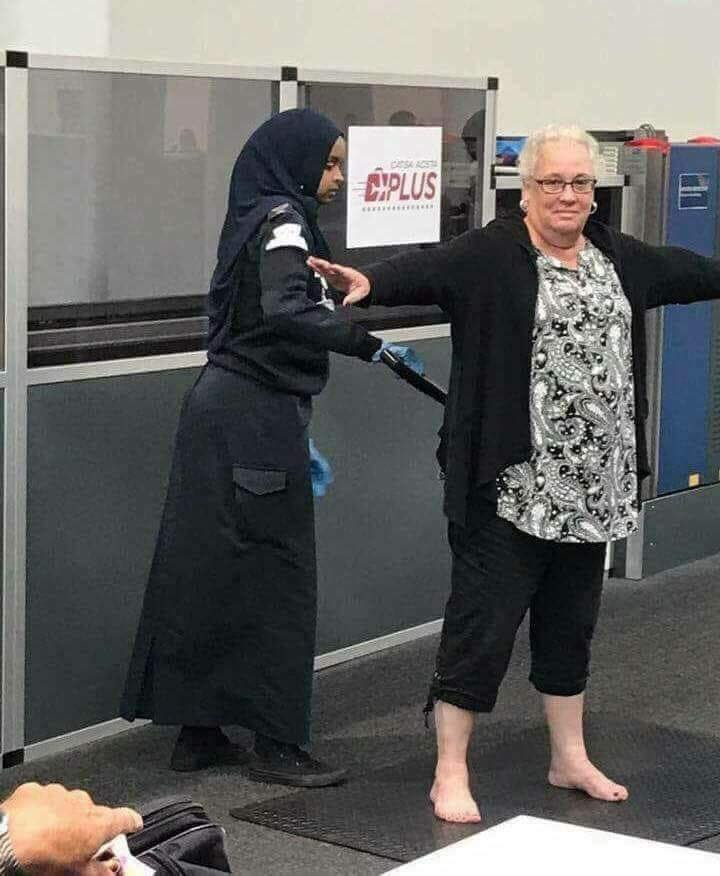
The photograph depicts a woman undergoing a security screening at an airport. She stands with arms outstretched, facing a full-body scanner. A security officer, wearing a hijab and blue gloves, is positioned to her left, seemingly directing her pose. The security officer is wearing a black uniform and a headscarf. The woman being scanned is wearing a floral-patterned top, black capri pants and is barefoot. The scanning machine is visible in the background, along with some surrounding structures. The overall setting is utilitarian and sterile, characteristic of airport security checkpoints. A sign reading “iPLUS” is visible. The scene is lit with a cool, artificial light. Part of another person’s face is visible in the bottom left.
Foucauldian Genealogical Discourse Analysis
This image is powerfully illustrative of Michel Foucault's concepts of power, surveillance, and discipline. The airport security checkpoint is a perfect example of a "panoptic" space. While not a literal panopticon (a prison where inmates are constantly visible to a central watchtower), the logic is similar. The woman being scanned is subjected to a system of observation (the scanner, and the security officer) that shapes her behavior, even before any 'crime' is committed. The woman is not seen as an individual but as a potential threat, categorized and subjected to standardized procedures.
- Discourse: The image embodies a discourse of security, risk assessment, and national protection. It’s not merely about finding threats, but creating a framework where everyone is potentially suspect.
- Power/Knowledge: The technology (the scanner) isn’t neutral. It creates knowledge about the individual – a digital 'image' of their body – and this knowledge is then used to exercise power over them. The rules and protocols governing the scan itself define what constitutes a 'normal' body and what is considered suspicious.
- Genealogy: A genealogical approach would examine how the current system of airport security developed historically, tracing the shifts in anxieties about terrorism and the evolving technologies used to control movement.
Critical Theory
The image offers fertile ground for a Critical Theory analysis, particularly regarding the ways power operates through seemingly neutral systems.
- Ideology: The security checkpoint can be viewed as a manifestation of ideological control. It subtly reinforces the idea that constant surveillance is necessary for safety, naturalizing the intrusion into personal space and privacy. The system promises security, but it does so at the cost of freedom and normalization of control.
- Commodification of the Body: The body of the woman being scanned is, in a sense, “commodified” – it becomes data to be analyzed and categorized. The scanner ‘reads’ the body, transforming it into information.
- Rationalization and Bureaucratization: The checkpoint exemplifies Max Weber's concept of rationalization – the increasing dominance of bureaucratic processes and impersonal rules. The woman is not treated as an individual but as a case, subjected to a standardized procedure.
Postmodernism
A postmodern reading might emphasize the image’s deconstruction of traditional notions of safety, identity, and boundaries.
- Simulacra and Simulation: The checkpoint can be seen as a 'simulation' of security. It appears to provide safety, but its effectiveness is debatable. The rituals of security become more important than the actual reduction of risk.
- Fragmentation of the Self: The scanning process can be interpreted as a fragmentation of the body, reducing it to digital data. This suggests a loss of wholeness and a decentering of the individual.
- Questioning Grand Narratives: The image challenges the grand narrative of national security, questioning its assumptions and highlighting the costs to individual freedom.
Queer Feminist Intersectional Analysis
This image also lends itself to analysis through a Queer Feminist Intersectional lens.
- Gendered Surveillance: The act of being subjected to full-body scans can be particularly invasive for women and individuals who do not conform to gender norms. The scan focuses on the body and can be experienced as a violation of bodily autonomy, disproportionately affecting those who are already vulnerable to objectification and sexualization.
- Racialization and Islamophobia: The security officer wearing a hijab immediately introduces questions about race, religion, and the dynamics of power. The fact that she is performing the scan on another person could be interpreted as a complex intersection of power and marginalization. Is she being used to normalize surveillance? Is she embodying the "good Muslim" who helps enforce security measures? This situation has the potential to reinforce negative stereotypes and contribute to Islamophobia.
- Intersectionality: The image highlights how different forms of oppression (gender, race, religion, security) intersect and create unique experiences of control and vulnerability. The woman being scanned is not simply a “body,” but a complex individual with a particular history, identity, and social location. The power dynamics at play are shaped by these intersecting factors.
- Bodily Autonomy and Control: The act of being scanned is a clear violation of bodily autonomy. The woman has no control over the process, and her body is subjected to scrutiny and judgment. This highlights the ways in which power operates through the control of bodies and the restriction of agency.
It's important to note that these are just potential interpretations, and the image is open to multiple readings. The richness of the image lies in its ability to provoke critical thought about power, control, and the social forces that shape our lives.
simple-description (llama3.2-vision)
The meme features a photo of a woman in a hijab helping an older woman with her yoga pose. The older woman is standing on one leg with her arms outstretched, while the woman in the hijab is holding her arms and providing support. The text "I'm not helping, I'm just making sure you don't fall on your face" is overlaid on the image.
tesseract-ocr
= — | a? : a r Va ee : ae ‘acl < =] pe oo) iy > ee , ; oe it i f ne pits