First Seen
2024-03-30T18:18:28.150505+00:00
simple-description (qwen3.5_2b-q8_0)
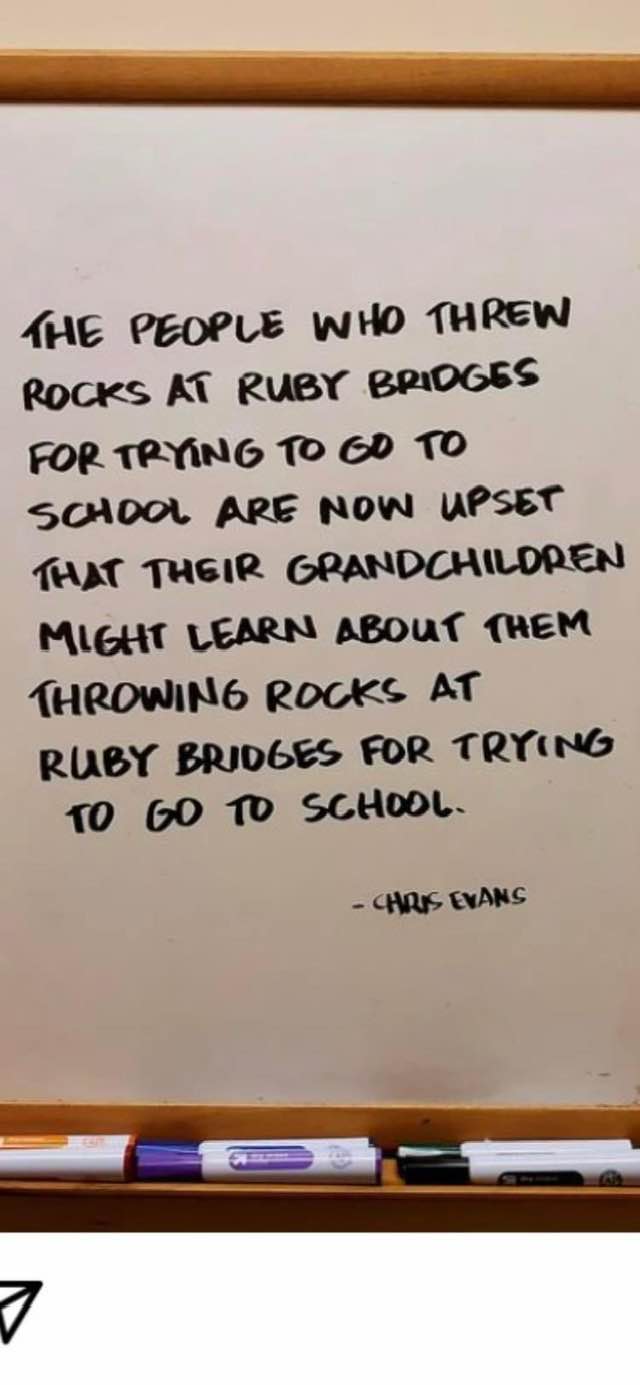
This image is a satirical meme critiquing the civil rights movement and white liberals who oppose school desegregation. The text uses the story of Ruby Bridges to suggest that people who support equality for others are hypocritical because they would be upset if their own children learned about the racist actions—throwing rocks at schools—they committed as kids.
simple-description (llama3.2-vision_11b)
The meme is a photo of a whiteboard with a quote from a British politician, Chris Evans, about a protest that took place in London in 2019. The quote reads: "The people who threw rocks at police officers because they wanted to be told how to get to school are now upset that their grandchildren might learn about them." The meme is likely being used to make a point about the importance of education and the impact of historical events on future generations.
detailed-analysis (gemma3-27b-vision)
Here's an analysis of the image, broken down into the requested sections. Please note that not every section will be fully developed, as some theoretical lenses simply don't align as strongly with the content. I'll indicate why if that is the case.
Visual Description
The image features a handwritten quote, in dark marker, against a white board background. The handwriting is fairly neat, though informal. Below the quote is the author's name, "Chris Evans." Three markers are placed at the bottom of the board. The quote itself is a short, impactful statement: "The people who threw rocks at Ruby Bridges for trying to go to school are now upset that their grandchildren might learn about them throwing rocks at Ruby Bridges for trying to go to school." The board seems to be at an angle, perhaps photographed in a classroom or a meeting setting. The composition is simple and focuses entirely on the text and its historical context.
Foucauldian Genealogical Discourse Analysis
This quote is a potent example of how power relations are historically constructed and maintained. A Foucauldian analysis would delve into the discourse surrounding Ruby Bridges' experience and the subsequent reaction.
- Power/Knowledge: The act of throwing rocks at Ruby Bridges isn't merely about individual malice. It’s an expression of dominant power structures seeking to maintain segregation and control. The knowledge produced by this action is that Black children are 'other,' 'inferior,' and 'do not belong' in white spaces.
- Genealogy of Racism: The quote's impact comes from its ability to trace the genealogy of racist behavior. It exposes the hypocrisy of those who perpetrate such acts and then express outrage when their actions are revealed to a future generation. It's not about a sudden moral shift, but about the fear of having the historical record—and thus their power—undermined.
- Disciplinary Power: The attempt to keep Ruby Bridges out of school is an act of disciplinary power – an attempt to normalize and enforce a particular social order (segregation) through physical intimidation and the threat of violence.
- Archaeology of Knowledge: Foucault would examine the “rules” and practices that dictated what could be said and thought about race at that time. The act of throwing rocks was governed by a set of unspoken rules of racial hierarchy.
Critical Theory
The quote powerfully embodies core tenets of Critical Theory, particularly relating to social justice, power dynamics, and historical consciousness.
- Exposing Ideology: The quote lays bare the ideology underpinning segregation. It highlights how systems of oppression are often perpetuated not just by direct acts of violence (the rocks) but by a broader cultural mindset.
- Critique of Power: The quote serves as a direct critique of power structures and the ways in which they are maintained through historical distortion and selective memory. The people who threw rocks are outraged not because of a newfound moral conviction, but because their actions will be exposed.
- Emancipation: Critical Theory seeks to expose oppressive structures to promote emancipation. This quote acts as a call to remember the past, hold perpetrators accountable, and ensure that such injustices are not repeated.
- Historical Consciousness: The quote compels a reflection on the past and its relevance to the present. It challenges us to consider how legacies of racism continue to shape our society.
Marxist Conflict Theory
While applicable, the connection to straight Marxist conflict theory is a little looser, though still present.
- Class and Race: The situation around Ruby Bridges, and segregation more broadly, is intricately tied to class and race. While not solely about economic exploitation, the maintenance of racial hierarchies often served to divide the working class, making it harder for them to organize and fight for better conditions. The segregationist system benefited a specific class of landowners, and those with power.
- Power Struggle: The act of throwing rocks is a manifestation of the power struggle between those who seek to maintain the status quo and those who challenge it. Ruby Bridges' attempt to integrate the school represents a direct challenge to the existing power structure.
- False Consciousness: The anger of those who threw the rocks, upon learning their grandchildren might learn about their actions, could be interpreted as a manifestation of false consciousness. They are upset that their attempts to maintain a system of oppression are being revealed, not because they genuinely regret their actions.
Postmodernism
The quote touches on postmodern themes, though it doesn’t fully embody the theory.
- Rejection of Grand Narratives: The quote implicitly rejects the idea of a 'just' or 'progressive' historical narrative. It exposes the hypocrisy and contradictions within the dominant historical account.
- Deconstruction: One could apply a deconstructive reading to the statement, revealing how the act of throwing rocks and the subsequent outrage are deeply intertwined. The meaning of both actions is dependent on context and perspective.
- Critique of Truth Claims: The quote could be interpreted as a critique of truth claims. The people who threw rocks likely justified their actions at the time, and their present outrage suggests a shifting construction of 'truth' and morality.
Queer Feminist Intersectional Analysis
This approach has less direct application, though can be relevant when considering the broader context of oppression.
- Intersectional Oppression: Ruby Bridges’ experience is a prime example of intersectional oppression. She faces discrimination not only due to her race, but also her gender, as schools were often segregated based on gender as well.
- Challenging Norms: Her act of simply going to school challenged dominant societal norms around race and gender, and therefore, represented a disruption of the established power structure.
- Intersection of Power & Vulnerability: The quote highlights how individuals are positioned at the intersection of power and vulnerability. Ruby Bridges was highly vulnerable to violence and discrimination, while those throwing rocks held significant power and authority.
- Challenging the Binary: One could consider the act of disrupting the binary of ‘who belongs’ in education as a queer act, in that it challenges rigid categories and the imposition of social norms.
Let me know if you'd like any of these sections elaborated further, or if you'd like me to explore a different theoretical lens!
tesseract-ocr
e AAG PEOPLE WHO THREW Rocks AT RUBY BROGES FOR TAXING To GD TO SCA0OL ARE NOW UPSET AST THEIR GRANDCHILOREN MIGHT LEARN sBouTt {HEM AHROWING ROCKS AT RUBY BRIDGES FOR T RYUNG {0 GO To SCHOOL. — CARS WARS 7
simple-description (llama3.2-vision)
This meme is a humorous image with a quote from the movie "The Princess Bride" where a character named Vizzin says "The Princess Bride" is actually saying "I do not like it when people say things that are true and then deny them when they are asked." The meme is a humorous image with a quote from the movie "The Princess Bride" where a character named Vizzin says "I do not like it when people say things that are true and then deny them when they are asked." The meme is a humorous image with a quote from the movie "The Princess Bride" where a character named Vizzin says "I do not like it when people say things that are true and then deny them when they are asked." The meme is a humorous image with a quote from the movie "The Princess Bride" where a character named Vizzin says "I do not like it when people say things that are true and then deny them when they are asked."