First Seen
2023-05-10T21:03:34+00:00
simple-description (llama3.2-vision_11b)
This meme is a humorous and satirical commentary on the controversy surrounding the use of police badges as a symbol of authority and the racial tensions that have been sparked by the Black Lives Matter movement. The image shows a white police officer standing behind a young black boy holding a sign that reads "I can breathe" - a reference to the infamous phrase "I can breathe" that was used by the police to justify the killing of George Floyd. The meme is a darkly comedic commentary on the racial disparities in the justice system and the ways in which the police are often able to get away with violence against black people.
detailed-analysis (gemma3-27b-vision)
Okay, here's an analysis of the image, broken down into the requested sections, only addressing those sections where relevant to the content of the image.
Visual Description
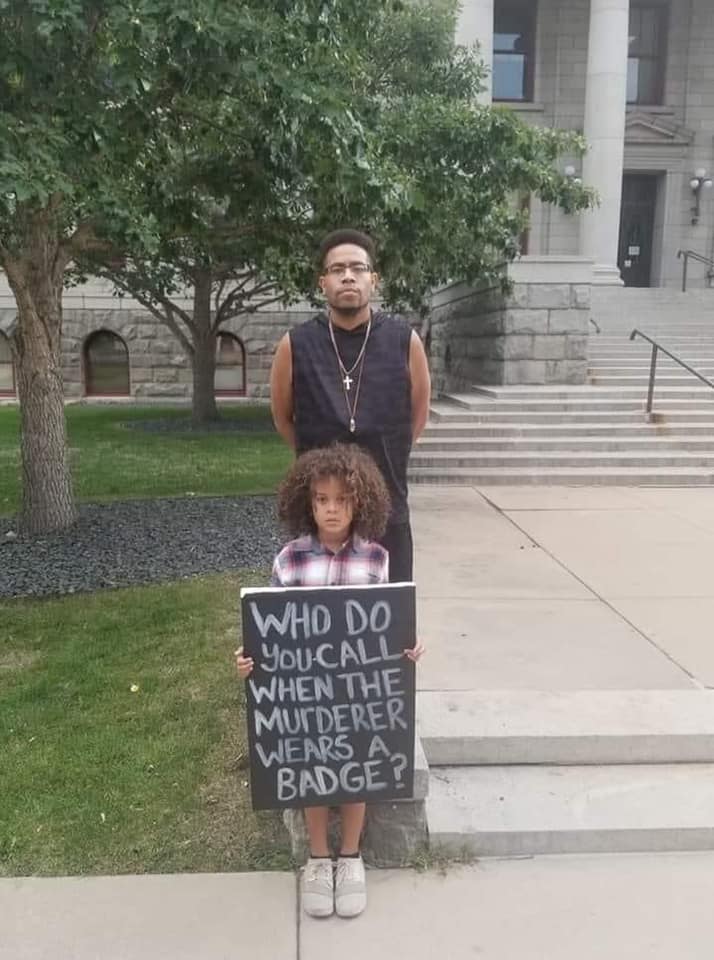
The photograph depicts a young Black child (approximately 6-8 years old) and an adult Black man standing on a sidewalk, holding a handmade sign. The sign reads, in bold, handwritten lettering, “WHO DO YOU CALL WHEN THE MURDERER WEARS A BADGE?” The background shows a stone building with stairs, suggesting a courthouse or government building. There is lush greenery in the form of trees and well-maintained landscaping. The child is looking up, while the adult stands behind and appears to be providing support and supervision. The child is wearing a plaid shirt and dark pants with shoes. The man is wearing a black tank top and a chain. Both are looking forward and directly at the camera.
Foucauldian Genealogical Discourse Analysis
This image is profoundly linked to Foucault’s ideas about power, discourse, and knowledge. The sign explicitly challenges the discourse surrounding law enforcement and the legitimacy of its authority.
- Power/Knowledge: The statement implies that the traditional understanding of "law enforcement" as protectors and servants of justice is a constructed discourse masking a different reality – one where those in authority can be perpetrators of violence. The "badge" isn't simply a symbol of legitimacy, but a tool that conceals and legitimizes violence.
- Genealogy: A Foucauldian genealogical analysis would explore the historical formation of the concept of policing. It would trace the evolution of the "badge" from a symbol of community protection to a potential indicator of abuse. This image implicitly asks us to question the history of policing in the US, particularly concerning race and the disproportionate violence experienced by Black communities.
- Discipline & Punishment: The question points to a breakdown in the systems of accountability and discipline intended to regulate the police. The "murderer wearing a badge" represents a failure of those systems to effectively prevent or punish abuse of power.
Critical Theory
This image deeply resonates with the principles of Critical Theory, particularly the Frankfurt School's concerns with ideology and power structures.
- Ideology Critique: The sign fundamentally challenges the dominant ideology surrounding law enforcement. The unquestioned belief in the "good cop" narrative is disrupted by the assertion that a "murderer" can be disguised by the badge.
- Hegemony: The image implies that a hegemonic narrative of law enforcement has been constructed that normalizes and protects problematic behavior. The question demands a disruption of that narrative and a re-evaluation of the power dynamics at play.
- Emancipatory Potential: The image, while critical, also contains an element of emancipatory potential. By raising the question, it invites a collective reconsideration of power structures and a demand for accountability. The fact that a child is involved highlights the urgency and necessity for change, in order to safeguard future generations.
Marxist Conflict Theory
This image has strong connections to Marxist Conflict Theory, as it highlights power imbalances and oppression.
- Class Struggle: While the image doesn't explicitly mention class, the history of policing in the US is deeply intertwined with controlling marginalized communities, including those facing economic hardship. The "murderer wearing a badge" can be seen as representing a system of oppression used to maintain the status quo and protect the interests of the powerful.
- State Apparatus: The police, in this context, are seen as an arm of the state used to enforce existing power structures, and the sign's question implies that the state is failing to hold its own agents accountable.
- Exploitation & Oppression: The image indirectly alludes to the historical exploitation and oppression of Black communities by a system that ostensibly exists to protect them.
Postmodernism
The image can be seen through a postmodern lens by questioning the grand narratives of justice and authority.
- Deconstruction of Truth: The sign implicitly deconstructs the notion of objective truth about law enforcement. It disrupts the assumption that police are inherently "good" and suggests that the perception of justice is socially constructed.
- Relativism & Subjectivity: The image suggests that experiences with law enforcement are not universal, but rather shaped by power dynamics and social positioning.
- Rejection of Metanarratives: It challenges the “metanarrative” of law and order as an inherently positive force, instead asking viewers to question the underlying assumptions of this narrative.
Queer Feminist Intersectional Analysis
While the image doesn’t explicitly focus on queer or feminist issues, an intersectional analysis is still relevant.
- Interlocking Systems of Oppression: The experience of police brutality and systemic oppression is often compounded for individuals facing multiple forms of marginalization, including race, gender, sexual orientation, and socioeconomic status.
- State Violence: An intersectional feminist analysis emphasizes how state violence (in this case, by law enforcement) disproportionately affects marginalized communities, including Black women, transgender individuals, and queer people of color.
- Vulnerability: Children, particularly Black children, are uniquely vulnerable to the impacts of state violence and systemic oppression, making their involvement in the protest all the more impactful.
Let me know if you'd like me to elaborate on any of these points or provide additional analysis.
simple-description (llama3.2-vision)
This meme features a photo of a man and a young boy standing on the steps of a courthouse or similar building. The boy is holding a sign that reads "I can explain" in a childlike handwriting, implying that he is trying to justify or explain something.
tesseract-ocr
os mae a pe r ay K Barth es X x mee: | SA ee no gg i Mg i) ae Soy aa: eo \) i 4 a ale My i's i iN ore — a= : + = : G was os PO an (Nees ee ANT l= so na ee: Wty Seg: aut: kag Pee wea d Bi pet Ries 5 ce eae : i FO ees aa Rie: