First Seen
2023-05-10T21:03:34+00:00
simple-description (llama3.2-vision_11b)
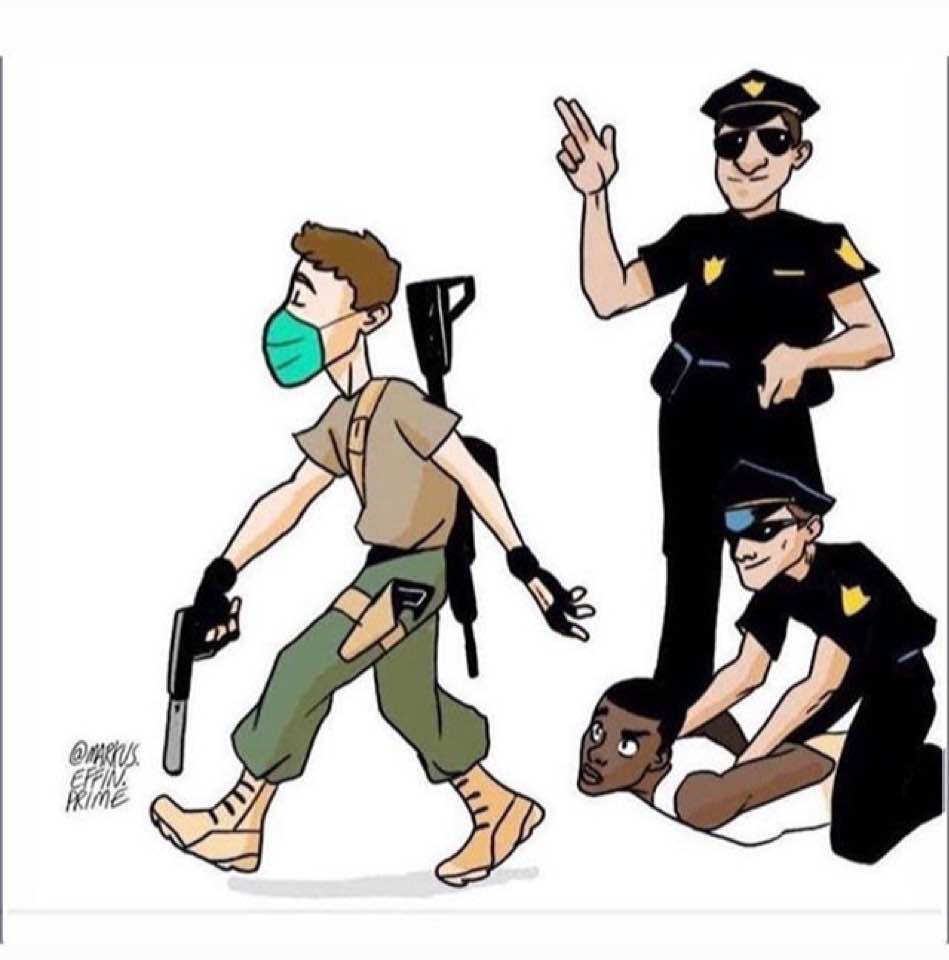
The meme is a satirical illustration depicting a white man with a gun, wearing a mask and carrying a rifle, juxtaposed with a black man kneeling and handcuffed, with a police officer standing over him. The text "I'm not racist" is written in a childish, scribble-like font above the white man's head. The meme is a commentary on systemic racism and police brutality, highlighting the absurdity of a white person claiming to be non-racist while perpetuating a racist stereotype.
detailed-analysis (gemma3-27b-vision)
Okay, here's an analysis of the cartoon based on the requested theoretical frameworks. I'll include sections only where the theory is relevant to the image. It's important to note that interpreting art is subjective, and these analyses are interpretations based on the frameworks.
Visual Description
The cartoon depicts a stark contrast between two figures and two kneeling individuals. On the left, a white man is fully equipped with tactical gear, a mask, and firearms, looking at the viewer with an assertive stance. On the right, two police officers in uniform stand over two kneeling Black figures, one appearing to be a man and the other a woman. The police officers are one standing with a hand raised in a "peace" sign gesture, while the other is standing over and seemingly suppressing the kneeling figures. The art style is cartoonish, with exaggerated features and strong lines. There’s a signature in the bottom left. The entire scene is set against a plain background, adding to the visual impact of the contrast.
Foucauldian Genealogical Discourse Analysis
This cartoon is a prime example for a Foucauldian analysis. The imagery illustrates power dynamics.
- Power/Knowledge: The tactical gear and weaponry of the white man symbolize a claim to legitimate knowledge and authority. He’s presented as “knowing” how to protect something, while the kneeling figures are depicted as lacking that knowledge and control. The police’s uniform are symbols of a perceived legitimate authority to maintain order, but the gesture of the “peace” sign complicates this. It suggests a performance of order while simultaneously exerting control.
- Discourse and Discipline: The scene itself constructs a discourse about security, law and order, and who is seen as a threat. The kneeling figures are implicitly positioned as “deviant” or “threatening,” justifying the police’s intervention and the white man’s readiness for conflict. It is a visible demonstration of a disciplinary power that acts through surveillance (the gaze of the police and armed man) and normalization (the expectation of submission from the kneeling figures).
- Genealogy: A genealogical reading would trace how the practices and ideas underlying this scene have historical roots. The imagery evokes a history of racialized policing, the “militarization” of civilian populations and an implicit fear of Black people and the need for control. It points to a genealogy of power where certain groups are historically positioned as subjects to be governed and others as those who exercise governance.
Critical Theory
This cartoon speaks directly to core tenets of Critical Theory.
- Ideology and Hegemony: The image subtly reinforces ideologies about race, safety, and authority. The white man’s preparation and the police’s presence perpetuate the idea that vigilant protection is necessary, implicitly suggesting a threat from those kneeling, rather than systemic societal failures. This contributes to a hegemonic narrative where certain groups are perpetually cast as the problem.
- Dominant and Subordinate Groups: The cartoon clearly illustrates power imbalances between the white man/police and the kneeling Black figures. This underscores the idea that society is structured around dominant groups maintaining control over subordinate groups.
- The Critique of Enlightenment Reason: The seemingly “rational” display of force and security can be interpreted as a critique of Enlightenment ideals. While seemingly logical, the justification for this power differential is based on historically constructed and biased assumptions.
Marxist Conflict Theory
This cartoon directly reflects themes central to Marxist Conflict Theory.
- Class Struggle and Power Dynamics: While not explicitly about economic classes, the image depicts a power struggle rooted in racial and social stratification. The figures with power (armed man/police) represent those who control the means of maintaining order, while the kneeling figures represent those subjected to that control.
- Oppression and Exploitation: The kneeling figures are visually oppressed and deprived of agency. This represents the broader concept of exploitation, where one group benefits from the control and suppression of another.
- False Consciousness: The “peace” sign gesture by the police could be seen as a performative act aimed at masking the reality of control and oppression. This contributes to a “false consciousness” where the true nature of the power dynamics is obscured.
Postmodernism
The cartoon has certain postmodern elements in how it subverts and challenges traditional narratives.
- Deconstruction of Grand Narratives: The image critiques the “grand narrative” of law and order, revealing the inherent biases and power dynamics that underpin it.
- Simulation and Hyperreality: The gesture of the “peace” sign can be seen as a simulation, a superficial performance that masks the underlying reality of control and oppression.
- Emphasis on Subjectivity: The cartoon invites viewers to question the perspectives and assumptions that shape their understanding of power and authority. It acknowledges the subjective nature of reality and challenges the notion of a single, objective truth.
Queer Feminist Intersectional Analysis
The image has elements that a queer feminist intersectional analysis can address.
- Interlocking Systems of Oppression: The cartoon highlights how race, gender and power intersect to create systems of oppression. The kneeling figures are racialized and their bodies are under control, while the image exposes the gendered dimensions of power with the representation of the female kneeling figure.
- Representation and Visibility: The cartoon focuses on the visibility of Black bodies as subjects of control and surveillance. The absence of representation of LGBTQ+ individuals does not negate the possibility of extending this analysis.
- Challenging Normative Power Structures: The image critiques the patriarchal and colonial power structures that reinforce these inequalities.
Disclaimer: This is an interpretive analysis, and other readings are possible. The image is complex and invites multiple levels of understanding.
simple-description (llama3.2-vision)
This meme is a satirical illustration that juxtaposes two different scenarios. On the left, a person is shown with a gun, wearing a mask and a backpack, likely representing a modern-day armed individual. The text "2nd Amendment" is likely written in the background. On the right, two police officers are shown restraining and handcuffing another person, likely representing a law enforcement scenario.
tesseract-ocr
’, Si Ee y in > iN ae J P B OS 2 a ol aD ine SS y ; Ff