First Seen
2023-05-10T21:03:34+00:00
simple-description (llama3.2-vision_11b)
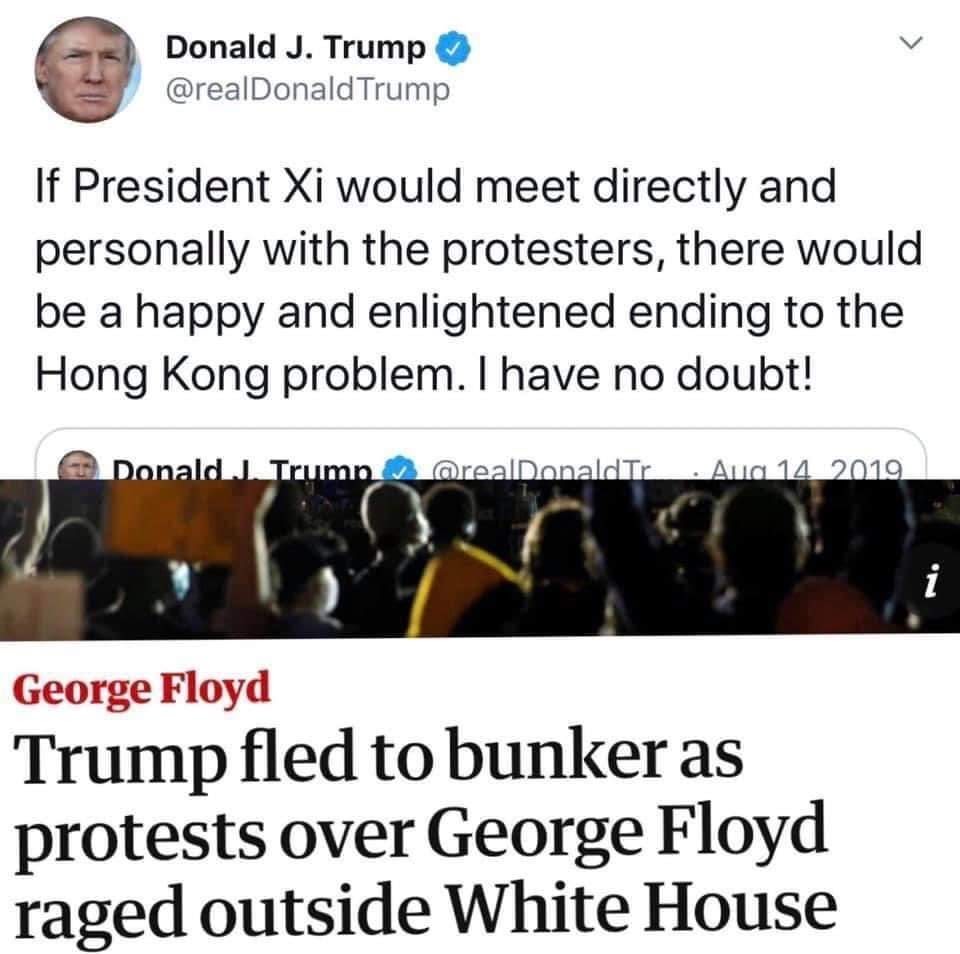
The meme is a screenshot of a tweet from Donald Trump's Twitter account, where he attempts to downplay the significance of the Hong Kong protests by comparing them to the situation in the US. He implies that if he were to meet with the protesters in Hong Kong, he would have a happy and enlightened ending to the Hong Kong problem. The meme is likely being used to criticize Trump's tone-deafness and lack of understanding of the Hong Kong protests, which are a response to the Chinese government's crackdown on the city's autonomy. The meme is likely being used to highlight the hypocrisy of Trump's statement, as he is known for his own "camps" at the US-Mexico border.
detailed-analysis (gemma3-27b-vision)
Here's an analysis of the image and text, broken down into the requested theoretical lenses. It's important to note that some lenses apply more strongly than others, and analysis can overlap.
Visual Description
The image presents a juxtaposition of two Twitter posts. The top post is a screenshot of a tweet from Donald Trump from August 14, 2019, concerning Hong Kong protests. It states that if President Xi Jinping would meet with protestors, there would be a "happy and enlightened ending." The accompanying profile picture is a highly stylized, digitally altered rendering of Trump.
Below this, is a screenshot of an article headline/image which reports that Trump took shelter in a bunker during protests related to the death of George Floyd. The photo accompanying the headline shows a dimly lit space, seemingly underground, with a visible person in the background. The atmosphere evokes a sense of isolation and fear.
The visual pairing creates a stark contrast between Trump’s stance on protests in Hong Kong (a perceived offer of mediation) and the reported events in the United States after George Floyd's death (his retreat from direct engagement with protestors).
Foucauldian Genealogical Discourse Analysis
Foucault’s approach would examine the discourse surrounding both Hong Kong and the George Floyd protests. The contrast in Trump’s statements highlights how power operates through discourse.
- Power/Knowledge: Trump’s pronouncements on Hong Kong and his actions regarding the Floyd protests showcase how knowledge (in this case, interpretations of events) is inseparable from power. He constructs the narrative of Hong Kong protests (potentially portraying them as needing benevolent leadership) and simultaneously demonstrates his own fear of, and control efforts over, the protests within the US.
- Genealogy: A genealogical analysis would trace the historical development of the discourses surrounding protest, political leadership, and national security. How has the concept of ‘leadership in the face of unrest’ been historically constructed? How do these historical formations shape Trump’s actions and statements? The contrast highlights a double standard, potentially revealing the construction of "acceptable" protest (abroad, where a different power dynamic exists) versus "unacceptable" protest (within the US, seen as a threat to his power).
- The Panopticon: The image of Trump in the bunker subtly evokes the panoptic model. He's hiding, surveilling from a position of power, and possibly projecting an image of control even while feeling vulnerable.
Critical Theory
Applying Critical Theory (rooted in the Frankfurt School) focuses on the systems of domination embedded in social and political structures.
- Ideology: The contrast between Trump’s tweets exposes ideological underpinnings. His statement on Hong Kong could be viewed as a way to present the US as a benevolent global actor, masking underlying geopolitical interests. His response to the Floyd protests, however, demonstrates a prioritization of maintaining power and control over addressing systemic injustice.
- Hegemony: Trump attempts to assert hegemony – a dominant ideology accepted as ‘common sense.’ He positions himself as a strong leader capable of resolving conflicts abroad (Hong Kong) while simultaneously suppressing dissent at home. The bunker image subverts this position, revealing vulnerability and undermining the assertion of control.
- Critique of Reason: The image highlights a problematic use of "reason." Trump’s proposed “solution” to the Hong Kong problem rests on a simplistic belief in direct negotiation. This contrasts with his lack of engagement with the underlying issues fueling the Floyd protests. It suggests a selective application of “reason” dependent on preserving existing power structures.
Marxist Conflict Theory
From a Marxist perspective, the image demonstrates the inherent class and power struggles within society.
- Class Conflict: The Floyd protests arose from deep-seated economic and racial inequalities – a manifestation of class conflict. Trump's retreat to the bunker highlights the interests of the ruling class in protecting its power and privilege, rather than addressing systemic injustice.
- State Apparatus: The bunker represents the repressive state apparatus used to maintain the status quo. It demonstrates how the state uses force and control to suppress dissent and protect the interests of the ruling class.
- Ideological Control: Trump’s statement on Hong Kong could be seen as a way to distract from the internal conflicts within the US. By focusing on a foreign issue, he attempts to divert attention from the demands for social and economic justice within the country.
Postmodernism
A postmodern analysis would question the very notion of objective truth and highlight the constructed nature of reality.
- Deconstruction of Narrative: The juxtaposition of the two tweets deconstructs the narrative of Trump as a strong, consistent leader. His actions and statements contradict each other, revealing the arbitrary and contingent nature of meaning.
- Simulacra and Simulation: Trump’s digital image in the first tweet could be seen as a simulacra - a copy without an original. This reflects the hyperreality of contemporary politics, where image and representation often outweigh substance.
- Fragmented Truth: The image suggests that truth is not singular or objective, but rather fragmented and dependent on perspective. Trump presents different narratives to different audiences, constructing reality to suit his own interests.
Queer Feminist Intersectional Analysis
While less directly applicable than other frameworks, this lens can offer insights.
- Power Dynamics and Vulnerability: The image of Trump in the bunker reveals vulnerability – a state traditionally associated with marginalized groups. However, his position of power means this vulnerability is expressed very differently than that experienced by those protesting systemic injustice.
- Intersectional Oppression: The George Floyd protests were driven by intersectional oppression – the overlapping of racial, economic, and other forms of discrimination. Trump’s response, retreating to the bunker, demonstrates a lack of understanding or concern for these intersecting forms of oppression.
- Challenging Hegemonic Masculinity: The image of a leader seeking shelter subverts the hegemonic expectation of strong, unwavering leadership – traditionally associated with masculinity. This challenges the conventional association of leadership with control and dominance.
It's important to remember that these are just interpretations, and a more comprehensive analysis could incorporate other theoretical frameworks. The power of the image lies in its ability to evoke multiple meanings and invite critical engagement with the complexities of power, politics, and social justice.
simple-description (llama3.2-vision)
This meme is a screenshot of a tweet from Donald Trump's Twitter account, featuring a photo of a crowd of people and the caption "I have no doubt!" above a quote from Trump's tweet. The tweet itself reads: "If President Xi would meet directly and personally with the protesters, there would be a happy and enlightened ending to the Hong Kong problem. I have no doubt!" The meme is likely poking fun at Trump's lack of understanding of the Hong Kong protests and his inability to understand the complexities of the situation.
tesseract-ocr
Donald J. Trump @ Vv a @realDonaldTrump If President Xi would meet directly and personally with the protesters, there would be a happy and enlightened ending to the Hong Kong problem. | have no doubt! © Donald , oe raalDona A A 20 J Is y) & George Floyd Trump fled to bunker as protests over George Floyd raged outside White House