First Seen
2023-05-10T21:03:34+00:00
simple-description (llama3.2-vision_11b)
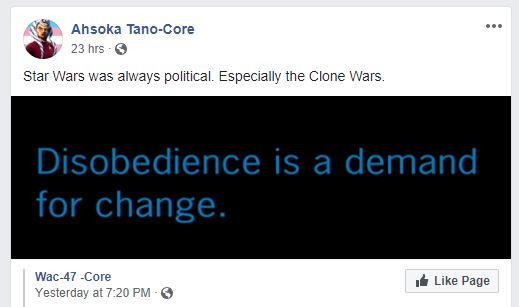
The meme features a screenshot of a Facebook post from a user named "Ahsoka Tano-Core" (a Star Wars character) with a quote from the Star Wars franchise. The quote "Disobedience is a good thing" is replaced with "Disobedience is a demand for change" to make a point about the Star Wars character's statement being an example of a demand for change.
detailed-analysis (gemma3-27b-vision)
Okay, here's an analysis of the Facebook post, broken down into the sections you requested. I'll indicate when a section doesn't apply, and I'll aim for a nuanced approach, recognizing the limitations of analyzing a single social media post.
Visual Description
The post consists of a Facebook post image. The profile picture for the page, "Ahsoka Tano-Core", features a stylized portrait of Ahsoka Tano, a character from the Star Wars universe. The main visual element is a black rectangular image with the phrase "Disobedience is a demand for change" in a bold, bright, blue font. Below the image is a comment from another Facebook page, "Wac-47-Core". The overall aesthetic is stark and declarative.
Foucauldian Genealogical Discourse Analysis
This post lends itself well to a Foucauldian analysis. Foucault's genealogy examines how concepts are constructed through discourse and power relations.
- Discourse on Disobedience: The statement itself establishes a discourse around disobedience. It doesn't simply state disobedience happens, but redefines it as a "demand." This framing suggests disobedience isn't inherently negative, but a proactive force for change. This disrupts traditional understandings of obedience as the norm.
- Power/Knowledge: The post implies that systems of power create the conditions requiring disobedience. The "demand for change" hints at existing power structures that are unsatisfactory, and disobedience is a response to that power. It positions disobedience as a form of resistance creating knowledge through action.
- Ahsoka Tano’s Significance: The page is dedicated to Ahsoka Tano, a character who actively challenges the established Jedi Order. Her journey involves questioning authority and ultimately rejecting the rigidity of the Jedi Council, making her a potent symbol for rebellion and dissent. The choice of this page as the vehicle for this message is not coincidental. The page constructs Ahsoka as a subject of resistance.
- Genealogical Trace: Tracing the history of the term "disobedience" would reveal its shifting meanings, often linked to punishment and societal control. This post actively seeks to reclaim that term and imbue it with a positive, transformative connotation.
Critical Theory
The post aligns strongly with Critical Theory.
- Ideology Critique: The statement subtly critiques the ideology of unquestioning obedience. Critical theorists argue that dominant ideologies often serve to maintain existing power structures. By reframing disobedience as a positive force, the post challenges the assumption that upholding the status quo is always desirable.
- Emancipatory Potential: The "demand for change" suggests a desire for a more just and equitable society. Critical Theory is fundamentally concerned with uncovering systems of oppression and working towards emancipation.
- Subjectivity and Agency: The post implies that individuals have agency and can actively shape their reality through acts of disobedience. This is a key tenet of many critical approaches.
- Reification and Deconstruction: The post implicitly deconstructs the reified notion of ‘authority’ and ‘order’ by questioning its inherent value and suggesting that disobedience is a legitimate response to problematic structures.
Marxist Conflict Theory
The post can be interpreted through a Marxist lens, though the connection is more indirect.
- Class Struggle: While not explicitly stated, the "demand for change" can be seen as an articulation of resistance against oppressive systems. In a Marxist framework, this might relate to economic or social inequalities. Disobedience, in this context, can be a response to exploitation or alienation.
- Ideological Control: The emphasis on disobedience challenges the ideological control of dominant groups. By reframing disobedience, the post undermines the narrative that upholding the status quo is in everyone's best interest.
- Revolutionary Potential: Though the post doesn’t call for outright revolution, it suggests a need for systemic change. Disobedience, particularly when collective, can be a catalyst for larger-scale transformation.
Postmodernism
The post embodies several postmodern themes.
- Deconstruction of Binary Oppositions: The post challenges the traditional binary opposition between “obedience” and “disobedience”, implying that neither is inherently good or bad. It complicates the simplistic equation of obedience with virtue and disobedience with vice.
- Rejection of Grand Narratives: The post can be seen as a rejection of grand narratives that justify authority and maintain power structures. It suggests that there is no single “truth” or “correct” way of doing things.
- Emphasis on Subjectivity: The post highlights the subjective experience of those who are subjected to oppressive systems. The "demand for change" implies that individuals have their own perspectives and needs that must be taken into account.
- Playfulness with Language: The declarative statement, stripped of context, creates a kind of poetic ambiguity. This playfulness with language is a common characteristic of postmodern discourse.
Queer Feminist Intersectional Analysis
While not overtly queer or feminist, the post can be read through this lens.
- Challenge to Hierarchies: Disobedience inherently challenges hierarchical power structures, which are central to systems of oppression based on gender, sexuality, race, and class.
- Intersectionality: The "demand for change" can be seen as encompassing a demand for justice across all forms of social inequality. Intersectional feminism recognizes that different forms of oppression are interconnected, and that addressing one requires addressing them all.
- Resistance to Norms: The act of disobedience itself is a form of resistance to normative expectations and social control. This is particularly relevant to queer and feminist perspectives, which often challenge dominant cultural norms.
- Power Dynamics: The choice to frame disobedience as a demand rather than a plea or request signifies a shifting of power dynamics. It asserts agency and challenges the notion that those in power have the right to dictate terms.
Important Note: This analysis is based on a single social media post. A more comprehensive understanding would require examining the broader context of the page, the user's history, and the surrounding online discourse. However, the post is rich with potential for theoretical interpretation, as I've attempted to demonstrate.
simple-description (llama3.2-vision)
The meme is a screenshot of a Facebook post from the Star Wars character Ahsoka Tano, but it's actually a joke about the TV show "Star Wars: The Clone Wars" being rebranded as "Star Wars: The Ahsoka Tano Wars". The text reads: "Star Wars was always political. Especially the Clone Wars."
tesseract-ocr
Q@P Ahsoka Tano-Core ere 231s @ Star Wars was always political. Especially the Clone Wars. Maca Core th Like Page esterday at 7:20 PM-@