First Seen
2023-05-10T21:03:34+00:00
simple-description (llama3.2-vision_11b)
The meme is a humorous commentary on the trend of "All Lives Matter" being used as a response to the Black Lives Matter movement. The image shows a person's response to a "Happy Holidays" message, with the person's name being "Karen", implying a stereotype of a middle-aged, white, and often self-absorbed woman who is known for being "not that kind of person" (i.e. a racist, a sexist, a transphobe, an Islamophobe, a xenophobe, a homophobe, a white supremacist, a neo-Nazi, a KKK member, an anti-Semitic, an anti-Christian, an anti-atheist, an anti-humanist, an anti-environmentalist, an anti-vegetarian, an anti-vegan, an anti-LGBTQ+, an anti-transgender, an anti-gender, an anti-sex, an anti-children, an anti-women, an anti-men, an anti-human, an anti-humanity, an anti-animals, an anti-environment, an anti-ecology, an anti-sustainability, an anti-climate change, an anti-nuclear, an anti-peace, an anti-human rights, an anti-humanity, an anti-animals, an anti-environment, an anti-ecology, an anti-sustainability, an anti-climate change, an anti-nuclear, an anti-peace, an anti-human rights, an anti-humanity, an anti-animals, an anti-environment, an anti-ecology, an anti-sustainability, an anti-climate change, an anti-nuclear, an anti-peace, an anti-human rights, an anti-humanity, an anti-animals, an anti-environment, an anti-ecology, an anti-sustainability, an anti-climate change, an anti-nuclear, an anti-peace, an anti-human rights, an anti-humanity, an anti-animals, an anti-environment, an anti-ecology, an anti-sustainability, an anti-climate change, an anti-nuclear, an anti-peace, an anti-human rights, an anti-humanity, an anti-animals, an anti-environment, an anti-ecology, an anti-sustainability, an anti-climate change, an anti-nuclear, an anti-peace, an anti-human rights, an anti-humanity, an anti-animals, an anti-environment, an anti-ecology, an anti-sustainability, an anti-climate change, an anti-nuclear, an anti-peace, an anti-human rights, an anti-humanity, an anti-animals, an anti-environment, an anti-ecology, an anti-sustainability, an anti-climate change, an anti-nuclear, an anti-peace, an anti-human rights, an anti-humanity, an anti-animals, an anti-environment, an anti-ecology, an anti-sustainability, an anti-climate change, an anti-nuclear, an anti-peace, an anti-human rights, an anti-humanity, an anti-animals, an anti-environment, an anti-ecology, an anti-sustainability, an anti-climate change, an anti-nuclear, an anti-peace, an anti-human rights, an anti-humanity, an anti-animals, an anti-environment, an anti-ecology, an anti-sustainability, an anti-climate change, an anti-nuclear, an anti-peace, an anti-human rights, an anti-humanity, an anti-animals, an anti-environment, an anti-ecology, an anti-sustainability, an anti-climate change, an anti-nuclear, an anti-peace, an anti-human rights, an anti-humanity, an anti-animals, an anti-environment, an anti-ecology, an anti-sustainability, an anti-cl…
detailed-analysis (gemma3-27b-vision)
Okay, here's an analysis of the image, broken down into the requested sections where applicable. It's a fairly loaded image, so a few of these sections will be quite detailed.
Visual Description
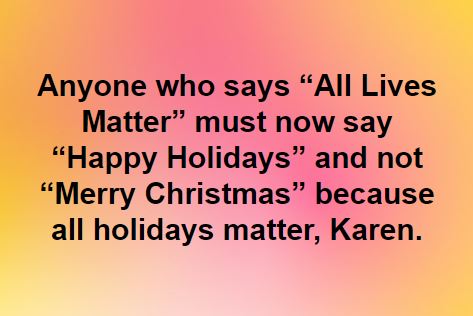
The image is a graphic with a vibrant gradient background shifting from a golden yellow to a reddish-orange. The text is in black, bold font and dominates the majority of the space. The text states: "Anyone who says 'All Lives Matter' must now say 'Happy Holidays' and not 'Merry Christmas' because all holidays matter, Karen." The use of "Karen" at the end is clearly intended as a pejorative and a dismissal of the recipient. The image aims to create a juxtaposition between two controversial slogans: "All Lives Matter" and the debate around "Merry Christmas" versus "Happy Holidays".
Foucauldian Genealogical Discourse Analysis
This image is a prime example of how discourse shapes power relations. From a Foucauldian perspective, we can trace the historical development of the concepts within the text to understand how they've come to carry specific meanings and exert power.
- "All Lives Matter" as a Counter-Discourse: "All Lives Matter" arose initially as a response to the "Black Lives Matter" movement. Foucault would see this not as a simple statement of equality, but as a discursive move to displace the focus away from systemic anti-Black racism and reassert a universalizing discourse that effectively silences specific claims of injustice. The image positions this statement as problematic.
- The "War on Christmas" Narrative: The debate over "Merry Christmas" versus "Happy Holidays" is a contemporary example of a cultural "moral panic." The narrative of a "war on Christmas" constructs a particular cultural identity (often white, Christian) as under threat, reinforcing its perceived legitimacy. By linking this to "All Lives Matter", the image suggests both are attempts to deny the legitimacy of specific groups or grievances.
- "Karen" as Disciplinary Power: The use of the term "Karen" functions as a form of micro-power. It serves to categorize and dismiss a perceived opponent (typically a white woman who is seen as entitled or demanding) without engaging with any substantive argument. It’s a form of shaming and social control.
- Genealogical Trace: Tracing the history of both slogans would reveal how they were constructed through specific historical and social contexts, and how they became intertwined with power dynamics.
Critical Theory
This image embodies many of the concerns central to critical theory.
- Ideology: The image presents a specific ideological viewpoint—that acknowledging specific struggles (like those addressed by Black Lives Matter) is not exclusionary, and that opposing that acknowledgement (using "All Lives Matter") is akin to dismissing diversity. The image is not a neutral statement but a subtle justification for specific actions or beliefs.
- Power Dynamics: The image highlights how power operates through language. The assertion that those who support “All Lives Matter” must use “Happy Holidays” is a power play—a demand for conformity and a silencing of dissent. It assumes the right to dictate language based on alignment with a particular set of values.
- Social Construction of Reality: The image reinforces the idea that even seemingly simple phrases like “Merry Christmas” and “Happy Holidays” are not neutral but are socially constructed—imbued with meaning through historical and cultural context. The image asserts a specific interpretation of these phrases.
- Hegemony: The image implies that a particular worldview (one that supports the Black Lives Matter movement and embraces inclusivity) is the dominant one, and those who don’t conform are viewed as resistant and deserving of reprimand.
Marxist Conflict Theory
From a Marxist perspective, this image can be analyzed through the lens of class and ideological struggle.
- Ideology as a Tool of Domination: The image reflects a clash of ideologies. The author is positioning their own ideology (which supports BLM and inclusivity) as being based in truth, while denouncing those who support "All Lives Matter" as misguided or oppositional. This aligns with the Marxist concept that dominant ideologies often serve to mask underlying power structures and maintain the status quo.
- Cultural Capital: The understanding and adoption of certain phrases ("Happy Holidays") can be seen as a form of cultural capital. In this context, the image suggests that recognizing the importance of inclusivity is a sign of being "with it" or "woke," while using "Merry Christmas" implies a lack of understanding or sensitivity.
- Class Struggle (Implied): While not explicitly about economic class, the image indirectly implies a cultural struggle between different groups within society. The use of "Karen" suggests an opposition to perceived entitlement and privilege.
Postmodernism
The image displays some characteristics of postmodern thought.
- Deconstruction of Meaning: The image attempts to deconstruct the seemingly simple meanings of phrases like "All Lives Matter" and "Merry Christmas," revealing the complex power dynamics and ideologies embedded within them.
- Relativism and Subjectivity: The image implicitly suggests that meaning is not fixed, but is constructed through language and social context. There is an implied rejection of universal truths and a focus on the subjective interpretations of different groups.
- Meta-Narrative Critique: The image indirectly critiques any attempt to create a grand narrative of equality or inclusivity that ignores specific injustices or struggles.
Queer Feminist Intersectional Analysis
This section offers a nuanced reading considering the complexities of intersectionality:
- Interlocking Systems of Oppression: The image, while centered on race (through the implicit reference to Black Lives Matter), can be expanded to consider how various systems of oppression intersect. The concept of "Karen" often carries coded references to white womanhood and its historical relationship to racial bias and privilege.
- The Politics of Recognition: The image's demand for conformity to "Happy Holidays" can be interpreted as a desire for recognition and validation from marginalized groups. It highlights the importance of acknowledging diverse perspectives and experiences.
- "Karen" and the Performance of Entitlement: The pejorative "Karen" often signals a perceived violation of social norms and a display of unearned privilege. In this context, it’s a way of calling out and shaming individuals who are seen as perpetuating oppressive systems.
- Centering Marginalized Voices: The image implicitly prioritizes the voices and experiences of marginalized groups over those who are seen as benefiting from the status quo. It emphasizes the importance of listening to and amplifying those voices.
In conclusion, the image is a complex and multilayered statement that can be interpreted through a variety of theoretical lenses. It embodies ongoing cultural struggles over power, identity, and the meaning of inclusivity.
simple-description (llama3.2-vision)
This meme is a humorous commentary on the "All Lives Matter" movement, which has been criticized for being a response to the Black Lives Matter movement. The meme suggests that the phrase "All Lives Matter" is being used as a response to the Black Lives Matter movement, but is being used in a way that is insensitive and dismissive of the original movement's focus on racial justice. The text in the meme reads: "Anyone who says 'All Lives Matter' must now say 'Happy Holidays' and not 'Merry Christmas' because all holidays matter, Karen."
tesseract-ocr
\nyone who says “All Lives Matter” must now say ‘Happy Holidays” and not ‘N lerry Christmas” because all holidays matter, Karen. =i