First Seen
2023-05-10T21:03:33+00:00
simple-description (llama3.2-vision_11b)
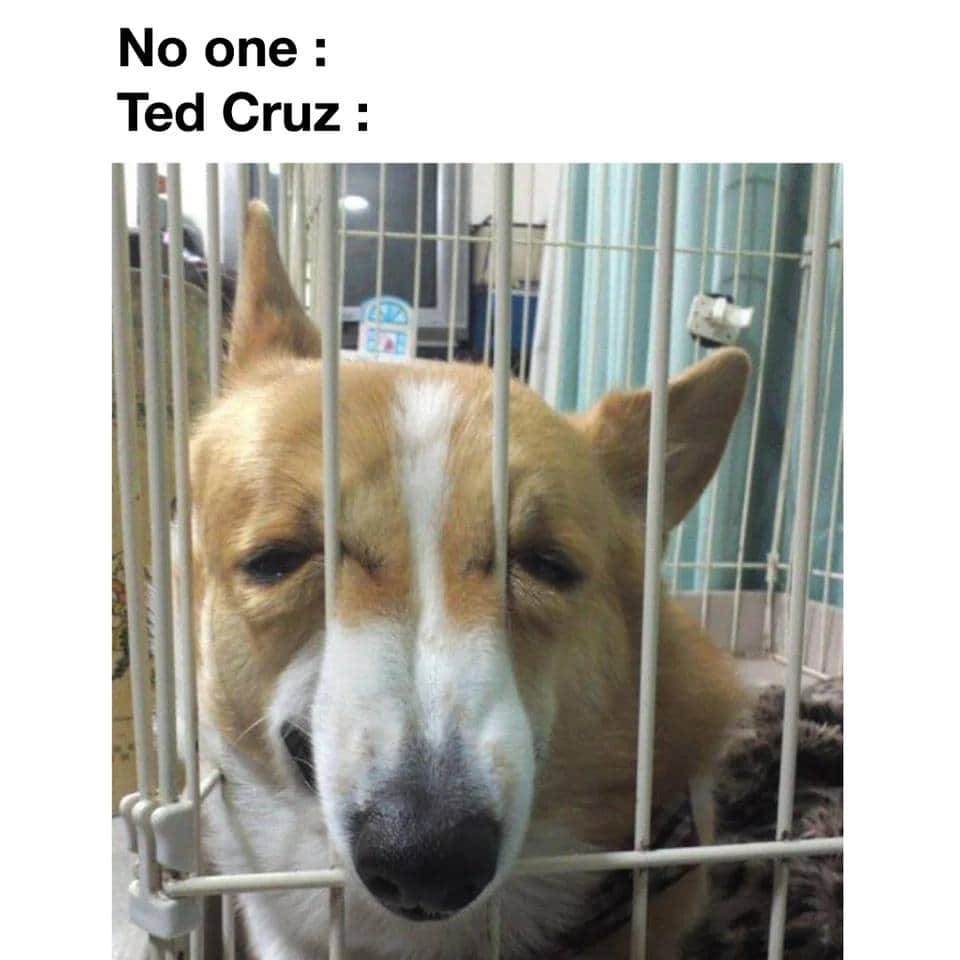
The meme features a photo of a dog with a disappointed expression, captioned "No one: Ted Cruz:". The meme is a play on the idea that even a dog, known for its loyalty and affection, would be disappointed by the actions of Ted Cruz, a politician known for his conservative and often divisive policies. The meme is a humorous way of expressing the idea that even the most unlikely of creatures would be disappointed by the actions of a politician who is known for his lack of empathy and compassion.
detailed-analysis (gemma3-27b-vision)
Okay, let's break down this image/meme through various theoretical lenses. It's important to note that applying complex theories to a simple meme can be a bit of stretching and interpretive exercise, but that's the point of these analyses.
Image Description
The image features a close-up of a dog (likely a Husky mix) peering through the bars of a cage. The dog has sad, droopy eyes and appears somewhat forlorn. The cage is a standard metal animal enclosure, and the background suggests a shelter or kennel environment. Above the image, are the words "No one" and below it "Ted Cruz".
Foucauldian Genealogical Discourse Analysis
This meme invites a Foucauldian analysis because it establishes a power dynamic. The cage constitutes a space of confinement, discipline and control. Foucault argued that power isn't simply repressive; it's productive. The cage produces a subject – the dog – defined by its limited agency.
The juxtaposition with "Ted Cruz" then becomes crucial. The meme discursively equates Ted Cruz (a US Senator, and often perceived as a rather rigid, unyielding figure) with the caged animal. It suggests Cruz identifies with being confined (or sees confinement as justifiable), or that he embodies the controlling forces that create the cage.
The genealogy might look at the historical discourse around animal welfare and political power. How have narratives of “control” been used to justify political restrictions and domination? How have figures historically been disciplined through public shaming or restriction? The meme draws on a pre-existing understanding of both cages as restrictive spaces and the public's perception of Ted Cruz as being out of touch or unfeeling.
Critical Theory
From a Critical Theory perspective, the meme can be seen as a commentary on the modern condition. The cage is a symbol of alienation, control, and the lack of autonomy experienced in modern society. The meme operates as a critique of the structures of power that limit freedom. The dog’s sad expression highlights the emotional cost of such confinement.
The linkage to Ted Cruz suggests he is a representative of the systems perpetuating this control. He isn't simply in the cage with the dog; he is the system that creates the cage. Critical Theory often challenges "taken for granted" assumptions, and this meme challenges the assumption that political figures are outside of, or immune to, the forces of control. It also invites reflection on how our cultural representations perpetuate (or resist) these power dynamics.
Marxist Conflict Theory
From a Marxist lens, the cage represents the unequal distribution of power and resources. The dog, a subject without agency (in this scenario), is symbolically representative of the proletariat, oppressed and confined by the structures of capitalism, in which a small powerful elite hold the key. The cage itself can be seen as a metaphor for the systemic barriers to social mobility, and the limited freedom experienced by many.
Ted Cruz, in this construction, becomes representative of the bourgeoisie, the class benefiting from these systems of control. The meme suggests he is either blind to the plight of the dog (the proletariat) or actively perpetuates the conditions that keep it confined. This is a simplification, but the meme leverages the core Marxist idea of class conflict.
Postmodernism
This meme aligns with postmodern themes through its embrace of irony and fragmentation. The absurd juxtaposition of a dog in a cage with the name "Ted Cruz" challenges conventional meaning-making. It's not a logical connection; it's a simulacrum, a copy without an original.
The meme relies on the audience to bring their own associations and interpretations to the image. There isn't a single "correct" reading. The meme destabilizes the traditional authority of both the image (the dog) and the text (Ted Cruz’s name). It’s a self-referential comment on the media landscape, where images and names are often decontextualized and re-appropriated for ironic or satirical effect.
Queer Feminist Intersectional Analysis
While not as directly applicable, an intersectional reading can still be developed. The cage can be read as a metaphor for the various forms of confinement experienced by marginalized groups. Historically, institutions (like animal shelters, prisons, and mental asylums) have been sites of control and oppression, particularly for women, people of color, and LGBTQ+ individuals.
The meme could be interpreted as highlighting how patriarchal and heteronormative systems “cage” bodies and limit agency. The dog, as a vulnerable creature, can be seen as a stand-in for those who are rendered voiceless or powerless.
Ted Cruz, often perceived as a conservative figure, represents the forces that perpetuate these systems of oppression. While a bit of a stretch, the meme implies a connection between his political ideology and the restriction of freedom. The sadness in the dog’s eyes can be seen as embodying the emotional toll of systemic oppression.
Disclaimer: These analyses are interpretive and speculative. Memes are inherently complex cultural artifacts, and their meaning is always open to debate. The above interpretations are offered as thought experiments, illustrating how different theoretical lenses can be applied to a seemingly simple image.
simple-description (llama3.2-vision)
This meme is a play on the 2020 US presidential election, where the image of a dog with a confused expression is captioned "No one: Ted Cruz:". The implication is that even a dog, known for its intelligence, is smarter than Ted Cruz, a former US Senator and presidential candidate, suggesting that even an animal can understand the absurdity of his actions.
tesseract-ocr
No one: Ted Cruz: i in j fe B ; ul ag } pal Hh) ig | || See ie\ |