First Seen
2023-05-10T21:03:33+00:00
simple-description (llama3.2-vision_11b)
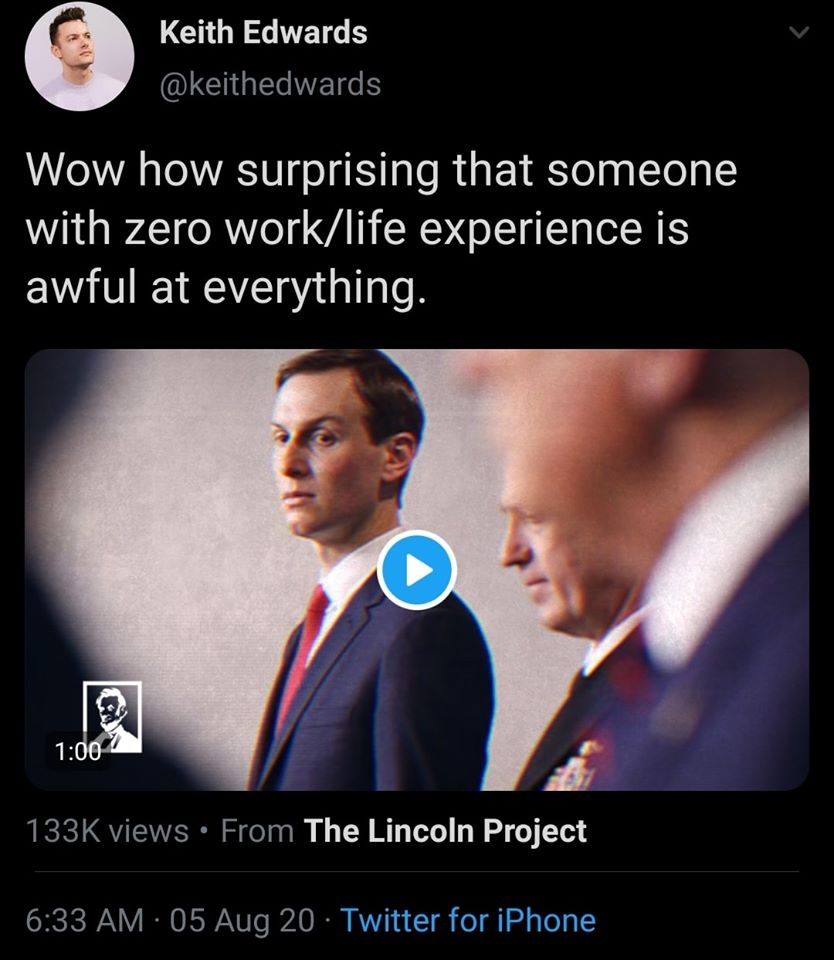
The meme is a screenshot of a Twitter thread where a user shares a video of a news anchor's awkward reaction to a question about a politician's lack of experience. The user's caption reads: "This is the face of someone with zero work/life experience being asked about policy."
detailed-analysis (gemma3-27b-vision)
Okay, let's break down this Twitter post using the frameworks you've requested. I'll only include sections where the frameworks apply and are relevant to the content.
Visual Description
The post features a video thumbnail with a close-up of a man speaking. He's sharply dressed in a navy suit with a red tie. His expression is intense, looking slightly upward and to the side. The lighting is dramatic, casting shadows across his face and the background. The framing focuses intently on the man's face, suggesting emphasis on his expression and communication. The video is uploaded by "The Lincoln Project" and shows 133k views. The video is a short form video (0:00).
Foucauldian Genealogical Discourse Analysis
This post lends itself well to a Foucauldian analysis because it's about the discourse around competence and experience. The statement, "Wow how surprising that someone with zero work/life experience is awful at everything," is not a neutral observation but a framing of who is considered competent and how competence is defined.
- Power/Knowledge: The post implicitly asserts a power dynamic where those with experience are deemed knowledgeable and therefore legitimate. Those without experience are constructed as "awful," creating a hierarchical relationship. The statement isn't about actual ability, but about the way experience is used as a marker of power and authority.
- Discursive Formation: The statement is part of a broader discourse surrounding meritocracy, qualifications, and expertise. It enforces a "normative" understanding of what it takes to be successful or even considered competent. This discourse isn't natural; it’s constructed through societal and institutional practices.
- Genealogy: We could trace the history of this discourse - how notions of experience as a prerequisite for competence have evolved, and how they've been used to justify social hierarchies. For instance, in the context of political commentary (given the source, "The Lincoln Project"), this might be used to delegitimize opponents.
Critical Theory
The post directly engages with themes central to Critical Theory:
- Ideology: The statement functions ideologically by reinforcing the dominant narrative that worth and competence are tied to accumulated experience and capital (in this case, "life" and "work" experience). This masks the possibility that other factors—like privilege, luck, or inherent talent—might be at play, or that existing structures may unfairly disadvantage some.
- Domination: The post subtly reproduces a system of domination. By framing inexperience as "awful," it contributes to the marginalization of those who haven't had the opportunities to accumulate traditional experience (perhaps due to socioeconomic circumstances, discrimination, or lack of access).
- Emancipation: A critical theoretical reading would question the very premise of the statement. Why is experience always valued above other qualities? What alternative measures of competence might exist? By questioning the assumptions underpinning the statement, we open the door to a more equitable and inclusive evaluation of individuals.
Marxist Conflict Theory
While not explicitly stated, conflict theory is present:
- Class/Power: The emphasis on "work/life experience" can be seen as a function of the capitalist system. Work experience is tied to economic productivity and the accumulation of capital. Those who have "experience" (i.e., have participated in the labor market) are privileged, while those who haven't (e.g., students, stay-at-home parents, the unemployed) are positioned as less valuable.
- Exploitation: The post could implicitly suggest that those without experience are somehow failing to contribute to the economic system, masking the structural factors that might limit their opportunities. It frames lack of experience as a personal failing rather than a product of systemic inequality.
- Conflict: The statement implicitly positions those with experience as the dominant group, and those without experience as the subordinate group. This perpetuates the power imbalance.
Postmodernism
A postmodern reading would deconstruct the idea of a singular, objective definition of "competence."
- Relativism: Postmodernism would argue that "competence" is a socially constructed concept, not an inherent quality. What is considered "competent" varies across cultures, contexts, and time periods.
- Deconstruction: The post presents "experience" as a straightforward indicator of competence. However, a postmodern reading would deconstruct this binary, questioning the validity of using "experience" as a singular marker. Is experience always relevant? Can someone be competent in one area but not another?
- Subjectivity: The statement assumes a neutral observer. However, postmodernism acknowledges that all knowledge is situated and subjective. The author's (and the viewer's) own experiences and biases inevitably shape their evaluation of competence.
I hope this detailed breakdown is helpful. Let me know if you'd like me to elaborate on any of these points or explore other theoretical frameworks.
simple-description (llama3.2-vision)
This meme is a screenshot of a tweet from "The Lincoln Project" featuring a video of three men in suits, with the caption "Wow, how surprising that someone with zero work/life experience is awful at everything." The text is likely referencing a person in a position of power or leadership who has no experience in a particular field, and the video is likely a satirical commentary on the person's incompetence.
tesseract-ocr
EG melielee ey @keithedwards Wow how surprising that someone with zero work/life experience is ENMU mlm casa) lan us - re ~ os ~' e | FA 133K views * From The Lincoln Project 6:33 AM - 05 Aug 20 - Twitter for iPhone