First Seen
2023-05-10T21:03:33+00:00
simple-description (llama3.2-vision_11b)
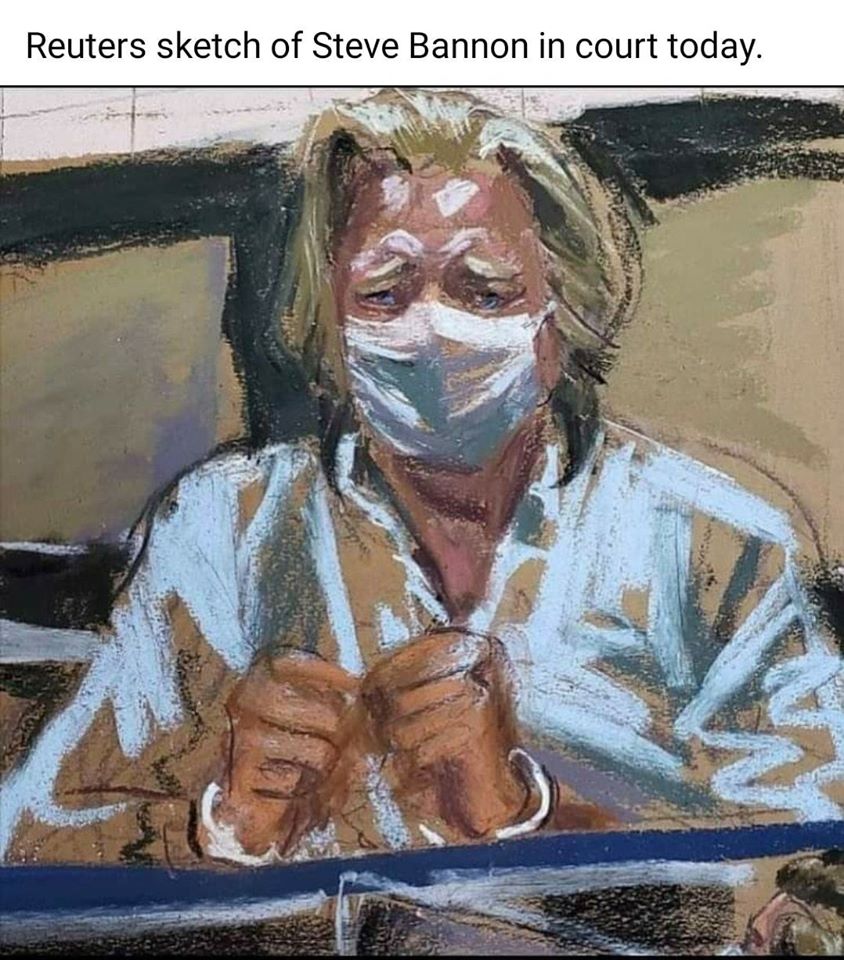
This meme is a humorous image of a courtroom sketch of Steve Bannon, a former White House advisor, wearing a mask and looking uncooperative during a Congressional hearing. The image is captioned "Bannon: 'I'm not coughing, I'm just... reflecting on my life choices'". The meme pokes fun at Bannon's uncooperative attitude and the absurdity of wearing a mask in a courtroom, implying that he's not just coughing, but also reflecting on his life choices.
detailed-analysis (gemma3-27b-vision)
Okay, here's an analysis of the courtroom sketch of Steve Bannon, broken down into sections as requested, focusing on the theoretical lenses you've provided. I will only include sections where the theory is relevant to the image and context.
Please note: These analyses are interpretations, and other readings are possible. I'll provide a reasonably detailed explanation for each section.
Visual Description
The image is a courtroom sketch, rendered in a style that favors quick impressionistic strokes and a limited color palette. The primary subject is Steve Bannon, depicted from the chest up. He's wearing a white shirt and a face mask (likely due to pandemic protocols). His hands are clasped in front of him, and he is looking downward. The artist has used primarily blues, whites, and yellows to define his face and clothing. The sketch is not hyper-realistic but conveys a sense of his physical presence and an air of seriousness. A dark horizontal band, likely the courtroom railing, is visible across the lower portion of the image. The background is suggested by vague strokes of color, not providing much detail. The overall effect is one of immediacy and a sense of witnessing a moment in time.
Foucauldian Genealogical Discourse Analysis
This image, depicting Bannon in a courtroom setting, is deeply resonant with Foucauldian concepts, particularly those related to power, discipline, and discourse.
- Discipline & The Panopticon: The courtroom itself functions as a modern iteration of Foucault’s Panopticon. Bannon is visibly subjected to the gaze of the court, the jury, the public, and, indirectly, the media. While he isn’t literally under constant surveillance, the potential for observation and judgment shapes his behavior (even subtle gestures) and is a fundamental component of the legal process. This creates a disciplinary effect.
- Power/Knowledge: The courtroom, as a site of legal proceedings, embodies the interplay of power and knowledge. The law, legal precedents, and the authority of the court constitute a particular form of knowledge that is used to both define and control behavior. Bannon is being subjected to this power/knowledge, and the very framing of the charges and the proceedings relies on the legitimacy of this system. The sketch itself is a representation of this dynamic, capturing a moment where power is being enacted.
- Genealogical Analysis: We can trace a genealogy of the courtroom as a site of power. It evolved from earlier forms of public punishment and justice, moving towards more formalized and institutionalized structures. Bannon’s presence in this space represents the continuation of this historical power dynamic, even as the specifics of the charges and the legal context change.
- Discourse & Truth: The legal proceedings themselves construct a particular version of “truth.” Bannon's narrative, the prosecution's evidence, and the judge's rulings all contribute to a discourse that defines reality within the context of the trial. The sketch is a snapshot of that discourse in action.
Critical Theory
The sketch, showing Bannon in a courtroom, strongly intersects with concepts central to Critical Theory, particularly regarding ideology, power, and hegemony.
- Ideology & Power: Bannon is a figure deeply associated with far-right ideologies, including nationalism, populism, and anti-globalism. His presence in court, even as the accused, represents the continued influence of these ideologies in contemporary society. The courtroom, as a space of “neutral” justice, can be seen as a site where competing ideologies clash.
- Hegemony & Counter-Hegemony: The legal system can be seen as a tool of the dominant culture to maintain its hegemony (i.e., its cultural, political, and economic dominance). However, by bringing Bannon to trial, the system is also potentially demonstrating its ability to challenge dominant narratives and individuals associated with counter-hegemonic forces (forces attempting to challenge the established order).
- Alienation & Dehumanization: The sketch’s style, while not overtly emotional, evokes a sense of alienation. Bannon is depicted as somewhat detached, almost as a figure being acted upon rather than an agent. This visual representation can be interpreted as reflecting the dehumanizing effects of the legal system, or the broader alienation of individuals within a complex socio-political structure.
- Representation & the Construction of Reality: The sketch is a representation of Bannon, but it’s not a direct, objective portrayal. The artist’s choices—the style, the colors, the composition—shape how we perceive him. This highlights the fact that our understanding of reality is always mediated through representation.
Marxist Conflict Theory
From a Marxist perspective, this image can be analyzed in terms of class struggle and the maintenance of power structures.
- The State as an Instrument of the Ruling Class: The courtroom, as an institution of the state, can be seen as a tool used by the ruling class to maintain its dominance. The charges against Bannon, and the proceedings themselves, can be interpreted as a means of controlling dissent or protecting the interests of the capitalist class.
- Ideological Struggle: Bannon represents a specific ideological position that challenges aspects of the existing social order (albeit from a far-right perspective). The trial can be seen as a site of ideological struggle, where the dominant ideology (often associated with the ruling class) is confronted with a counter-ideology.
- Commodification of Justice: A Marxist lens might also question the commodification of justice, in terms of lawyers fees and how this might affect accessibility to fair trials.
Important Note: The far-right ideology Bannon represents isn’t necessarily aligned with traditional Marxist goals of social equality, but the Marxist framework can still be used to analyze the power dynamics at play.
I have omitted Queer Feminist Intersectional Analysis because the image does not directly engage with themes of gender, sexuality, or intersectional identities in a way that would warrant a detailed analysis using that theoretical framework. While those issues might be indirectly relevant to the broader context of Bannon's activities, the image itself doesn't provide sufficient visual or contextual clues to support a meaningful application of that theory.
I hope this analysis is helpful! Let me know if you’d like me to elaborate on any of these sections or explore other theoretical perspectives.
simple-description (llama3.2-vision)
The meme is a satirical image of a courtroom sketch of Steve Bannon, a former Trump administration official, in a court appearance. The image shows a drawing of Bannon with a defiant expression, wearing a mask and handcuffs, with the text "This is the face of a man who's about to get a 10-year sentence for 2 counts of 100% un-fact-checked conspiracy theories" above it.
tesseract-ocr
Reuters sketch of Steve Bannon in court today. — i \\ Fo ns s a ers ee oS £ a oe 4 it. i/ \4 , z , Z 7 a > af ro : ;