First Seen
2023-05-10T21:03:33+00:00
simple-description (llama3.2-vision_11b)
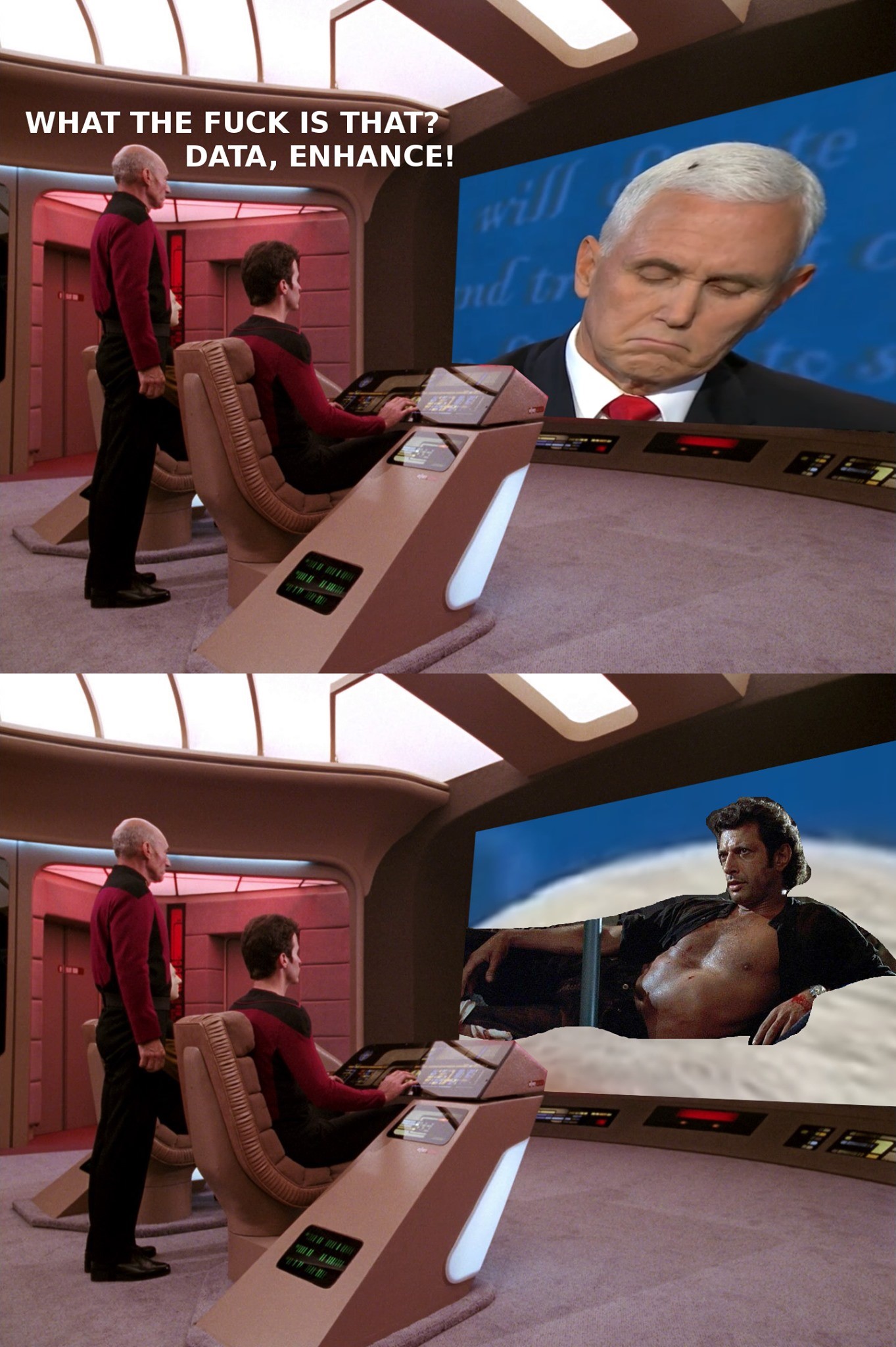
This meme is a humorous commentary on the absurdity of a politician's response to a question about their data-driven approach to governance. The image shows a politician being asked about their data-driven approach, and their response is a bizarre and nonsensical statement about the importance of "data" and "enhance" in a context that is completely unrelated to the topic at hand. The image is a play on the infamous "I see dead people" line from the movie "The Sixth Sense", where the politician's response is a bizarre and nonsensical statement about the importance of "data" and "enhance" in a context that is completely unrelated to the topic at hand.
detailed-analysis (gemma3-27b-vision)
Okay, let's break down this meme using the requested theoretical frameworks. It's a layered image with a clear shift in context, lending itself to various analyses.
Visual Description
The image is a three-panel meme using screenshots from Star Trek: The Next Generation.
- Panel 1: Captain Picard stands looking at Data, who is at a console. Picard is exclaiming, "WHAT THE F*CK IS THAT?" and ordering, "DATA, ENHANCE!" The screen behind them displays a close-up of a face.
- Panel 2: The same scene, but the image displayed on the screen has shifted dramatically. We now see a shirtless, muscular man with a prominent sternum and nipples visible. He's in some sort of dramatic, watery setting.
- Panel 3: Repeats Panel 2, reinforcing the change in what is being “enhanced.”
The meme relies on the juxtaposition of the formal, scientific context of Star Trek with the unexpected and arguably gratuitous display of male anatomy. The humor comes from subverting the expectations set by the Star Trek universe, known for its exploration of philosophical and scientific themes.
Foucauldian Genealogical Discourse Analysis
This meme is ripe for a Foucauldian analysis. The act of “enhancing” an image, as Picard requests, is a prime example of the creation of discourse and the operation of power/knowledge.
- Power/Knowledge: Picard’s command ("Data, Enhance!") isn’t simply a technical request; it’s an exertion of power to define what is visible and therefore knowable. The original image represents a certain kind of “truth” (a face, presumably important to a plotline). Data's ability to enhance the image allows him to reveal further information, thus constructing a new version of that “truth.” The second image, though, represents a shift in that power dynamic, showing that “enhancement” is subjective and can be directed towards different, and in this case, sexualized, ends.
- Genealogy: This meme can be seen as a small genealogy of how images are created and controlled. It suggests that any image is not a neutral representation of reality, but a constructed artifact subject to manipulation. The meme implicitly questions the authority behind the act of “enhancement” – who decides what is seen, and for what purpose? The original image, and the revealed image, reflect underlying assumptions about what is "appropriate" or "interesting" to view.
- Discipline/Surveillance: The request to "enhance" could be seen as a form of control. By demanding more detail, Picard is effectively demanding more "visibility," and therefore more control over the information presented.
Critical Theory
From a Critical Theory perspective (drawing on the Frankfurt School, particularly Adorno and Horkheimer), this meme points to several dynamics related to the culture industry and the commodification of the body.
- Culture Industry: The Star Trek universe, while seemingly progressive, is itself a product of the culture industry. The meme subverts this established narrative by inserting a highly sexualized image. This highlights how even “high-brow” cultural products are susceptible to the pressures of spectacle and the exploitation of the body.
- Commodification of the Body: The shift from a neutral face to a hyper-masculine physique speaks to the commodification of the male body in media. It suggests that the male body is often reduced to a spectacle of muscularity, consumed for visual pleasure.
- False Consciousness: The meme might be read as a commentary on how even supposedly rational and scientific endeavors (like Star Trek) can be co-opted by base desires and the perpetuation of problematic representations.
Marxist Conflict Theory
Applying a Marxist lens, the meme can be interpreted as a commentary on the class structures and power dynamics inherent in image production and consumption.
- Control of the Means of Production: Data, as the technological agent, controls the means of enhancing the image. Picard, as Captain, exerts authority over Data. The meme highlights how access to technology and the power to control its output are not equally distributed.
- Ideology and Representation: The original image potentially represents the dominant ideology of Star Trek – a focus on exploration, diplomacy, and intellectual pursuits. The sudden shift to a sexualized image disrupts this ideology, revealing a latent desire for spectacle and perhaps a reinforcement of patriarchal norms. The revealed image then highlights the prioritization of “desirability” (as socially constructed) over other potential forms of information.
- Alienation: The meme, while humorous, could be seen as reflecting a sense of alienation from meaningful content in a media-saturated world. The shift to a superficial image suggests a disconnect between genuine inquiry and base desire.
Postmodernism
From a Postmodern perspective, this meme revels in pastiche, irony, and the breakdown of grand narratives.
- Simulacra and Simulation: The meme presents a simulacrum – an image that has no original reality, but is a copy of a copy. The original face, the enhanced image – both are representations that lack a “true” referent. The meme underscores the impossibility of accessing authentic reality in a world saturated with images.
- Irony and Parody: The meme is inherently ironic, juxtaposing the serious tone of Star Trek with the unexpected display of male anatomy. This parody serves to deconstruct the conventions of both the source material and the expectations of the audience.
- Deconstruction: The meme “deconstructs” the meaning of “enhancement.” What does it really mean to enhance an image? The meme suggests that it’s not necessarily about revealing truth, but about fulfilling desire. The shift in what is "enhanced" questions the very purpose of analysis and scrutiny.
Queer Feminist Intersectional Analysis
Applying a Queer Feminist Intersectional lens highlights the ways in which power, gender, and sexuality intersect within the meme.
- Male Gaze: The meme can be read as an example of the “male gaze” – the way in which women (and, in this case, men) are presented as objects of sexual desire for a heterosexual male viewer. By “enhancing” the image to reveal a hyper-masculine physique, the meme reinforces the objectification of the male body.
- Patriarchal Power Structures: The meme reinforces patriarchal power dynamics by prioritizing male desirability and reducing the body to a spectacle. The sudden shift in focus from a potentially intellectual pursuit to a sexualized image reflects the ways in which patriarchy often centers male pleasure and dominance.
- Intersectionality: While primarily focused on gender and sexuality, it's worth considering how other intersecting factors (like race, class, or ability) might be present in the way the male body is represented. The ideal of hyper-masculinity often excludes bodies that do not conform to this narrow standard.
I hope this multi-faceted analysis provides a thorough interpretation of the meme from various theoretical perspectives. Let me know if you'd like me to elaborate on any particular aspect!
simple-description (llama3.2-vision)
This meme is a play on a scene from the TV show Star Trek: The Next Generation, where Captain Jean-Luc Picard is surprised by a graphic display on his ship's console. The meme shows a still image of the scene with the text "WHAT THE [EXPLETIVE] IS THAT? DATA, ENHANCE!" (in the style of the show's dialogue) and an image of a shirtless, muscular Jeff Goldstein (from the movie "The 100") on the screen, with the caption "DATA, ENHANCE!" (in the style of the show's dialogue) on the top.
tesseract-ocr
WHAT THE FUCK IS THAT? f mr DATA, ENHANCE! 2 a | | oe | ae , Peas x ee " a | = o a a> | ar 2 ' ? yA ) a y x i y d : } . é- ao . = ae & V//, ar 2 ' ? yA ) a y