First Seen
2023-05-10T21:03:33+00:00
simple-description (llama3.2-vision_11b)
The meme is a screenshot of a Twitter post from user @AntiReac, which reads: "When someone says 'I'm not a fan of the idea of a relationship between a man and his dog, but I do think it's interesting to consider the implications of it when it comes to the idea of a relationship between a man and his dog." The post is a humorous take on the idea of a man having a romantic relationship with his dog, and the author is poking fun at the idea of a man having a romantic relationship with a dog, rather than a human.
detailed-analysis (gemma3-27b-vision)
Okay, let's break down this tweet using the requested theoretical frameworks. It's important to note that applying multiple frameworks can reveal different facets of the same text. I'll provide sections only where the framework is reasonably applicable.
Visual Description
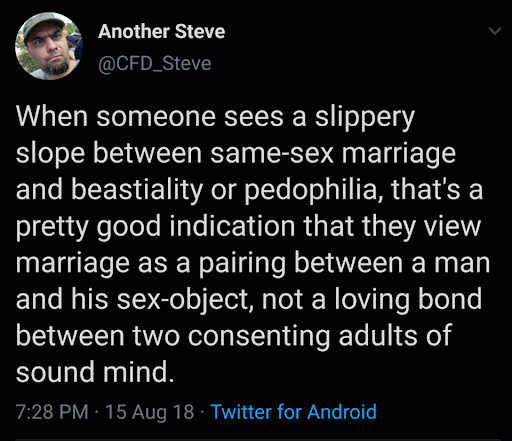
The image is a screenshot of a tweet. The tweet is from an account called "@CFD_Steve" with a profile picture featuring a man in a dark jacket. The tweet's text is the focus, written against a dark blue background. At the bottom is a timestamp "7:28 PM · 15 Aug 18 · Twitter for Android".
Queer Feminist Intersectional Analysis
This tweet is strongly amenable to a Queer Feminist Intersectional analysis.
-
Deconstructing the “Slippery Slope”: The tweet directly addresses a common rhetorical tactic used to oppose same-sex marriage – the “slippery slope” argument. This argument posits that legalizing same-sex marriage will inevitably lead to the acceptance of behaviors considered harmful (bestiality, pedophilia). The tweet reframes this as a specific, revealing stance about the nature of marriage itself.
-
Objectification and Power Dynamics: The core of the argument lies in the assertion that those who make the slippery slope connection view marriage as a "pairing between a man and his sex-object." This directly addresses feminist concerns about the objectification of people (and especially women) within patriarchal structures. It frames the opposition to same-sex marriage not as a concern about societal morals, but as a desire to maintain a power dynamic where one person (specifically, a man) owns or controls their partner.
-
Queer Critique of Heteronormativity: By contrasting this “sex-object” view with a “loving bond between two consenting adults,” the tweet implicitly challenges heteronormative assumptions about the purpose of relationships. It argues that the slippery slope argument is rooted in an inability to see relationships as based on genuine affection, mutual respect, and equality, which is particularly salient in the context of queer relationships that challenge traditional gender roles and power dynamics.
-
Intersectionality (Potential): While not explicitly stated, the tweet alludes to the fact that the argument against same-sex marriage is rooted in a patriarchal worldview. This is also linked to historical and ongoing power imbalances rooted in various systems of oppression, and it’s possible to extrapolate this argument further through an intersectional lens. For example, concerns about “protecting children” are often used as a pretext for oppressing LGBTQ+ people.
Foucauldian Genealogical Discourse Analysis
This tweet lends itself to a Foucauldian analysis, particularly focusing on the discourse surrounding marriage and sexuality.
-
Power/Knowledge: The tweet demonstrates how the "slippery slope" argument is not a neutral observation, but a power/knowledge formation. It isn't about logic; it's about a specific way of understanding marriage and sexuality that serves to maintain existing power structures. The argument creates the idea of a necessary progression from same-sex marriage to harmful acts, solidifying a particular moral order.
-
Genealogy of "Marriage": A genealogical analysis would trace the historical development of the concept of "marriage." Foucault would be less interested in the “true” meaning of marriage and more interested in how the practices and discourses surrounding marriage have changed over time, and how those changes are linked to shifts in power relations. The tweet suggests that some conceptions of marriage are rooted in controlling, possessive desires.
-
Disciplinary Power: The "slippery slope" argument can be seen as a form of disciplinary power. It attempts to regulate behavior by creating fear and associating certain actions with dire consequences, reinforcing a particular moral code and controlling the boundaries of acceptable sexuality.
Critical Theory
The tweet aligns with tenets of Critical Theory, particularly regarding ideology and social control.
-
Ideology Critique: The tweet is essentially an ideological critique of the “slippery slope” argument. It exposes how this argument functions not as a logical statement, but as a mask for underlying power dynamics and a desire to maintain traditional social hierarchies. It reveals how seemingly “neutral” arguments can be ideological tools used to legitimize oppression.
-
Social Control and Norms: The argument highlights how social norms are constructed and enforced. The “slippery slope” seeks to control behavior by associating it with perceived social threats. The tweet argues that this control is not about genuine concern for well-being, but about maintaining a specific (and oppressive) vision of acceptable relationships.
Important Note: The other theoretical frameworks (Marxist Conflict Theory and Postmodernism) aren't particularly strong fits for this specific tweet, at least not without significant stretching. While the tweet touches on power dynamics, it doesn't explicitly address class struggle (Marxist Conflict Theory) nor does it actively deconstruct meaning or deny grand narratives (Postmodernism) in a pronounced way. It's more directly engaged with issues of power, ideology, and the construction of social norms through discourse, making the other frameworks more relevant.
Let me know if you'd like me to elaborate on any of these analyses or explore a different theoretical lens.
simple-description (llama3.2-vision)
This meme is a humorous commentary on the controversy surrounding the relationship between a 30-year-old man and a 17-year-old girl. The image features a quote from the 2013 film "The 30-50-60 Rule" from the movie "The 30-50-60 Rule" (also known as "The 30-50-60 Rule"), which is a humorous and satirical take on the "30-50-60" rule. The quote reads: "When someone sees a slippery slope between same-sex marriage and bestiality or pedophilia, that's a pretty good indication that they view marriage as a pairing between a man and his sex-object, not a loving bond between two consenting adults of sound mind."
tesseract-ocr
B& PUES Cy @CFD_Steve When someone sees a slippery slope between same-sex marriage and beastiality or pedophilia, that's a pretty good indication that they view marriage as a pairing between a man and his sex-object, not a loving bond between two consenting adults of sound mind. 7:28 PM - 15 Aug 18 - Twitter for Android