First Seen
2023-05-10T21:03:33+00:00
simple-description (llama3.2-vision_11b)
The meme is a screenshot from a TV show, with a character's face and a quote "I'm not arguing, I'm just explaining why I'm right". The text above the image reads "When someone tries to explain why they're right but actually just can't handle being disagreed with". The meme is from the perspective of an Anti-Reactionary, who is a type of person who values intellectual honesty and critical thinking, and is often frustrated by people who try to defend their opinions without actually engaging with counterarguments.
detailed-analysis (gemma3-27b-vision)
Okay, let's break down this meme through several theoretical lenses. It's a rich image and text pairing, offering quite a bit to unpack.
Visual Description
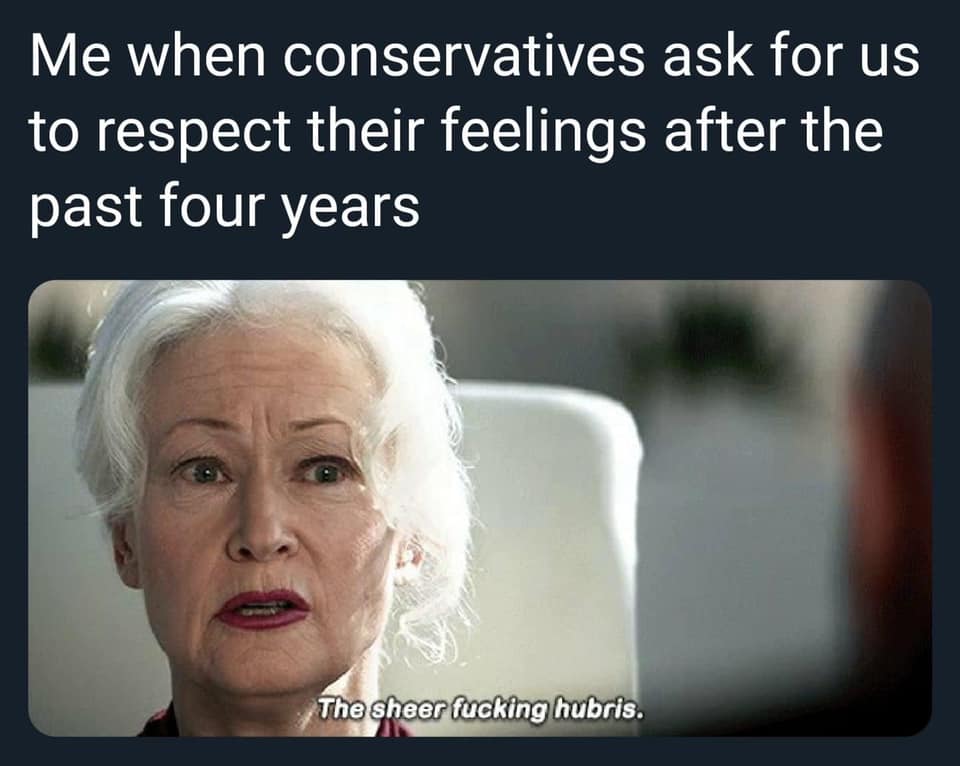
The meme features a still image of actress Glenn Close in character from the film Fatal Attraction. She is in close-up, gazing directly at the camera with a look of tightly controlled disdain. Her facial expression is one of barely-concealed exasperation, bordering on fury. The image is framed by a white pillow. Superimposed across the bottom of the image is the phrase: “The sheer fucking hubris.” Above the image is the text: "Me when conservatives ask for us to respect their feelings after the past four years."
The framing is intentionally dramatic, emphasizing the intensity of the emotional state displayed. The use of profanity in the text adds to this intensity and signals strong emotional investment.
Foucauldian Genealogical Discourse Analysis
This meme can be interpreted through a Foucauldian lens by examining the discourses surrounding political respectability and the construction of "good" political actors.
- Power/Knowledge: The meme challenges the idea that all viewpoints deserve equal respect. By juxtaposing the image of suppressed fury with the claim that conservatives are asking for respect, it suggests that this request is not legitimate, particularly in light of the past four years. The "respect" being sought is not earned but demanded, revealing an imbalance of power.
- Genealogy: A genealogical analysis would trace the historical construction of the idea of “respectful discourse” in politics. For Foucault, these concepts aren't natural, but are produced through specific historical struggles and discourses. This meme implies a break from that expectation of respect, suggesting that past actions have forfeited that claim. It suggests a genealogy where the norms of respectful discourse do not apply in the face of perceived hypocrisy or harmful political behavior.
- Disciplinary Power: The image itself is a display of restrained rage, but it implies a broader rejection of the disciplinary norms of polite political conversation. It's a refusal to play by the rules of engagement conservatives might expect.
Critical Theory
From a Critical Theory perspective, this meme speaks to the inherent power dynamics embedded in social and political life.
- Hegemony: The meme challenges the hegemonic notion that all political positions deserve equal consideration. Hegemony (Gramsci) refers to the dominance of certain ideas and values within a society. The meme pushes back against the idea that conservative views should be respected, implying those views may be oppressive or harmful.
- Ideology: The meme implicitly critiques the ideology underpinning the conservative request for respect. The "past four years" likely refer to the Trump presidency, and the meme suggests that the actions taken during that period invalidate any claim to respectful consideration. It suggests a disconnect between stated values and actual behavior, and exposes a perceived hypocrisy.
- Emancipatory critique: The meme isn’t necessarily arguing for specific political outcomes, but rather for a rejection of the expectation that certain viewpoints deserve respect. It’s a challenge to the status quo and a call for a more honest reckoning with political behavior.
Marxist Conflict Theory
While not immediately a core Marxist reading, conflict theory can be applied.
- Class Conflict/Power Dynamics: The meme speaks to broader power imbalances. The "past four years" refer to a period marked by significant political polarization and, for many, a perceived erosion of democratic norms. The meme frames this as a conflict between groups – those aligned with conservative politics and those who oppose them.
- False Consciousness: Some may read this meme as suggesting that conservatives are unaware of the harm their views or actions have caused. The meme’s disdain suggests a rejection of the notion that their request for respect is genuine or based on a clear understanding of the impact of their actions.
Postmodernism
A Postmodern reading focuses on deconstruction and the rejection of universal truths.
- Deconstruction of Respect: The meme deconstructs the very notion of "respect" in political discourse. It shows respect is not a neutral value but a socially constructed concept, contingent on actions and historical context. The meme suggests that respect is earned, not automatically given.
- Rejection of Grand Narratives: The meme rejects the idea of a singular, universally applicable standard of political respect. It implies that different historical contexts and political realities require different approaches to discourse.
- Simulacra & Simulation: The request for respect could be seen as a simulacrum of genuine engagement, a performance of politeness masking underlying power dynamics.
Queer Feminist Intersectional Analysis
This is where the meme potentially gains a lot of depth. It’s not immediately obvious, but intersectionality is key.
- Marginalized Groups & Harm: The “past four years” were particularly damaging to marginalized communities (people of color, LGBTQ+ individuals, immigrants, women). The request for respect from conservatives, often the very groups responsible for this harm, is deeply problematic. The meme is a rejection of the expectation that those who inflict harm deserve empathy or consideration.
- Emotional Labor: The meme speaks to the emotional labor often expected of marginalized groups. They are frequently asked to engage in polite discourse with those who actively seek to undermine their rights and safety. This meme is a refusal to perform that emotional labor.
- Rejection of Accommodation: The meme isn’t about finding common ground; it’s about rejecting the expectation that marginalized groups must accommodate harmful ideologies in the name of “civility.” The intense expression on Glenn Close’s face signals a refusal to compromise or placate.
- Intersectional Harm: It’s important to note that the harm experienced during the “past four years” was not experienced equally. The meme implicitly recognizes that some groups were disproportionately affected, and the demand for respect feels particularly galling in that context.
In conclusion, the meme is layered with meaning and open to multiple interpretations through these theoretical lenses. It's a concise yet powerful statement about power dynamics, emotional labor, and the rejection of false equivalence in political discourse.
simple-description (llama3.2-vision)
This meme is a humorous commentary on the current state of politics and social interactions. The image features a photo of a woman with a shocked expression, accompanied by the text "Me when conservatives ask for me to respect their feelings after the past four years." The image is meant to convey the idea that the speaker is shocked and incredulous that someone would expect them to be respectful of their feelings after a long period of being treated poorly.
tesseract-ocr
Me when conservatives ask for us to respect their feelings after the past four years al 4 nw : , as = : q é. { ite = > ’ $ ? yihe) € cr fucking/hubris.