First Seen
2024-01-31T22:53:45.851134+00:00
simple-description (qwen3.5_2b-q8_0)
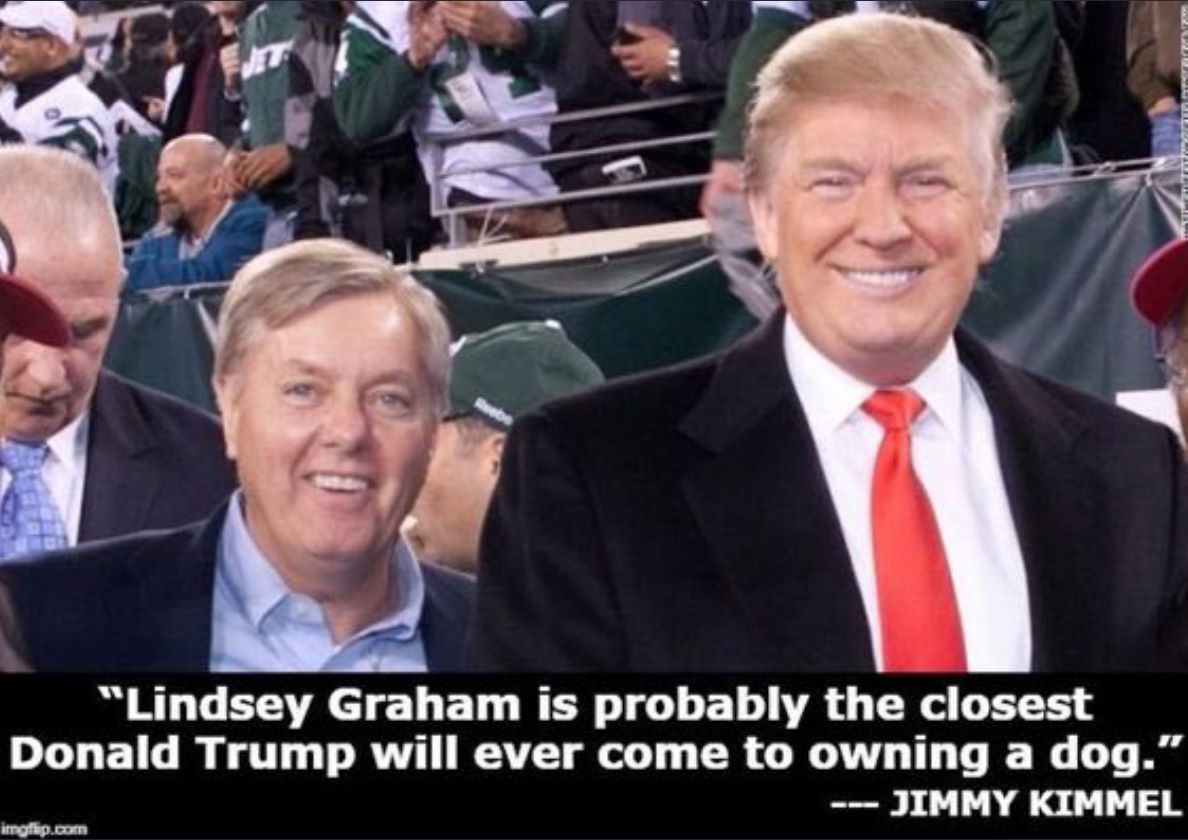
This anti-reactionary meme is a political mockery of Senator Lindsey Graham. The text mocks him by stating that he is "probably the closest Donald Trump will ever come to owning a dog," implying that his devotion to Trump is excessive and unnatural. From a reactionary viewpoint, the meme frames Graham as a "too soft" or moderate Democrat who lacks the strict loyalty and hawkish stance they associate with Trump supporters. They use this to insult Graham, suggesting he is overly attached to Trump rather than remaining a distinct conservative figure.
simple-description (llama3.2-vision_11b)
The meme is a humorous image featuring a photo of Donald Trump and a quote from him, juxtaposed with a statement from comedian and TV host Jimmy Kimmel. The image implies that Trump's own words are being used against him, highlighting his own hypocrisy and lack of self-awareness.
detailed-analysis (gemma3-27b-vision)
Okay, let's break down this meme through various theoretical lenses.
Visual Description
The image depicts Donald Trump and Lindsey Graham standing close together, likely at a sporting event (based on the surrounding crowd and green jerseys). Trump is positioned slightly ahead and to the right, smiling broadly, while Graham is to his left, looking upwards and smiling as well, almost positioned as if looking up at Trump. The background is a blurred crowd in green attire. The image is captioned with a quote attributed to Jimmy Kimmel: "Lindsey Graham is probably the closest Donald Trump will ever come to owning a dog.” The bottom of the image shows the source of the image being imgflip.com.
Foucauldian Genealogical Discourse Analysis
This meme operates as a fragment within a broader discourse about power dynamics, relationships, and the construction of masculinity. Foucault’s genealogy explores how concepts and practices (like "dominance," "submission," "care," “friendship”) are not natural or fixed, but historically contingent and shaped by power relations.
- Power/Knowledge: The statement suggests a connection between Trump’s perceived lack of emotional capacity (specifically, the inability to form a caring bond with a pet) and his power dynamics with others. The "dog" isn't simply a pet, it becomes a symbol of vulnerability, emotional openness, and reciprocal care – qualities the meme implies Trump lacks. Graham, in this construction, becomes the stand-in for the nurturing element.
- Discourse & Subjectivity: The meme participates in a discourse about Trump's personality, constructing a specific subjectivity for him – one that is defined by a lack of empathy and an inability to engage in reciprocal relationships. This subjectivity isn’t inherent but constructed through repeated representations in the media and political commentary.
- Genealogical Tracing: The meme draws on a pre-existing understanding of Trump as a controlling, domineering figure and uses this to create a “genealogy” of his inability to connect with something that requires unconditional care. This isn’t about literal dog ownership but rather a symbolic exploration of his emotional capacity.
Critical Theory
The meme can be viewed through the lens of Critical Theory, specifically focusing on the themes of domination and control. The meme subtly alludes to a power imbalance in the perceived relationship between Trump and Graham. The comparison to a dog owner and pet can be interpreted as a metaphor for control and dependency.
- Dominant Ideology: The meme critiques the dominant ideology that surrounds power dynamics in political relationships. It implies that Trump views relationships in terms of control and self-interest, rather than mutual respect and genuine connection.
- Deconstruction of Power: The use of humor and metaphor allows the meme to deconstruct the traditional notions of power and control, suggesting that true power comes from empathy, care, and connection, something Trump, in the meme's construction, is perceived to lack.
Queer Feminist Intersectional Analysis
This meme, while not overtly feminist or queer, can be read through an intersectional lens by examining the coded implications of the dynamic portrayed.
- Submissive Role: The “dog” metaphor, historically laden with associations of obedience and submission, is assigned to Graham. This, within the context of Trump’s public persona, can be seen as subtly reinforcing problematic power dynamics. It evokes the potential for exploitation and unequal treatment, even if done through humor.
- Masculinity & Emotional Labour: The meme subtly touches upon expectations of masculinity. Traditional masculinity often discourages emotional openness and vulnerability. The contrast between the “dog” and Trump implies that caring for another being is considered feminine or weak, and therefore, incompatible with Trump’s constructed masculinity.
- Intersectional Implications: While not explicitly stated, the meme operates within a larger context of political and social power structures. The dynamic depicted can be seen as reflecting broader issues of dominance and submission, particularly in relation to gender, sexuality, and political affiliation.
Important Note: It’s crucial to remember that memes are often complex and multi-layered. These analyses are interpretations and aren't necessarily the author's intended message. The meaning of a meme is always open to debate and interpretation.
Let me know if you’d like me to elaborate on any of these points or explore a different theoretical lens.
simple-description (llama3.2-vision)
This meme is a humorous comparison between two politicians, Donald Trump and Lindsey Graham, made by comedian Jimmy Kimmel's show host, Jimmy Kimmel. The meme uses an image of the two politicians and a quote from Jimmy Kimmel, saying "Lindsey Graham is probably the closest Donald Trump will ever come to owning a dog."
tesseract-ocr
>i ewe ae. ie Gy “Ge or | = | @ = 2. OY ; re aoe oe _ fl Y ) Pee . “ x» oe ff: o GE ; . é } F — 4 : J é? Py ~ i " = C , . a =e ite aul “Lindsey Graham is probably the closest Donald Trump will ever come to owning a dog.” —_ St ba ete