First Seen
2023-05-10T21:03:33+00:00
simple-description (llama3.2-vision_11b)
The meme is a screenshot of a Twitter conversation between Matt Walsh and a user named "Jeff" (not Jeff Jeff, but Jeff). The conversation starts with Matt Walsh asking a user if it's okay to call his fiancé "the fiancé" or "the fiancée". The user responds with a sarcastic comment about how Matt Walsh's fiancé is actually his wife, not his fiancé. The user then asks if Matt Walsh's wife is a "fiancé" or a "wife" and if he's been married for 32 years. The user then says "I'm not married to you, I'm married to your wife" and that Matt Walsh is not married to his wife. The user then says "I'm not married to you, I'm not married to your wife" and that Matt Walsh is not married to his wife. The user then says "I'm not married to you, I'm not married to your wife" and that Matt Walsh is not married to his wife.
detailed-analysis (gemma3-27b-vision)
Okay, here's an analysis of the provided Twitter exchange, broken down into the requested sections. Please note that some of these theoretical frameworks won't be strongly applicable, and I'll indicate that where it's the case. Also, Twitter content is often fragmented and emotionally charged, making rigorous theoretical analysis somewhat challenging.
Visual Description
The image shows a screenshot of a Twitter exchange.
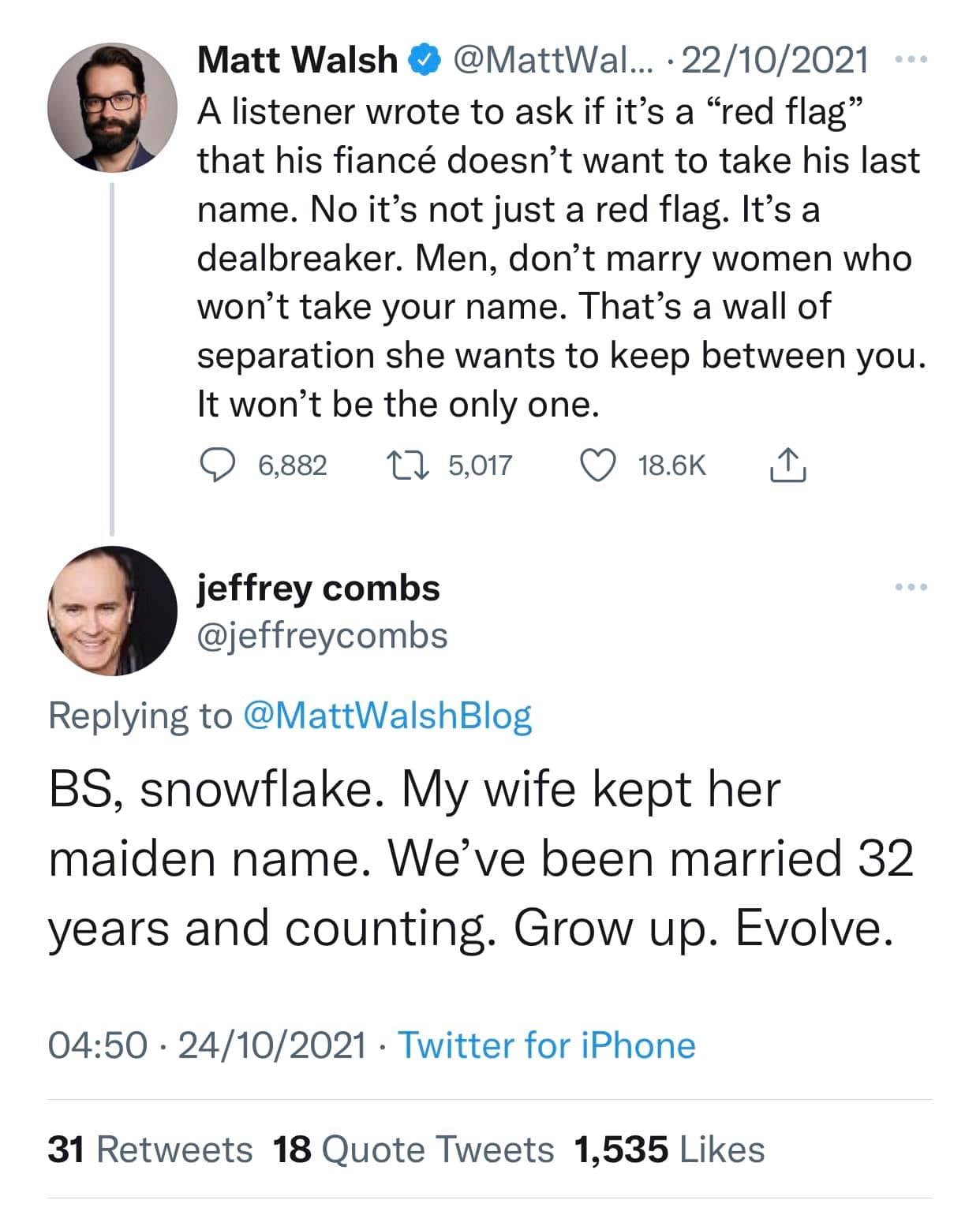
- Top Tweet: Features a profile picture of a man with glasses, identified as “Matt Walsh” (@MattWalshBlog). The tweet’s text expresses a strong negative judgment about a woman who doesn’t take her husband's name upon marriage, framing it as a "red flag" and a sign of future problems.
- Reply Tweet: Beneath this is a reply from a user named “jeffrey combs” (@jeffreycombs), also with a profile picture of a man. He dismisses Walsh’s claim as “BS, snowflake” and states his wife maintained her maiden name throughout their 32+ year marriage, ending with a directive to “grow up. Evolve.”
- Engagement Metrics: Underneath each tweet are indicators of interaction – retweets, quote tweets, and likes. These show substantial engagement with both tweets, particularly Walsh's.
- Metadata: The bottom of the image indicates the timestamps of the tweets and the device used to post them.
Foucauldian Genealogical Discourse Analysis
This exchange is rich for Foucauldian analysis.
- Discourse of Marriage and Names: Walsh's tweet is a clear example of a power/knowledge regime operating around marriage. He presents a particular understanding of marriage – one where the woman taking the husband's name is seen as natural and essential. This isn't a neutral observation; it’s an assertion of authority and a definition of what "proper" marriage looks like.
- Genealogy of the "Red Flag": The use of the term "red flag" itself is interesting. It traces back to historical warning signals, but has been adapted into contemporary dating and relationship discourse. Walsh deploys it as a means of categorizing and controlling behavior, labeling deviation from his norm as problematic.
- Disciplinary Power: Walsh's claim operates as a form of disciplinary power. He seeks to regulate women’s behavior by creating a social expectation and attaching a negative consequence (being labeled a “red flag”) to non-compliance.
- Combs' Challenge as Disruption: Combs' reply disrupts this discourse, offering a counter-example and a call for "evolution." He challenges the assumptions underlying Walsh’s claims, suggesting that alternative models of marriage can be successful and that the rigid rules are unnecessary.
Critical Theory
This exchange can be examined through the lens of Critical Theory, particularly regarding social norms and power dynamics.
- Ideology and False Consciousness: Walsh's statement can be seen as reflecting and reinforcing a patriarchal ideology. The expectation that women adopt their husband’s name is presented as a natural part of marriage, obscuring the fact that it’s a socially constructed practice with historical roots in male ownership and patriarchal control. Women who disagree are implicitly positioned as deviating from the ‘natural’ order.
- Hegemony: The prevalence of this expectation (even if not universally held) demonstrates its hegemonic power – the way it appears as common sense and is internalized by many. Walsh’s tweet seeks to reaffirm this hegemony.
- Emancipation: Combs' response, while brief, can be interpreted as a call for emancipation from these outdated norms. His lived experience contradicts the claim that maintaining her name leads to marital problems.
Marxist Conflict Theory
While not the strongest fit, Marxist conflict theory can offer some insights.
- Patriarchy as a System of Oppression: The expectation for women to change their names can be seen as a manifestation of broader patriarchal power structures – a system where men historically control resources and maintain dominance.
- Control of Identity: The name itself is a form of identity. By emphasizing the importance of women surrendering their names, Walsh implicitly reinforces a system where women’s identities are subsumed within their marital roles.
- Combs as Challenging the Status Quo: Combs, through his personal example, represents a challenge to this established order.
Postmodernism
Postmodernism helps to deconstruct the idea of a singular "truth" regarding marriage and names.
- Deconstruction of “Traditional” Marriage: The exchange exposes the constructed nature of "traditional" marriage. Walsh presents his view as natural, but it's revealed as a historically and culturally specific preference.
- Relativism and Subjectivity: Postmodernism highlights the subjectivity of values. What constitutes a "red flag" is not universal, but dependent on individual beliefs and social norms.
- Fragmentation of Meaning: The rapid exchange on social media reflects the fragmented nature of communication in the postmodern era. Meaning is often fleeting and context-dependent.
Queer Feminist Intersectional Analysis
This framework provides a particularly nuanced reading.
- Heteronormativity and Compulsory Heterosexuality: Walsh's statement assumes a heterosexual marital model as the default. The expectation of name change reinforces the idea that marriage is defined by patriarchal roles within a heterosexual context.
- Patriarchal Control and Female Identity: The insistence on women changing their names is a manifestation of patriarchal control over women's bodies and identities. It symbolically marks the woman as belonging to the husband.
- Intersectional Perspective: While the immediate issue is about names, this connects to broader issues of gender inequality, power imbalances in relationships, and the societal expectations placed upon women. The demand for name change can be seen as part of a larger pattern of control and erasure.
- Challenging Gender Roles: Combs' experience actively challenges these gendered expectations, showcasing a different dynamic in which both individuals can maintain their identity.
I hope this detailed analysis meets your requirements! Let me know if you'd like me to expand on any specific aspect.
simple-description (llama3.2-vision)
The meme is a screenshot of a Twitter conversation between Matt Walsh and actor Jeff Goldblum's son, who is impersonating him. Matt Walsh writes that a listener asked if "it's a red flag" that his fiancé doesn't want to take his last name. The impersonator, pretending to be Jeff Goldblum, responds with a sarcastic and absurdly long response, saying "BS, snowflake. My wife kept her maiden name. We've been married 32 years and counting. Grow up."
tesseract-ocr
-& Matt Walsh @ @MattWal... -22/10/2021 | Alistener wrote to ask if it’s a “red flag” * that his fiancé doesn’t want to take his last name. No it’s not just a red flag. It’s a dealbreaker. Men, don’t marry women who won't take your name. That’s a wall of separation she wants to keep between you. It won’t be the only one. © 6882 tl 5,017 © 186K ft, f jeffrey combs @jeffreycombs Replying to @MattWalshBlog BS, snowflake. My wife kept her maiden name. We’ve been married 32 years and counting. Grow up. Evolve. 04:50 - 24/10/2021 - Twitter for iPhone 31 Retweets 18 Quote Tweets 1,535 Likes