First Seen
2023-05-10T21:03:33+00:00
simple-description (llama3.2-vision_11b)
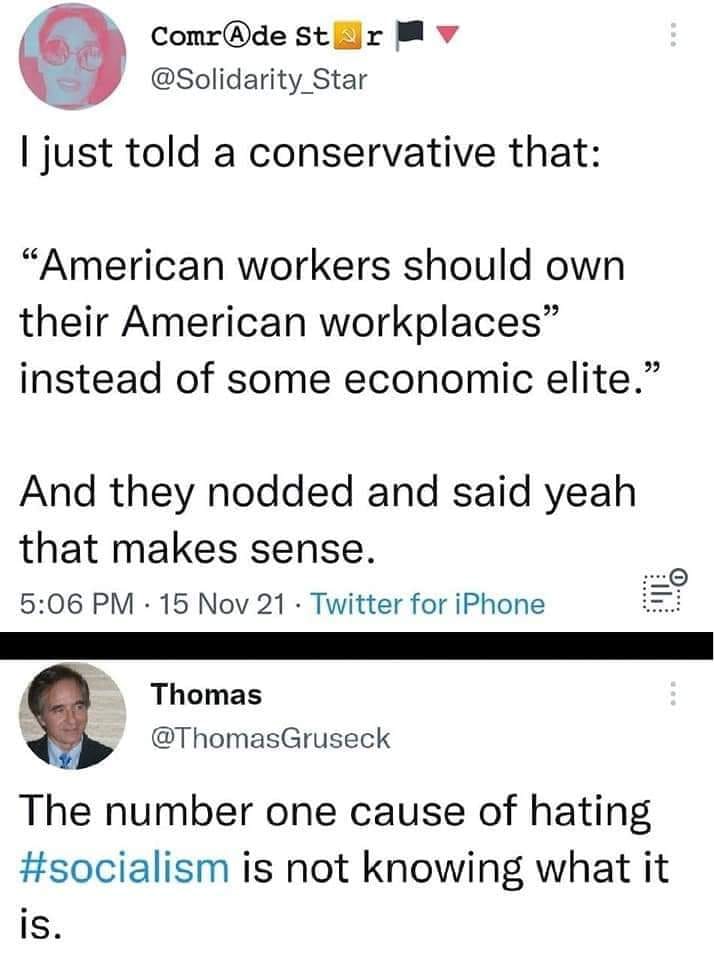
The meme is a screenshot of a Twitter conversation between two users, with one user (the "Anti-Reactionary") responding to a comment about the "liberal" or "leftist" (L) category. The user is reacting to a statement about the "liberal" or "leftist" (L) category, which they interpret as a "liberal" or "leftist" (L) category. The user is responding to a statement about the "liberal" or "leftist" (L) category, which they interpret as a "liberal" or "leftist" (L) category.
detailed-analysis (gemma3-27b-vision)
Okay, here's an analysis of the provided Twitter screenshots, broken down into relevant theoretical lenses. Some sections will be brief or non-existent if the content doesn't strongly lend itself to that framework.
Visual Description
The image consists of two screenshots from Twitter.
- Top Tweet: The first tweet is from an account named "Comrade Star" (@Solidarity_Star). It features a profile picture with a stylized communist symbol (star within a circle). The tweet details a conversation where the user stated to a conservative that "American workers should own their workplaces instead of some economic elite" and the conservative seemingly agreed. Metadata indicates the tweet was posted on November 15, 2021, via iPhone.
- Bottom Tweet: The second tweet is from an account named "Thomas Gruseck" (@ThomasGruseck). It's a simple statement asserting that the primary reason people dislike socialism is a lack of understanding of what it actually is. The tweet is accompanied by a hashtag "#socialism."
Foucauldian Genealogical Discourse Analysis
This is a strong area for analysis. The tweets highlight a discourse around ownership, work, and economic systems.
- Power/Knowledge: The tweets reveal the interplay of power and knowledge. The speaker from the top tweet attempts to introduce a specific framing ("workers own the means of production") that challenges the dominant discourse of capitalist ownership. The conservative’s acceptance implies that the framing resonated and disrupted their previously held understanding. Foucault would be interested in how this seemingly simple statement has the potential to challenge the current power structures.
- Genealogy of “Ownership”: Tracing the history of the concept of “ownership” would be fruitful. Foucault would ask: How did the idea of individual (or elite) ownership of workplaces become normalized? What historical forces and discourses shaped this understanding? The tweet implicitly suggests that this is not a natural or inevitable arrangement, but a constructed one.
- Disciplinary Power: The concept of "workplaces" is also ripe for Foucauldian analysis. Modern workplaces function as disciplinary institutions – they produce docile bodies through schedules, hierarchy, and constant evaluation. The idea of worker ownership is a potential disruption of this disciplinary power dynamic, a challenge to the very structures that control and regulate labor.
Critical Theory
This aligns well with Critical Theory, especially the Frankfurt School.
- Ideology Critique: The tweets implicitly critique the dominant ideology of capitalism. The statement about worker ownership directly challenges the idea that a small elite should control the means of production. It suggests that this arrangement is not based on merit or efficiency, but on power and exploitation.
- Reason and Enlightenment: Critical theorists would be interested in the “reason” behind the conservative’s acceptance. Was it simply a logical extension of their existing beliefs, or did it represent a break from previously held assumptions? The tweet suggests a moment of critical reflection, a questioning of the status quo.
- Reification: The concept of "workplaces" as owned entities is a form of reification – treating a social construct as a natural or objective reality. The tweets implicitly challenge this reification by suggesting that there are alternative ways to organize economic life.
Marxist Conflict Theory
This is central to understanding the content.
- Class Struggle: The tweet explicitly highlights the conflict between workers and the "economic elite." This is a classic Marxist concept. The statement about worker ownership is a direct call for a redistribution of power and resources.
- Means of Production: The core issue is control of the "means of production" (workplaces, factories, resources). Marx argued that whoever controls the means of production controls society. The tweet advocates for transferring control from the elite to the workers themselves.
- Alienation: Marx argued that capitalism alienates workers from their labor, from each other, and from themselves. Worker ownership is seen as a way to overcome this alienation by giving workers a stake in the success of their workplaces.
Postmodernism
While present, this is a more subtle application.
- Meta-Narratives: The tweets could be seen as challenging the "grand narrative" of capitalism – the belief that it is the most efficient and just economic system. The assertion that workers should own their workplaces is a disruption of this narrative.
- Deconstruction: The idea of “ownership” itself could be deconstructed. What does “ownership” actually mean? Is it a purely economic concept, or is it also a social and political one? The tweets implicitly invite this type of questioning.
- Subjectivity: Postmodernism emphasizes the subjective nature of reality. The conservative’s acceptance of the idea suggests that they were open to a different framing of the economic system, demonstrating that their beliefs were not fixed or absolute.
Queer Feminist Intersectional Analysis
This lens is the least applicable to the core content. While not entirely absent, it's a stretch.
- Power Dynamics: Intersectional analysis would examine how the power dynamics inherent in the workplace intersect with other forms of oppression, such as gender, race, and sexuality. The conservative's acceptance of worker ownership might stem from an intersectional analysis of oppression, but the text does not indicate as much.
- Critique of Capitalist Exploitation: While capitalism can exploit people across intersections, this is not overtly mentioned. The statement focuses on the class-based structure of economic dominance.
In conclusion, the tweets offer a rich opportunity for analysis through various theoretical lenses. Marxist conflict theory and Critical Theory seem the most directly applicable, while Foucauldian analysis provides insights into the power dynamics and discourses at play. Postmodernism offers a way to deconstruct the assumptions behind the statement, and Queer Feminist Intersectional analysis, while less direct, could be used to explore the broader implications for social justice.
simple-description (llama3.2-vision)
The meme is a Twitter exchange between two users. The first user, @SolidarityStar, responds to a conservative's comment about American workers owning their workplaces, saying it's a myth. The second user, @ThomasGruseck, points out that the idea is not true, citing a lack of understanding about socialism. The text in the image reads: "I just told a conservative that 'American workers should own their workplaces' and they said 'I don't know what socialism is'."
tesseract-ocr
(i ; Comr@de st (jr Bw \ ; @Solidarity_Star | just told a conservative that: “American workers should own their American workplaces” instead of some economic elite.” And they nodded and said yeah that makes sense. - 5:06 PM - 15 Nov 21 - Twitter for iPhone i a f Thomas @ThomasGruseck The number one cause of hating #socialism is not knowing what it is.